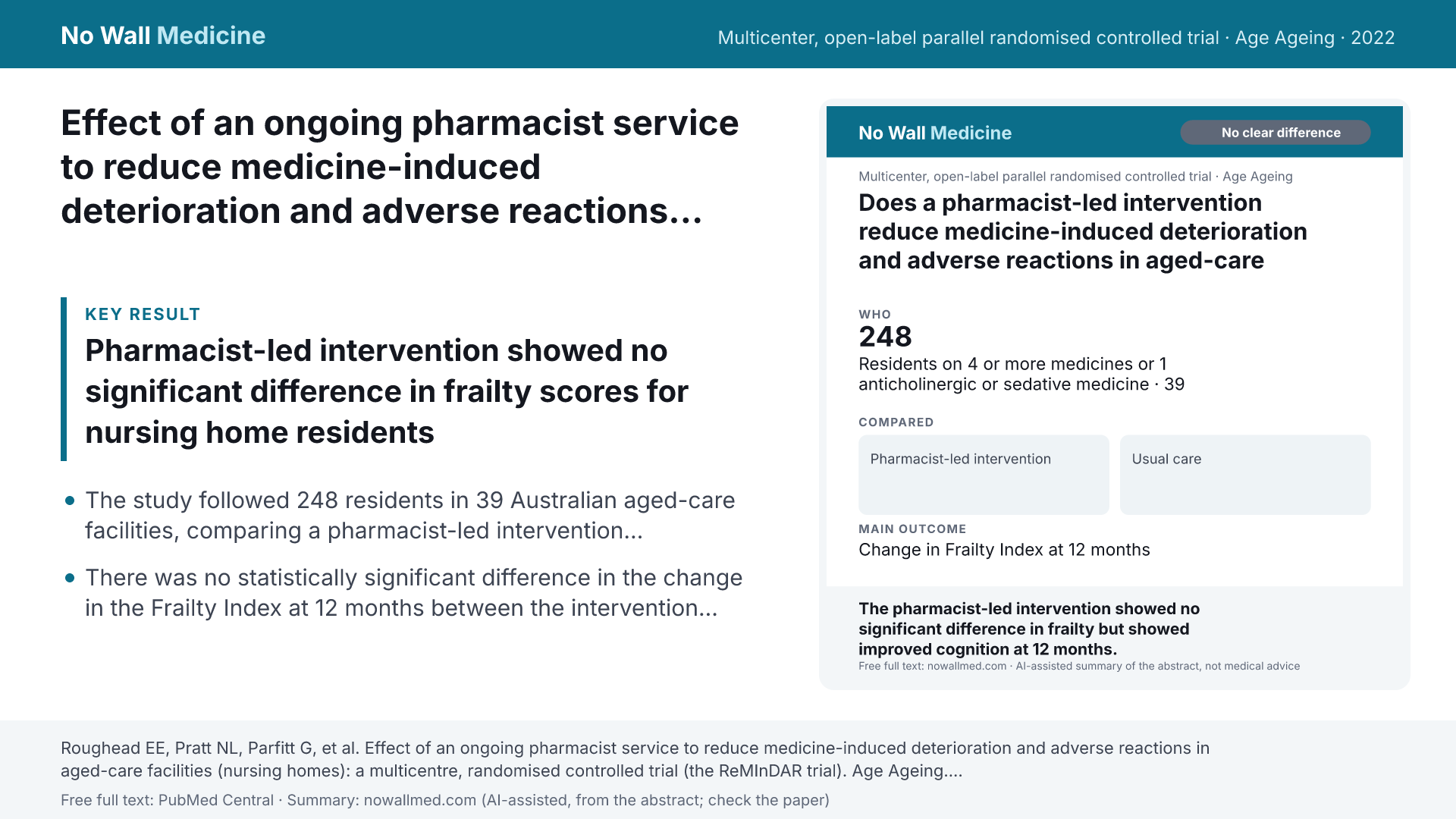
Pharmacist-led intervention showed no significant difference in frailty scores for nursing home residents
Effect of an ongoing pharmacist service to reduce medicine-induced deterioration and adverse reactions in aged-care facilities (nursing homes): a multicentre, randomised controlled trial (the ReMInDAR trial)
Multicenter, open-label parallel randomised controlled trialNo clear difference
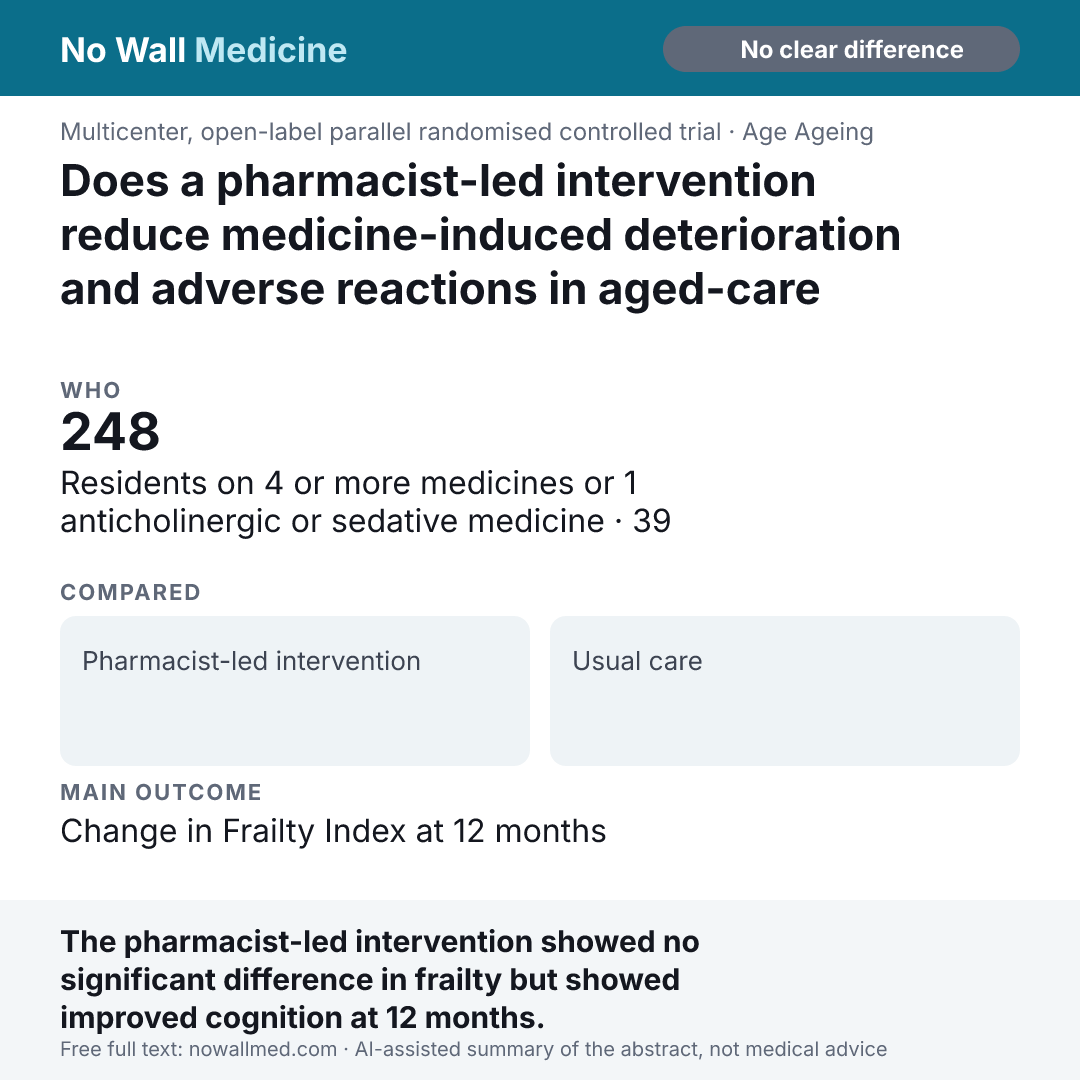
Does a pharmacist-led intervention reduce medicine-induced deterioration and adverse reactions in aged-care facilities?
Who
248
Residents on 4 or more medicines or 1 anticholinergic or sedative medicine · 39 Australian aged-care facilities
Compared
Pharmacist-led intervention
Usual care
Main outcome
Change in Frailty Index at 12 months
Result: mean difference: 0.009, 95% CI: -0.028, 0.009
Bottom line: The pharmacist-led intervention showed no significant difference in frailty but showed improved cognition at 12 months.
Age Ageing · 2022-04-23 · Save PNG
Clinical question: Does a pharmacist-led intervention reduce medicine-induced deterioration and adverse reactions in aged-care facilities?
Key points
- The study followed 248 residents in 39 Australian aged-care facilities, comparing a pharmacist-led intervention using validated tools to usual care.
- There was no statistically significant difference in the change in the Frailty Index at 12 months between the intervention and control groups (mean difference: 0.009, 95% CI: -0.028, 0.009, P = 0.320).
- A significant difference was observed for cognition, with a mean difference of 1.36 point change at 12 months (95% CI: 0.01, 2.72, P = 0.048).
Headline and key points written with AI from the paper’s abstract, with every number checked against it. Read the paper before relying on them.
Was this summary helpful?
Subject terms
Headline, design, result, key points, caveat and citation as plain text.
Cite this article
Roughead EE, Pratt NL, Parfitt G, et al. Effect of an ongoing pharmacist service to reduce medicine-induced deterioration and adverse reactions in aged-care facilities (nursing homes): a multicentre, randomised controlled trial (the ReMInDAR trial). Age Ageing. 2022;51(4). doi:10.1093/ageing/afac092
Spotted a mistake? Suggest a correction