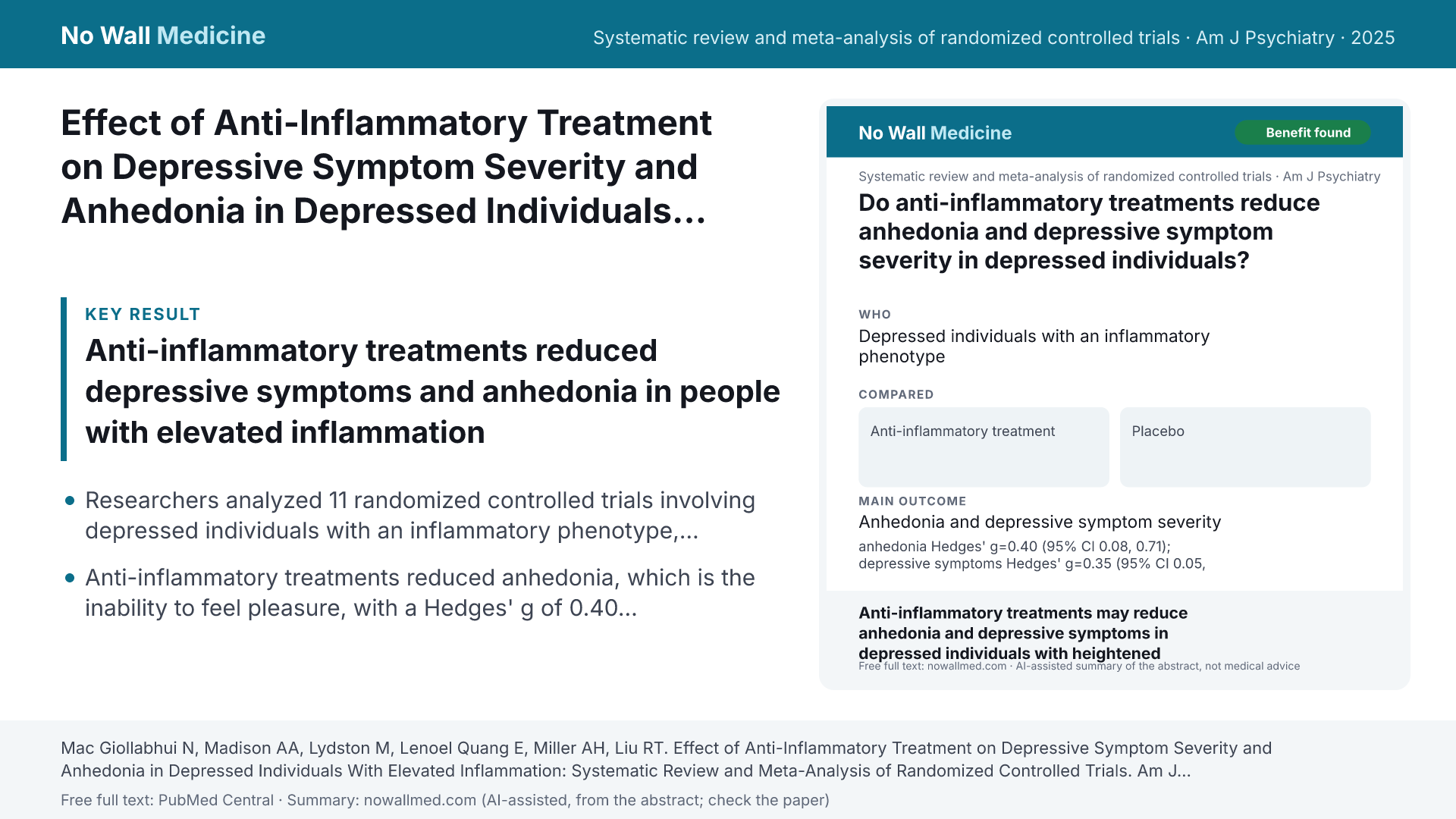
Anti-inflammatory treatments reduced depressive symptoms and anhedonia in people with elevated inflammation
Effect of Anti-Inflammatory Treatment on Depressive Symptom Severity and Anhedonia in Depressed Individuals With Elevated Inflammation: Systematic Review and Meta-Analysis of Randomized Controlled Trials
Systematic review and meta-analysis of randomized controlled trialsBenefit found
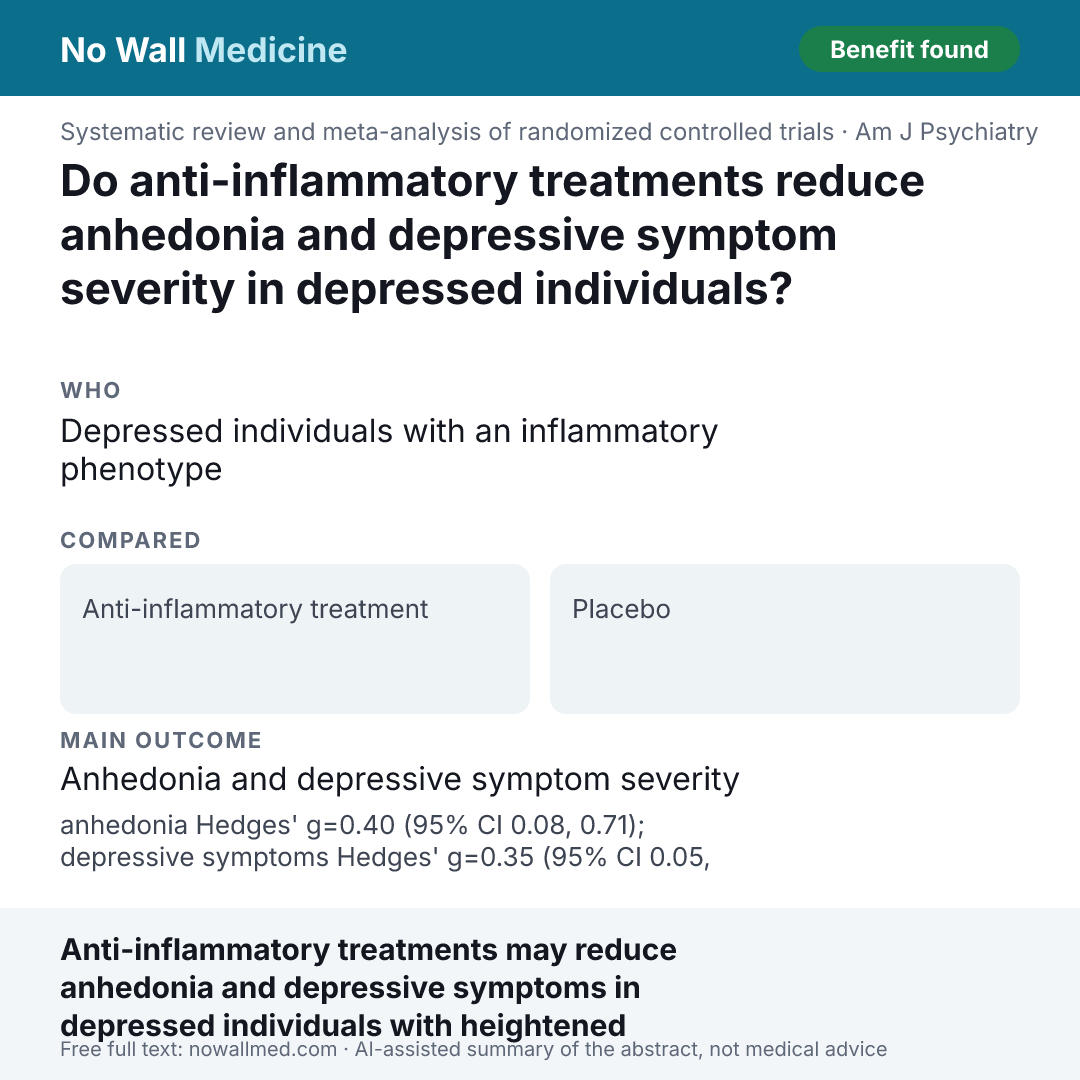
Do anti-inflammatory treatments reduce anhedonia and depressive symptom severity in depressed individuals?
Who
Depressed individuals with an inflammatory phenotype
Compared
Anti-inflammatory treatment
Placebo
Main outcome
Anhedonia and depressive symptom severity
Result: anhedonia Hedges' g=0.40 (95% CI 0.08, 0.71); depressive symptoms Hedges' g=0.35 (95% CI 0.05, 0.64)
Bottom line: Anti-inflammatory treatments may reduce anhedonia and depressive symptoms in depressed individuals with heightened inflammation.
Am J Psychiatry · 2025-12-10 · Save PNG
Clinical question: Do anti-inflammatory treatments reduce anhedonia and depressive symptom severity in depressed individuals?
Key points
- Researchers analyzed 11 randomized controlled trials involving depressed individuals with an inflammatory phenotype, defined by C-reactive protein levels of 2 mg/L or higher.
- Anti-inflammatory treatments reduced anhedonia, which is the inability to feel pleasure, with a Hedges' g of 0.40 and depressive symptoms with a Hedges' g of 0.35.
- The treatments did not show significant differences in treatment response rates or remission rates compared to a placebo.
Headline and key points written with AI from the paper’s abstract, with every number checked against it. Read the paper before relying on them.
Was this summary helpful?
Subject terms
Headline, design, result, key points, caveat and citation as plain text.
Cite this article
Mac Giollabhui N, Madison AA, Lydston M, Lenoel Quang E, Miller AH, Liu RT. Effect of Anti-Inflammatory Treatment on Depressive Symptom Severity and Anhedonia in Depressed Individuals With Elevated Inflammation: Systematic Review and Meta-Analysis of Randomized Controlled Trials. Am J Psychiatry. 2026;183(1):70-79. doi:10.1176/appi.ajp.20241115
Spotted a mistake? Suggest a correction