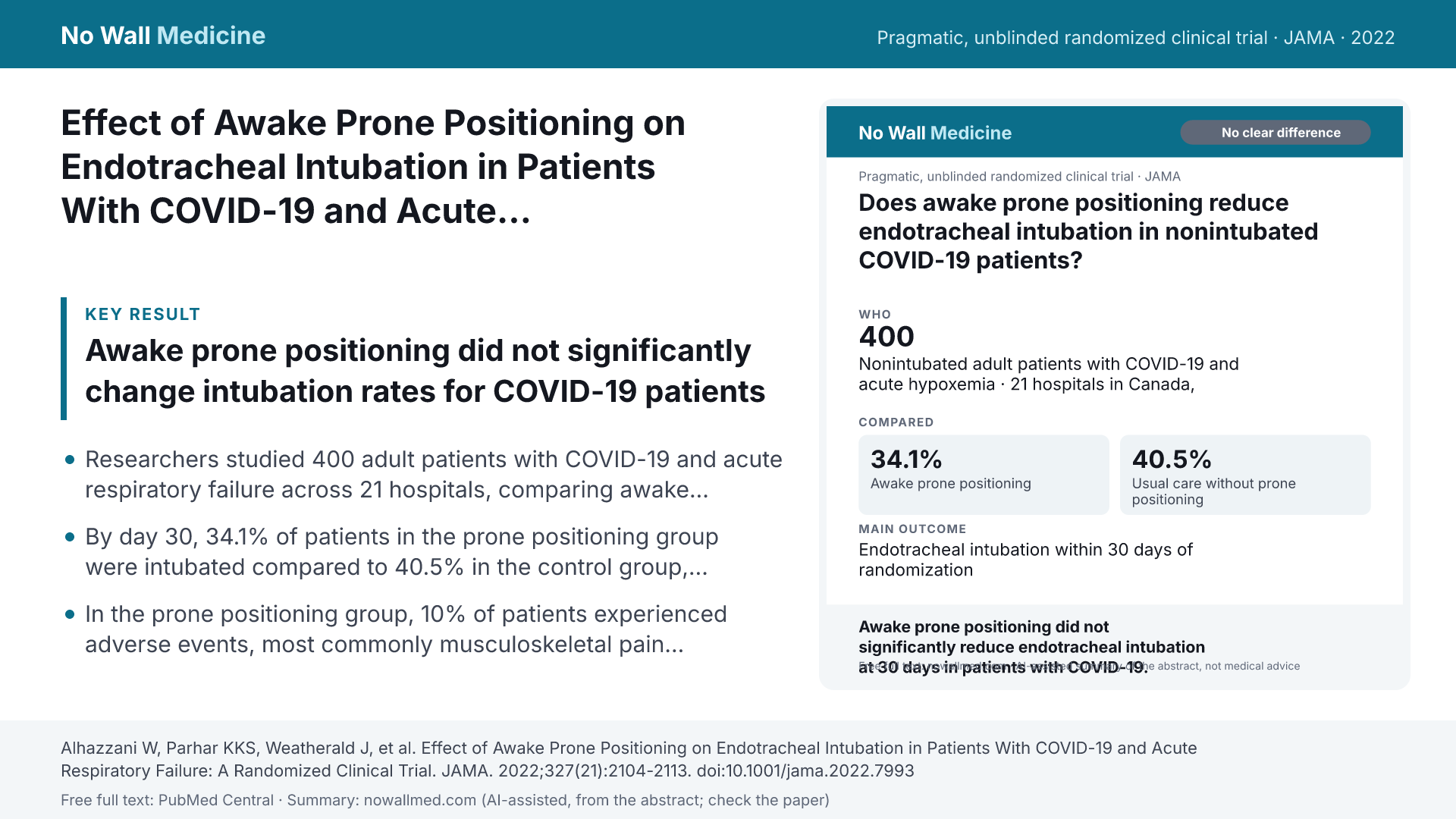
Awake prone positioning did not significantly change intubation rates for COVID-19 patients
Effect of Awake Prone Positioning on Endotracheal Intubation in Patients With COVID-19 and Acute Respiratory Failure: A Randomized Clinical Trial
Pragmatic, unblinded randomized clinical trialNo clear difference
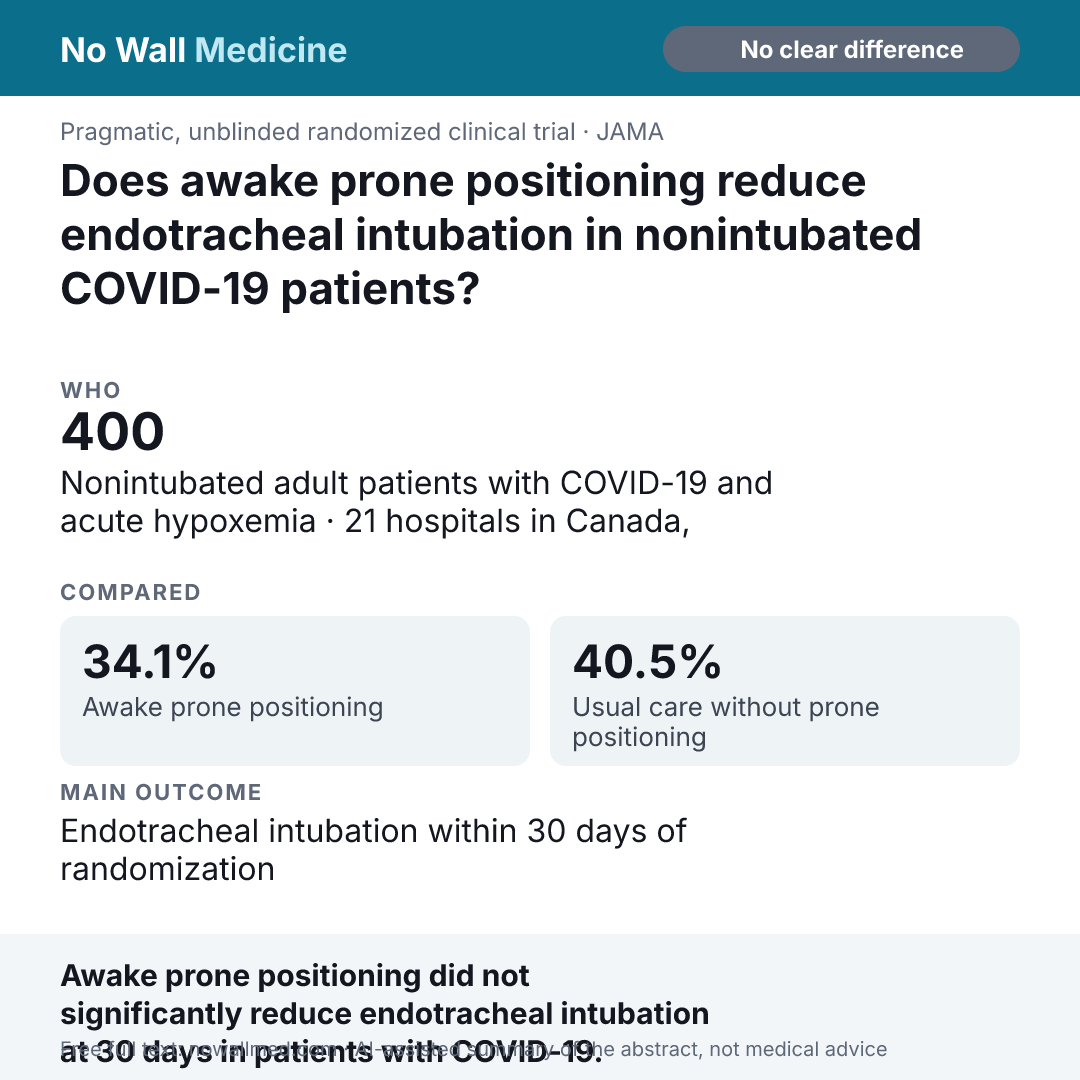
Does awake prone positioning reduce endotracheal intubation in nonintubated COVID-19 patients?
Who
400
Nonintubated adult patients with COVID-19 and acute hypoxemia · 21 hospitals in Canada, Kuwait, Saudi Arabia, and the US
Compared
34.1%Awake prone positioning
40.5%Usual care without prone positioning
Main outcome
Endotracheal intubation within 30 days of randomization
Result: hazard ratio 0.81 (95% CI 0.59 to 1.12)
Bottom line: Awake prone positioning did not significantly reduce endotracheal intubation at 30 days in patients with COVID-19.
Limitation: The effect size for the primary study outcome was imprecise and does not exclude a clinically important benefit.
JAMA · 2022-05-16 · Save PNG
Clinical question: Does awake prone positioning reduce endotracheal intubation in nonintubated COVID-19 patients?
Key points
- Researchers studied 400 adult patients with COVID-19 and acute respiratory failure across 21 hospitals, comparing awake prone positioning to usual care.
- By day 30, 34.1% of patients in the prone positioning group were intubated compared to 40.5% in the control group, which was not a statistically significant difference.
- In the prone positioning group, 10% of patients experienced adverse events, most commonly musculoskeletal pain or discomfort at 6.34%.
Headline and key points written with AI from the paper’s abstract, with every number checked against it. Read the paper before relying on them.
Was this summary helpful?
Subject terms
Headline, design, result, key points, caveat and citation as plain text.
Cite this article
Alhazzani W, Parhar KKS, Weatherald J, et al. Effect of Awake Prone Positioning on Endotracheal Intubation in Patients With COVID-19 and Acute Respiratory Failure: A Randomized Clinical Trial. JAMA. 2022;327(21):2104-2113. doi:10.1001/jama.2022.7993
Spotted a mistake? Suggest a correction