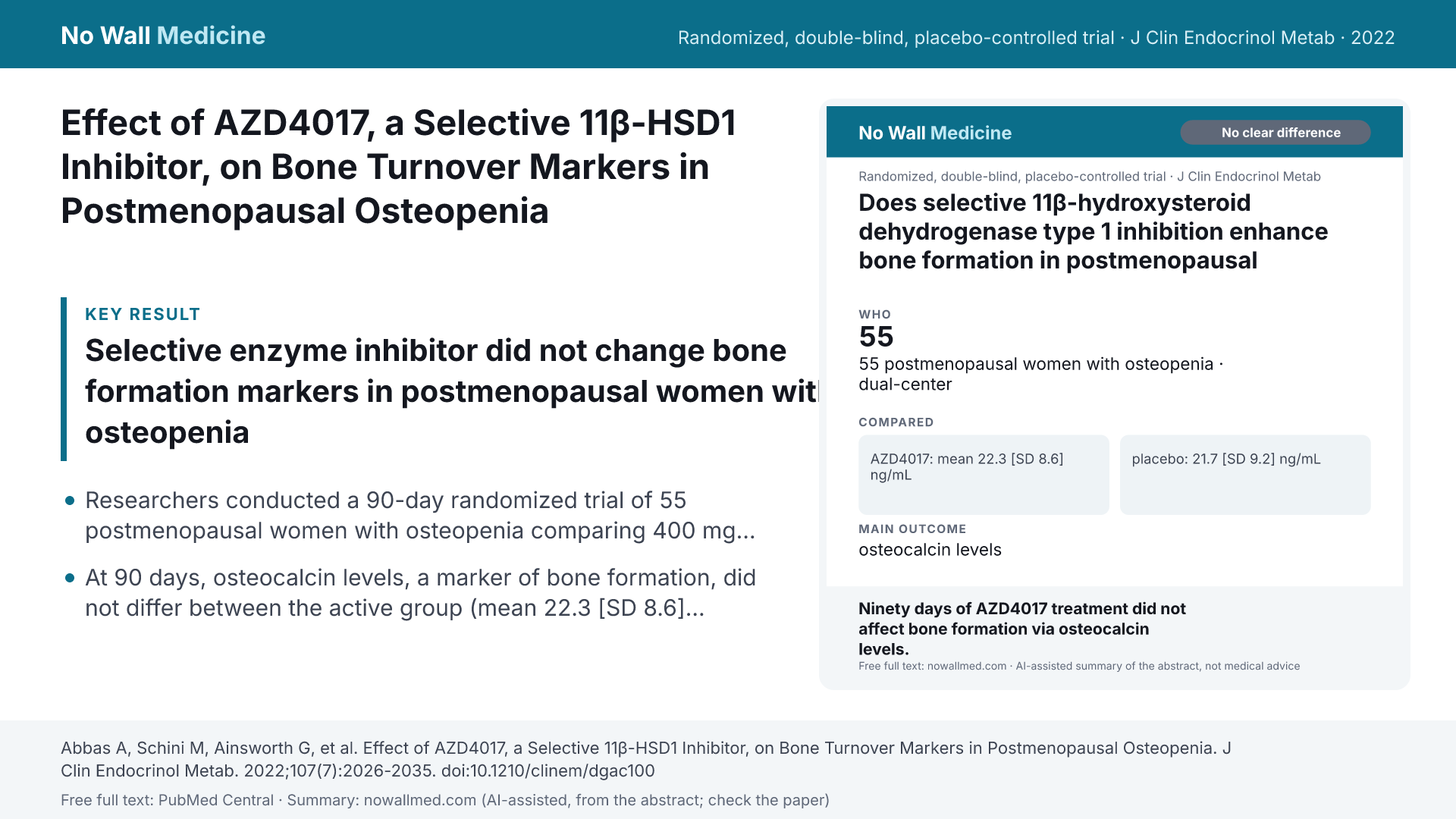
Selective enzyme inhibitor did not change bone formation markers in postmenopausal women with osteopenia
Effect of AZD4017, a Selective 11β-HSD1 Inhibitor, on Bone Turnover Markers in Postmenopausal Osteopenia
Randomized, double-blind, placebo-controlled trialNo clear difference
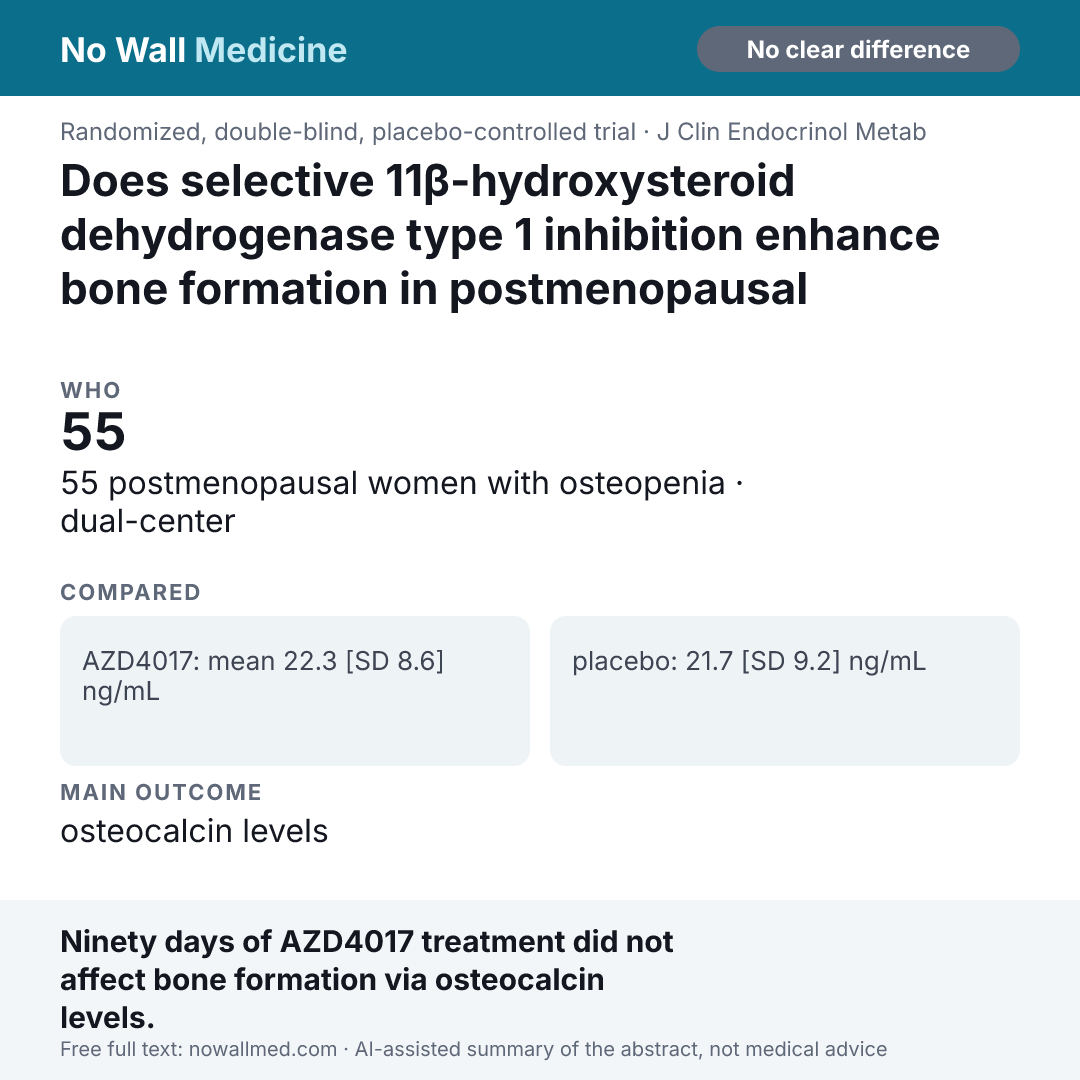
Does selective 11β-hydroxysteroid dehydrogenase type 1 inhibition enhance bone formation in postmenopausal osteopenia?
Who
55
55 postmenopausal women with osteopenia · dual-center
Compared
AZD4017: mean 22.3 [SD 8.6] ng/mL
placebo: 21.7 [SD 9.2] ng/mL
Main outcome
osteocalcin levels
Result: 0.95 (95% CI: -2.69, 4.60)
Bottom line: Ninety days of AZD4017 treatment did not affect bone formation via osteocalcin levels.
J Clin Endocrinol Metab · 2022-03-12 · Save PNG
Clinical question: Does selective 11β-hydroxysteroid dehydrogenase type 1 inhibition enhance bone formation in postmenopausal osteopenia?
Key points
- Researchers conducted a 90-day randomized trial of 55 postmenopausal women with osteopenia comparing 400 mg of AZD4017 twice daily to a placebo.
- At 90 days, osteocalcin levels, a marker of bone formation, did not differ between the active group (mean 22.3 [SD 8.6] ng/mL) and placebo (21.7 [SD 9.2] ng/mL).
- The treatment confirmed a > 90% inhibition of 11β-hydroxysteroid dehydrogenase type 1, an enzyme that increases local cortisol production.
Headline and key points written with AI from the paper’s abstract, with every number checked against it. Read the paper before relying on them.
Was this summary helpful?
Subject terms
Headline, design, result, key points, caveat and citation as plain text.
Cite this article
Abbas A, Schini M, Ainsworth G, et al. Effect of AZD4017, a Selective 11β-HSD1 Inhibitor, on Bone Turnover Markers in Postmenopausal Osteopenia. J Clin Endocrinol Metab. 2022;107(7):2026-2035. doi:10.1210/clinem/dgac100
Spotted a mistake? Suggest a correction