Azithromycin was associated with higher asthma remission rates in adults with uncontrolled asthma
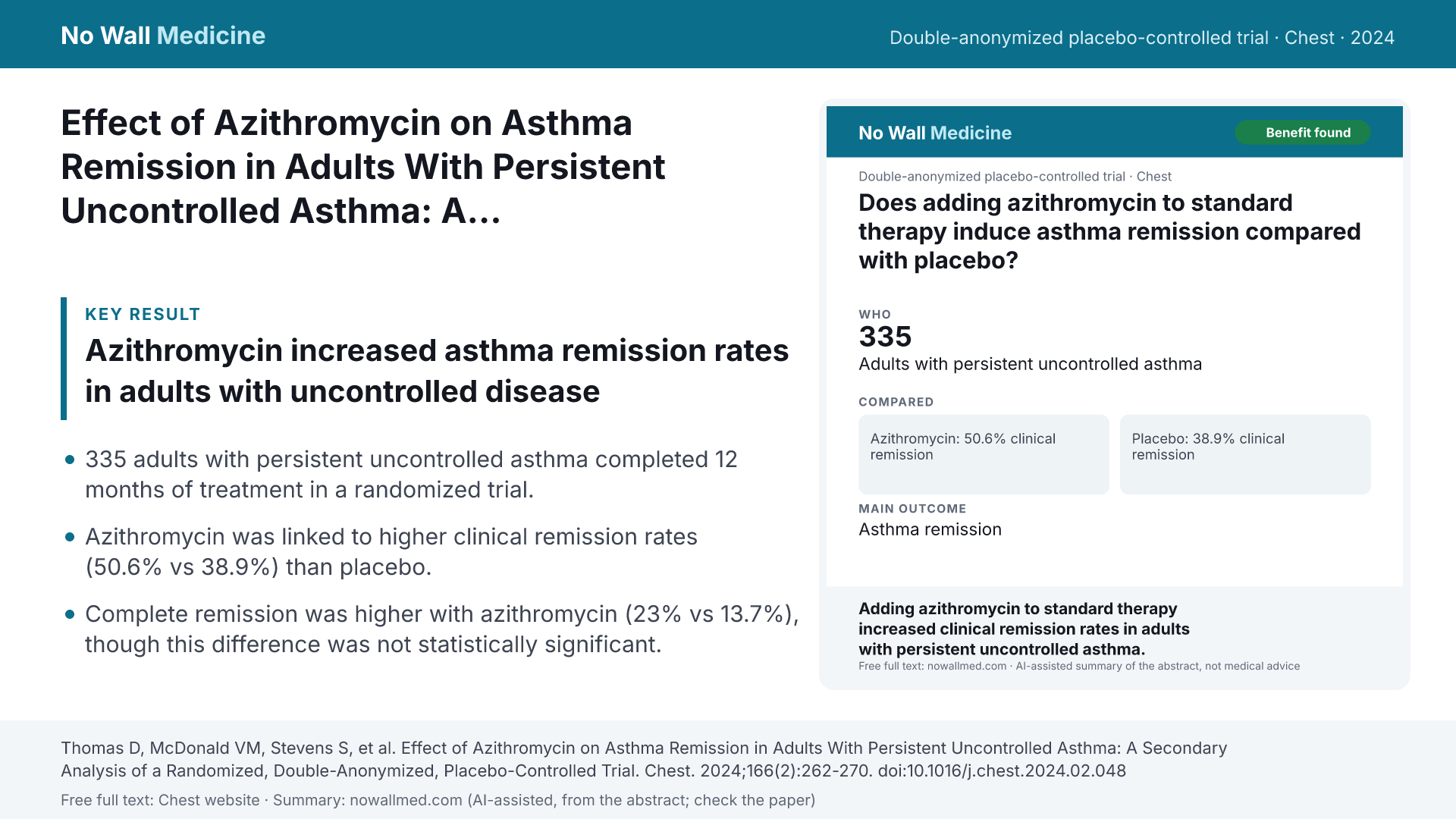
Effect of Azithromycin on Asthma Remission in Adults With Persistent Uncontrolled Asthma: A Secondary Analysis of a Randomized, Double-Anonymized, Placebo-Controlled Trial
Double-anonymized placebo-controlled trialBenefit found
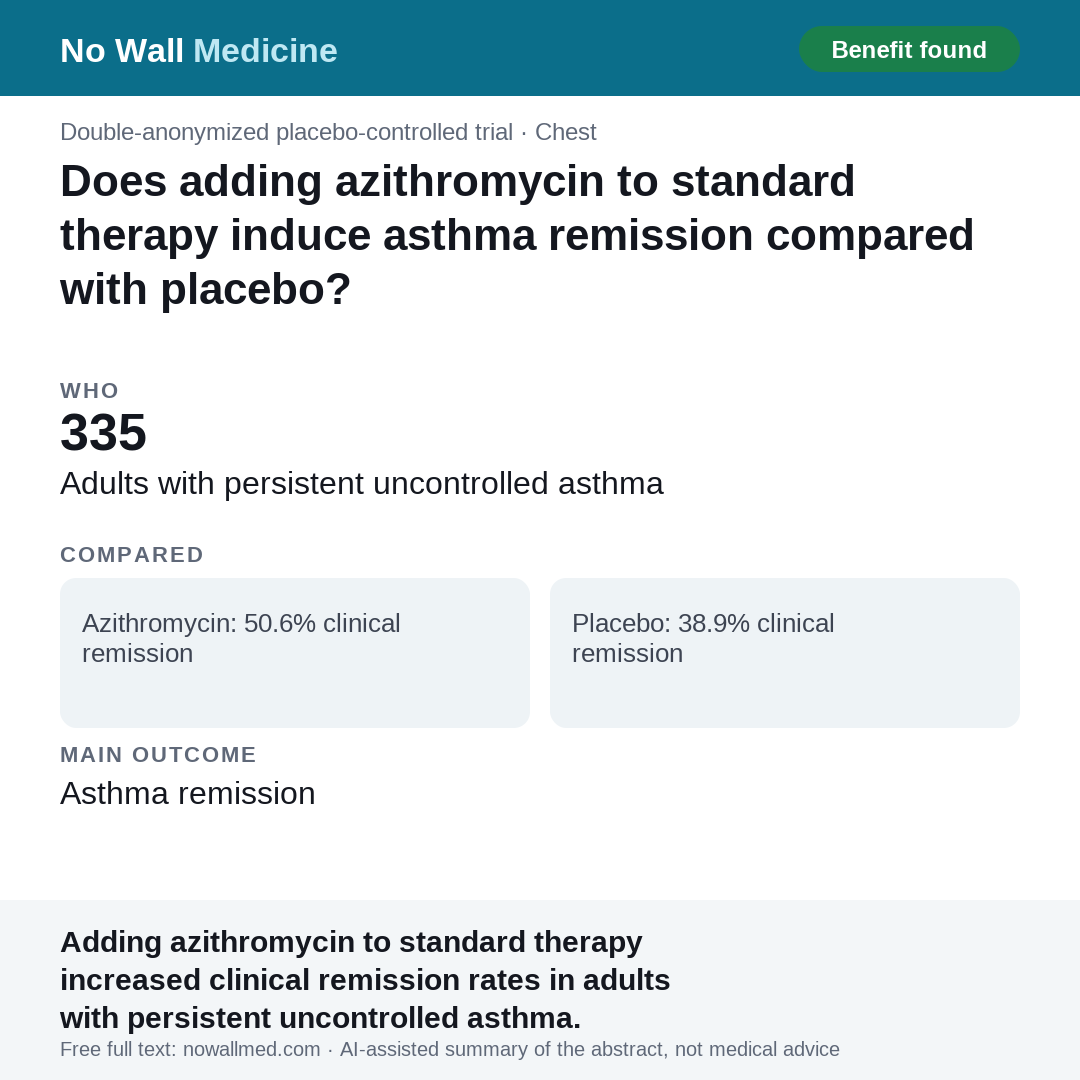
Does adding azithromycin to standard therapy induce asthma remission compared with placebo?
Who
335
Adults with persistent uncontrolled asthma
Compared
Azithromycin: 50.6% clinical remission
Placebo: 38.9% clinical remission
Main outcome
Asthma remission
Bottom line: Adding azithromycin to standard therapy increased clinical remission rates in adults with persistent uncontrolled asthma.
Chest · 2024-02-29Download image
Clinical question: Does adding azithromycin to standard therapy induce asthma remission compared with placebo?
Why it matters: It was unknown whether adding azithromycin to standard therapy for patients with persistent uncontrolled asthma could induce asthma remission.
In absolute numbers
Azithromycin: 50.6% · Placebo: 38.9% → a difference of 11.7 percentage points, so about 9 people would need the treatment for 1 more to benefit (number needed to treat) over the trial’s follow-up.
Worked out by us from the two group results above, not reported by the authors. Check the paper for the exact outcome and timing.
Key points
- Researchers analyzed 335 participants from a randomized, double-anonymized, placebo-controlled trial to see if adding azithromycin to standard therapy helped achieve asthma remission.
- The azithromycin group had higher rates of clinical remission at 50.6% compared to 38.9% for placebo, and higher rates of clinical remission plus lung function criteria at 50.8% versus 37.1%.
- Complete remission, which includes specific sputum eosinophil counts and lung function, was achieved by 23% of the azithromycin group compared to 13.7% of the placebo group.
Headline and key points written with AI from the paper’s abstract, with every number checked against it. Read the paper before relying on them.
Was this summary helpful?
Subject terms
Cite this article
Thomas D, McDonald VM, Stevens S, et al. Effect of Azithromycin on Asthma Remission in Adults With Persistent Uncontrolled Asthma: A Secondary Analysis of a Randomized, Double-Anonymized, Placebo-Controlled Trial. Chest. 2024. doi:10.1016/j.chest.2024.02.048
Spotted a mistake? Suggest a correction