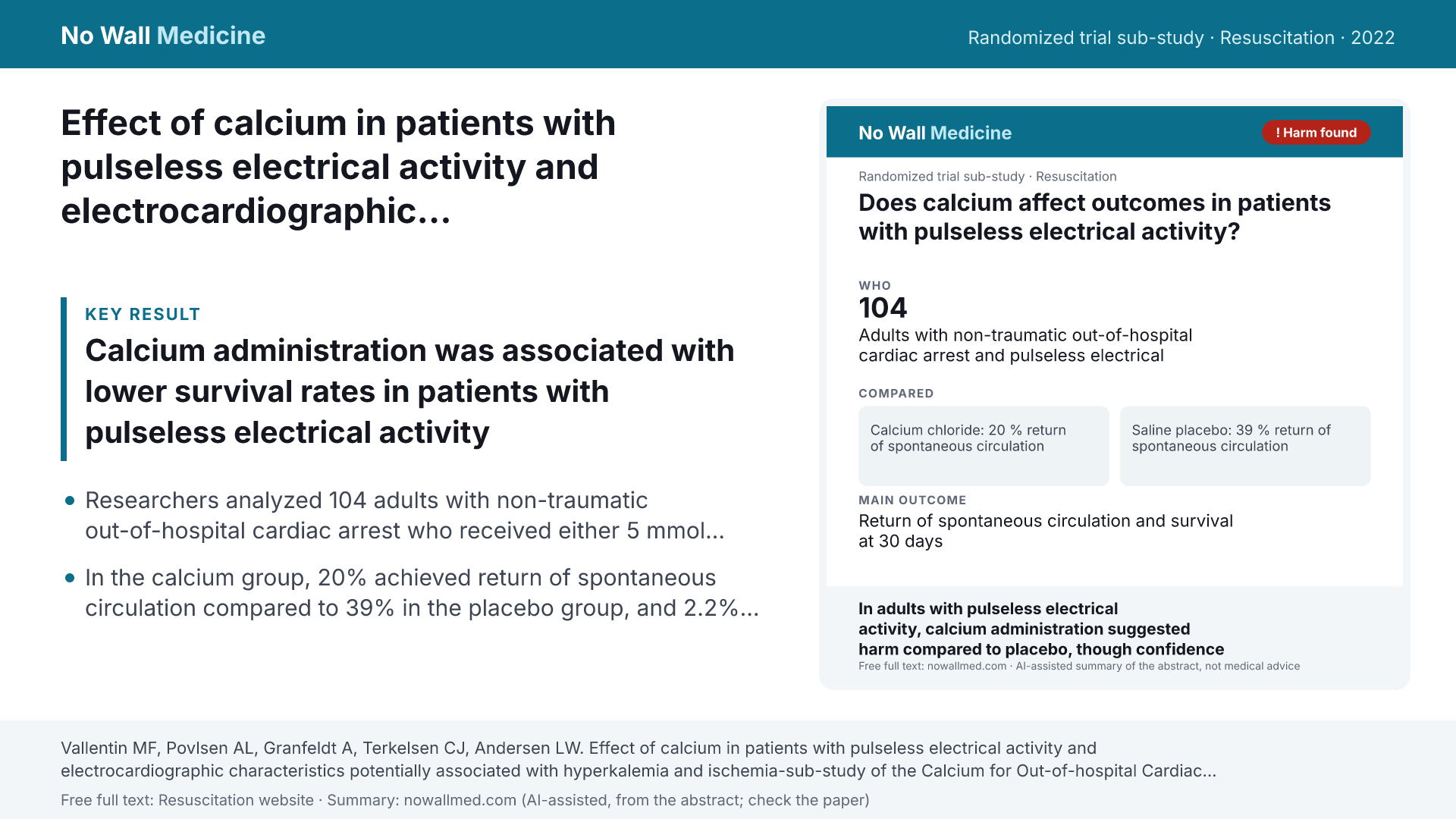
Calcium administration was associated with lower survival rates in patients with pulseless electrical activity
Effect of calcium in patients with pulseless electrical activity and electrocardiographic characteristics potentially associated with hyperkalemia and ischemia-sub-study of the Calcium for Out-of-hospital Cardiac Arrest (COCA) trial
Randomized trial sub-studyHarm found
Does calcium affect outcomes in patients with pulseless electrical activity?
Who
104
Adults with non-traumatic out-of-hospital cardiac arrest and pulseless electrical activity · Out-of-hospital
Compared
Calcium chloride: 20 % return of spontaneous circulation
Saline placebo: 39 % return of spontaneous circulation
Main outcome
Return of spontaneous circulation and survival at 30 days
Result: risk ratio 0.51 (95 %CI 0.26, 1.00)
Bottom line: In adults with pulseless electrical activity, calcium administration suggested harm compared to placebo, though confidence intervals were wide.
Resuscitation · 2022-11-18Download image
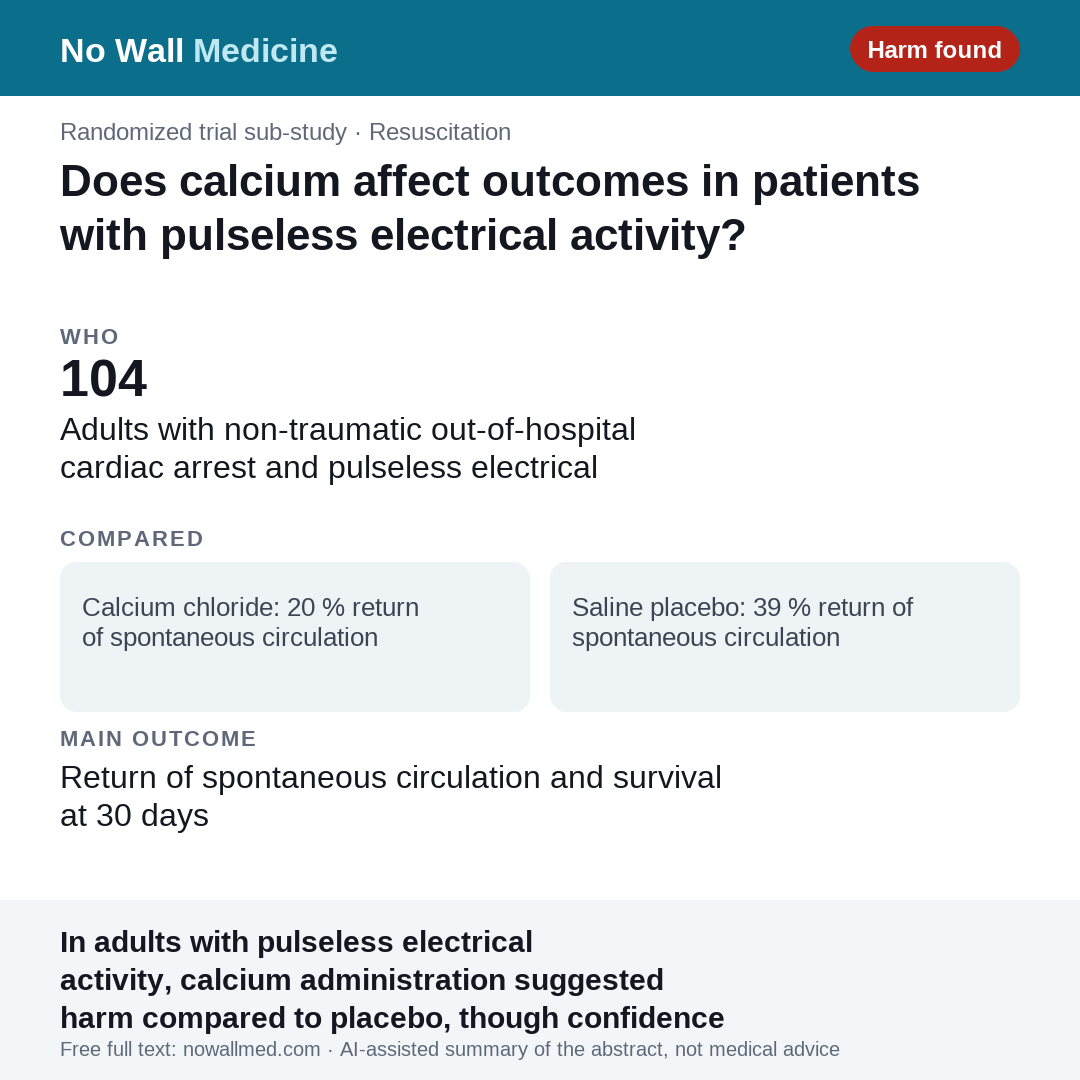
Clinical question: Does calcium affect outcomes in patients with pulseless electrical activity?
Why it matters: It is unknown if administering calcium based on specific heart rhythm patterns during out-of-hospital cardiac arrest improves patient outcomes.
Key points
- Researchers analyzed 104 adults with non-traumatic out-of-hospital cardiac arrest who received either 5 mmol of calcium chloride or a saline placebo.
- In the calcium group, 20% achieved return of spontaneous circulation compared to 39% in the placebo group, and 2.2% were alive at 30 days compared to 13.6% in the placebo group.
- Subgroup analyses of patients with heart rhythm patterns potentially linked to high potassium or ischemia showed similar results.
Headline and key points written with AI from the paper’s abstract, with every number checked against it. Read the paper before relying on them.
Was this summary helpful?
Subject terms
Cite this article
Vallentin MF, Povlsen AL, Granfeldt A, Terkelsen CJ, Andersen LW. Effect of calcium in patients with pulseless electrical activity and electrocardiographic characteristics potentially associated with hyperkalemia and ischemia-sub-study of the Calcium for Out-of-hospital Cardiac Arrest (COCA) trial. Resuscitation. 2022. doi:10.1016/j.resuscitation.2022.11.006
Spotted a mistake? Suggest a correction