Low-dose capecitabine improved 5-year disease-free survival in early-stage triple-negative breast cancer
Effect of Capecitabine Maintenance Therapy Using Lower Dosage and Higher Frequency vs Observation on Disease-Free Survival Among Patients With Early-Stage Triple-Negative Breast Cancer Who Had Received Standard Treatment: The SYSUCC-001 Randomized Clinical Trial
Randomized clinical trialBenefit found
Does low-dose capecitabine maintenance improve disease-free survival in early-stage triple-negative breast cancer?
Who
443
Patients with early-stage triple-negative breast cancer after standard adjuvant chemotherapy · 13 academic centers and clinical sites in China
Compared
82.8%Capecitabine
73.0%Observation
Main outcome
disease-free survival
Result: hazard ratio 0.64 (95% CI 0.42-0.95)
Bottom line: Low-dose capecitabine maintenance therapy significantly improved 5-year disease-free survival compared to observation in early-stage triple-negative breast cancer.
JAMA · 2020-12-11Download image
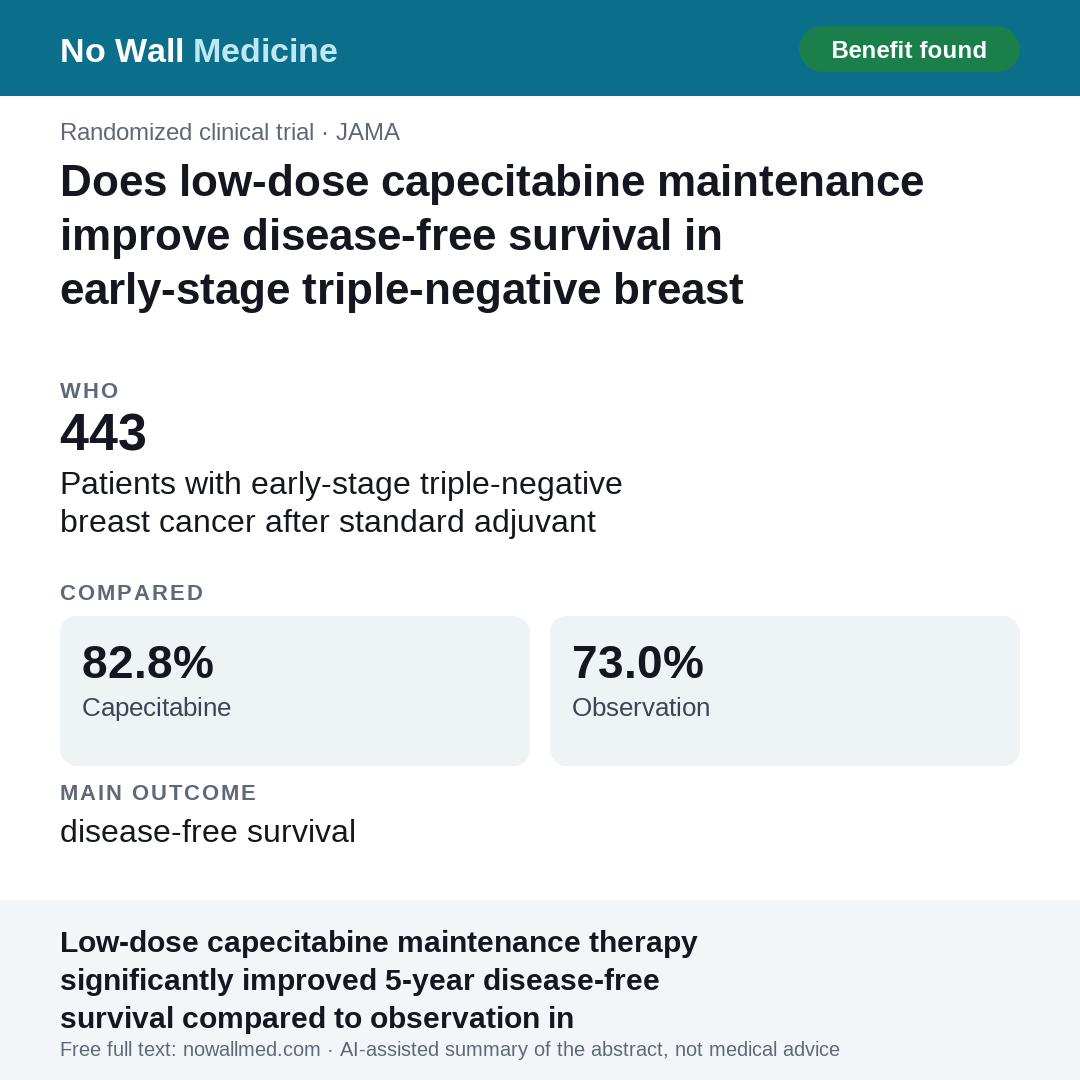
Clinical question: Does low-dose capecitabine maintenance improve disease-free survival in early-stage triple-negative breast cancer?
Why it matters: Effective strategies to reduce relapse risk in triple-negative breast cancer are needed
In absolute numbers
Capecitabine: 82.8% · Observation: 73% → a difference of 9.8 percentage points, so about 11 people would need the treatment for 1 more to benefit (number needed to treat) over the trial’s follow-up.
Worked out by us from the two group results above, not reported by the authors. Check the paper for the exact outcome and timing.
Key points
- 443 women with early-stage triple-negative breast cancer were randomized to capecitabine or observation after standard chemotherapy.
- Capecitabine group had 82.8% 5-year disease-free survival, compared to 73.0% in the observation group.
- Hand-foot syndrome was the most common capecitabine-related adverse event, affecting 45.2% of patients.
Headline and key points written with AI from the paper’s abstract, with every number checked against it. Read the paper before relying on them.
Was this summary helpful?
Subject terms
Cite this article
Wang X, Wang SS, Huang H, Cai L, Zhao L, Peng RJ. Effect of Capecitabine Maintenance Therapy Using Lower Dosage and Higher Frequency vs Observation on Disease-Free Survival Among Patients With Early-Stage Triple-Negative Breast Cancer Who Had Received Standard Treatment: The SYSUCC-001 Randomized Clinical Trial. JAMA. 2020. doi:10.1001/jama.2020.23370
Spotted a mistake? Suggest a correction
Top studies every Monday
The week’s key trials and guidelines in your specialties, plus any topics you follow. By email, free.
Get the weekly digest