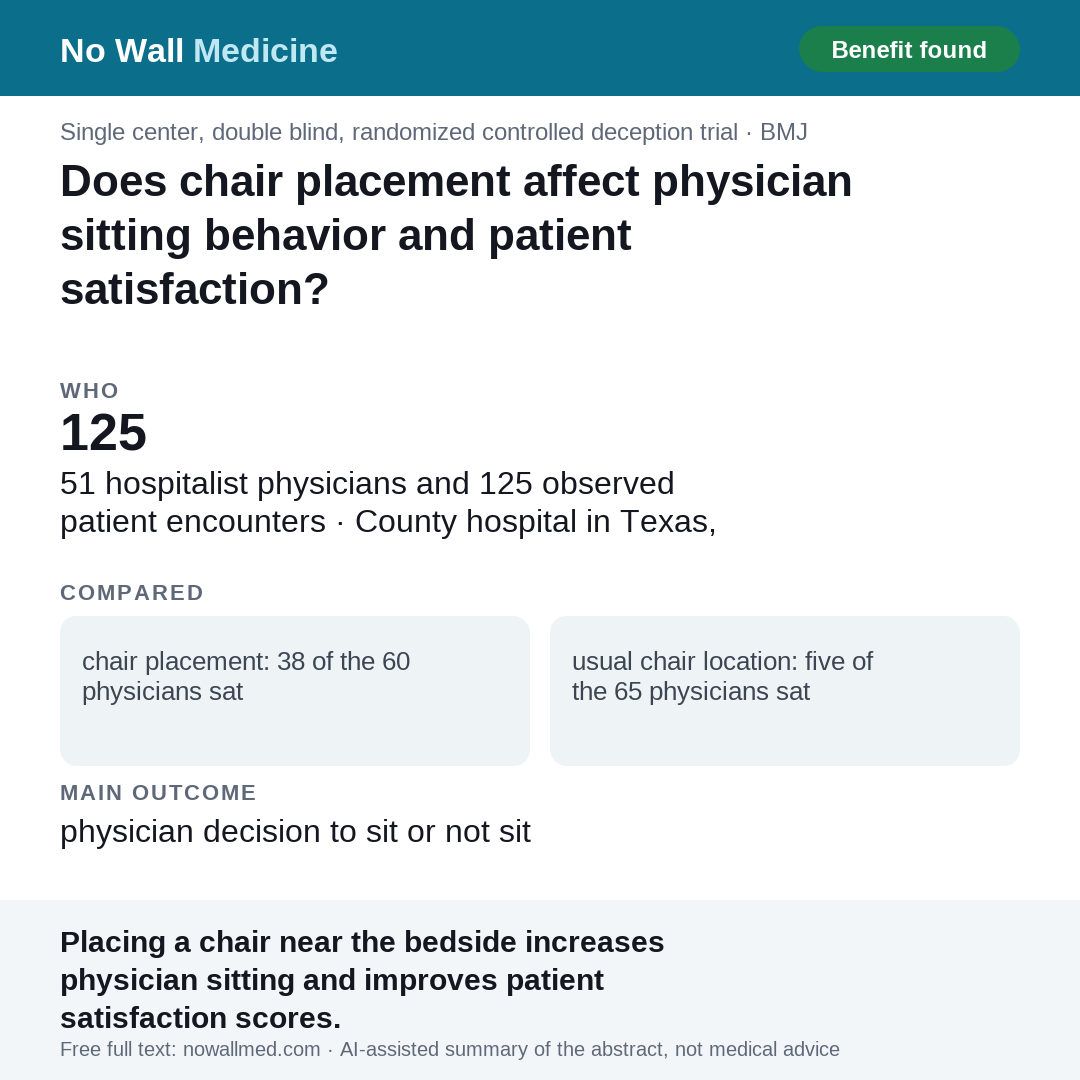
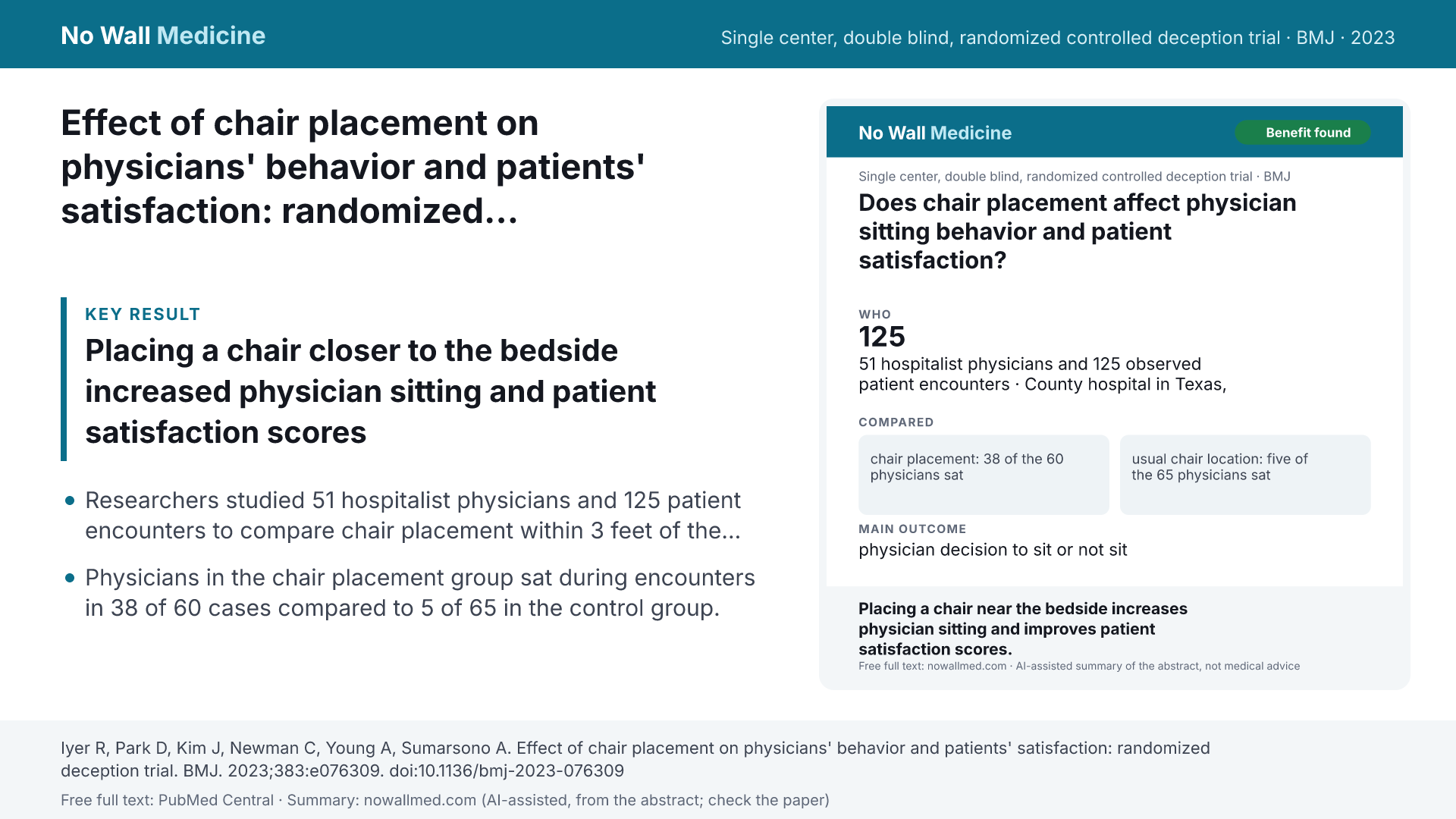
Placing a chair closer to the bedside increased physician sitting and patient satisfaction scores
Effect of chair placement on physicians' behavior and patients' satisfaction: randomized deception trial
Single center, double blind, randomized controlled deception trialBenefit found
Does chair placement affect physician sitting behavior and patient satisfaction?
Who
125
51 hospitalist physicians and 125 observed patient encounters · County hospital in Texas, USA
Compared
chair placement: 38 of the 60 physicians sat
usual chair location: five of the 65 physicians sat
Main outcome
physician decision to sit or not sit
Result: odds ratio 20.7 (95% confidence interval 7.2 to 59.4)
Bottom line: Placing a chair near the bedside increases physician sitting and improves patient satisfaction scores.
BMJ · 2023-12-15Download image
Clinical question: Does chair placement affect physician sitting behavior and patient satisfaction?
Why it matters: It is unclear if the physical location of a chair during bedside consultations influences how often physicians sit or how patients perceive their care.
Key points
- Researchers studied 51 hospitalist physicians and 125 patient encounters to compare chair placement within 3 feet of the bed to usual chair locations.
- Physicians in the chair placement group sat during encounters in 38 of 60 cases compared to 5 of 65 in the control group.
- Chair placement was associated with 3.9% greater TAISCH satisfaction scores and 5.1 greater odds of complete HCAHPS satisfaction scores.
Limitation the authors note: This was a single center study conducted at a county hospital in Texas.
Headline and key points written with AI from the paper’s abstract, with every number checked against it. Read the paper before relying on them.
Was this summary helpful?
Abstract
Objective
To evaluate the effect of chair placement on length of time physicians sit during a bedside consultation and patients' satisfaction. Design
Single center, double blind, randomized controlled deception trial. Setting
County hospital in Texas, USA. Participants
51 hospitalist physicians providing direct care services, and 125 observed encounters of patients who could answer four orientation questions correctly before study entry, April 2022 to February 2023. Intervention
Each patient encounter was randomized to either chair placement (≤3 feet (0.9 m) of patient's bedside and facing the bed) or usual chair location (control). Main outcome measures
The primary outcome was the binary decision of the physician to sit or not sit at any point during a patient encounter. Secondary outcomes included patient satisfaction, as assessed with the Tool to Assess Inpatient Satisfaction with Care from Hospitalists (TAISCH) and the Hospital Consumer Assessment of Healthcare Providers and Systems (HCAHPS) surveys, time in the room, and both physicians' and patients' perception of time in the room. Results
125 patient encounters were randomized (60 to chair placement and 65 to control). 38 of the 60 physicians in the chair placement group sat during the patient encounter compared with five of the 65 physicians in the control group (odds ratio 20.7, 95% confidence interval 7.2 to 59.4; P<0.001). The absolute risk difference between the intervention and control groups was 0.55 (95% confidence interval 0.42 to 0.69). Overall, 1.8 chairs needed to be placed for a physician to sit. Intervention was associated with 3.9% greater TAISCH scores (effect estimate 3.9, 95% confidence interval 0.9 to 7.0; P=0.01) and 5.1 greater odds of complete scores on HCAHPS (95% confidence interval 1.06 to 24.9, P=0.04). Chair placement was not associated with time spent in the room (10.6 minutes v control 10.6 minutes) nor perception of time in the room for physicians (9.4 minutes v 9.8 minutes) or patients (13.1 minutes v 13.5 minutes). Conclusion
Chair placement is a simple, no cost, low tech intervention that increases a physician's likelihood of sitting during a bedside consultation and resulted in higher patients' scores for both satisfaction and communication. Trial registration
ClinicalTrials.gov NCT05250778.
Abstract reproduced under the article’s CC BY NC licence.
Subject terms
Cite this article
Iyer R, Park D, Kim J, Newman C, Young A, Sumarsono A. Effect of chair placement on physicians' behavior and patients' satisfaction: randomized deception trial. BMJ. 2023. doi:10.1136/bmj-2023-076309
Spotted a mistake? Suggest a correction
Top studies every Monday
The week’s key trials and guidelines in your specialties, plus any topics you follow. By email, free.
Get the weekly digest