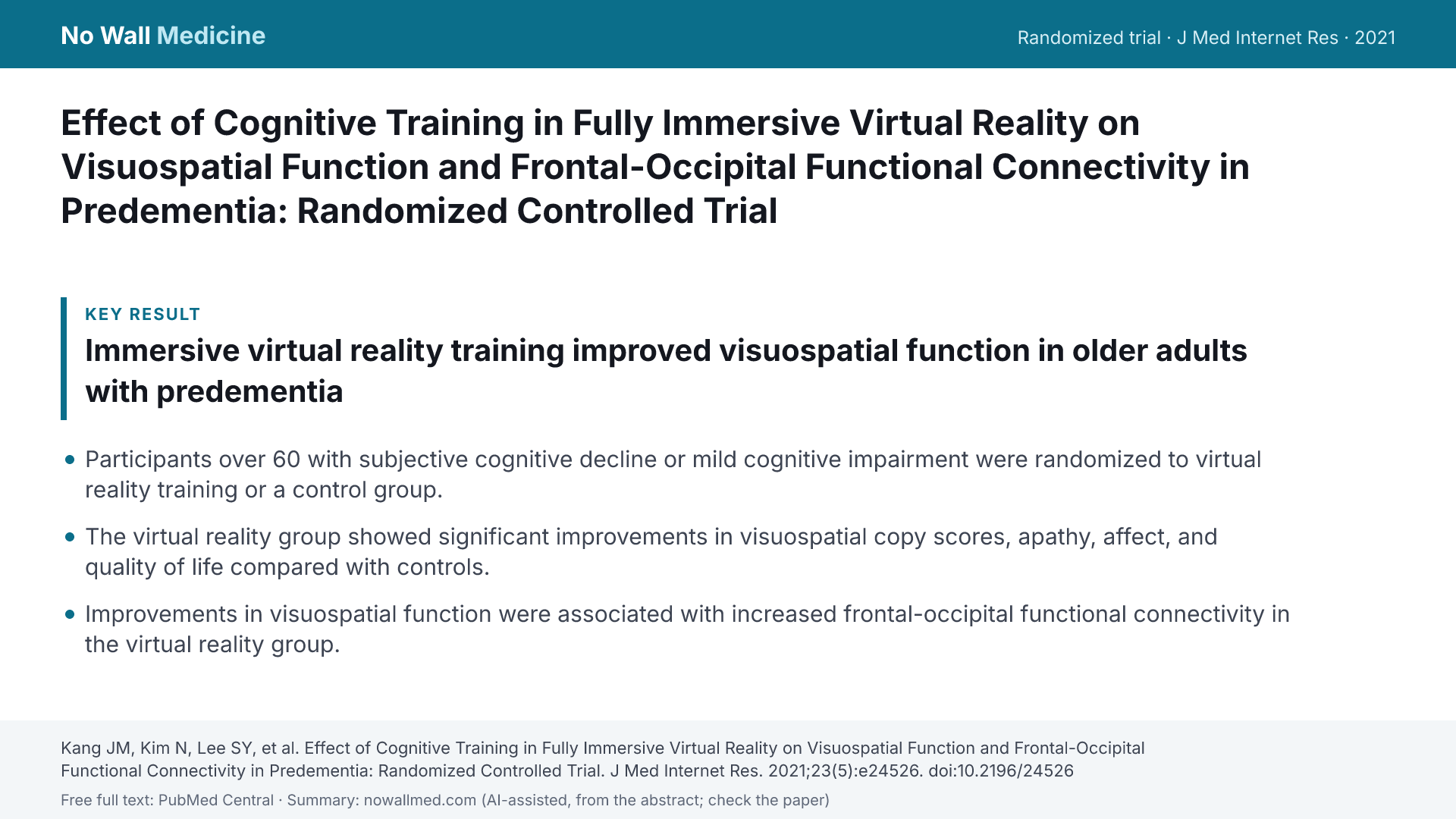
Effect of Cognitive Training in Fully Immersive Virtual Reality on Visuospatial Function and Frontal-Occipital Functional Connectivity in Predementia: Randomized Controlled Trial
Key result: Immersive virtual reality training improved visuospatial function in older adults with predementia
Key points
- Participants over 60 with subjective cognitive decline or mild cognitive impairment were randomized to virtual reality training or a control group.
- The virtual reality group showed significant improvements in visuospatial copy scores, apathy, affect, and quality of life compared with controls.
- Improvements in visuospatial function were associated with increased frontal-occipital functional connectivity in the virtual reality group.
Why it matters: Results from previous studies using semi-immersive virtual reality for cognitive training have been inconsistent.
Discussion prompts
- Would these patients look like yours? Who was left out?
- Is the main outcome one that matters to patients?
- Is the difference large enough to change what you do?
Cite: Kang JM, Kim N, Lee SY, et al. Effect of Cognitive Training in Fully Immersive Virtual Reality on Visuospatial Function and Frontal-Occipital Functional Connectivity in Predementia: Randomized Controlled Trial. J Med Internet Res. 2021;23(5):e24526. doi:10.2196/24526
Free full text: PubMed Central · Summary and visual abstract: nowallmed.com/a/effect-of-cognitive-training-in-fully-immersive-virtual-reality-on-1r9qpty/ (AI-assisted from the abstract; check the paper before relying on it).