Collaborative dementia care program was associated with fewer potentially inappropriate medications in community-dwelling patients
Effect of collaborative dementia care on potentially inappropriate medication use: Outcomes from the Care Ecosystem randomized clinical trial
Randomized clinical trialBenefit found
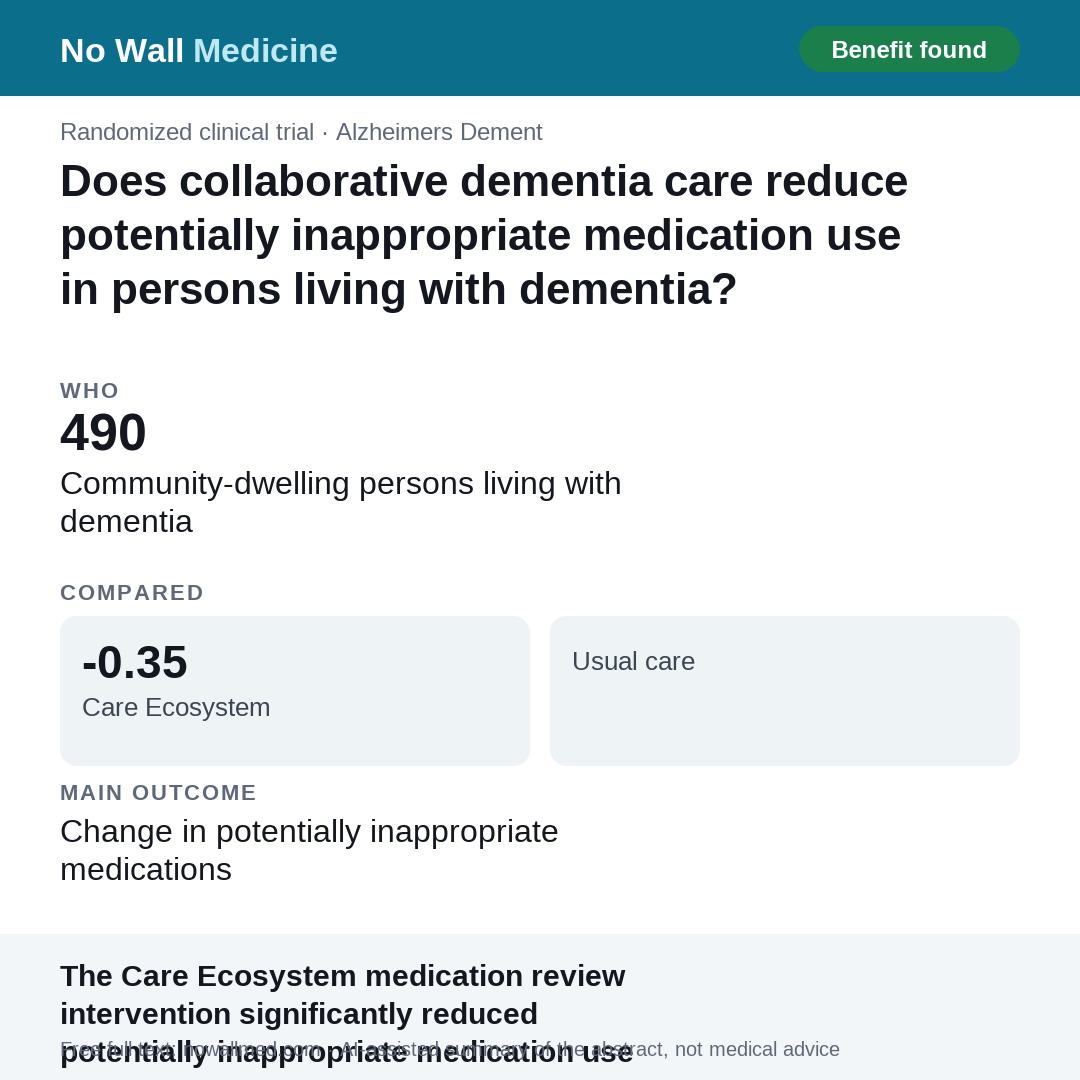
Does collaborative dementia care reduce potentially inappropriate medication use in persons living with dementia?
Who
490
Community-dwelling persons living with dementia
Compared
-0.35Care Ecosystem
Usual care
Main outcome
Change in potentially inappropriate medications
Result: -0.35 (95% CI, -0.49 to -0.20)
Bottom line: The Care Ecosystem medication review intervention significantly reduced potentially inappropriate medication use among persons living with dementia.
Alzheimers Dement · 2022-11-04Download image
Clinical question: Does collaborative dementia care reduce potentially inappropriate medication use in persons living with dementia?
Why it matters: It is unknown if a collaborative dementia care program can change the use of potentially inappropriate medications among people living with dementia in the community.
Key points
- Researchers analyzed 490 people living with dementia from a randomized clinical trial to compare a collaborative care program to usual care over 12 months.
- The collaborative care program resulted in significantly fewer potentially inappropriate medications, which are drugs that may cause harm, compared to usual care (-0.35; 95% CI, -0.49 to -0.20; P < 0.0001).
- The program was also associated with lower use of anticholinergics, benzodiazepines, and opioids, and more frequent modifications to anti-dementia medication regimens.
Headline and key points written with AI from the paper’s abstract, with every number checked against it. Read the paper before relying on them.
Was this summary helpful?
Subject terms
Cite this article
Liu AK, Possin KL, Cook KM, Lynch S, Dulaney S, Merrilees JJ. Effect of collaborative dementia care on potentially inappropriate medication use: Outcomes from the Care Ecosystem randomized clinical trial. Alzheimers Dement. 2022. doi:10.1002/alz.12808
Spotted a mistake? Suggest a correction
Top studies every Monday
The week’s key trials and guidelines in your specialties, plus any topics you follow. By email, free.
Get the weekly digest