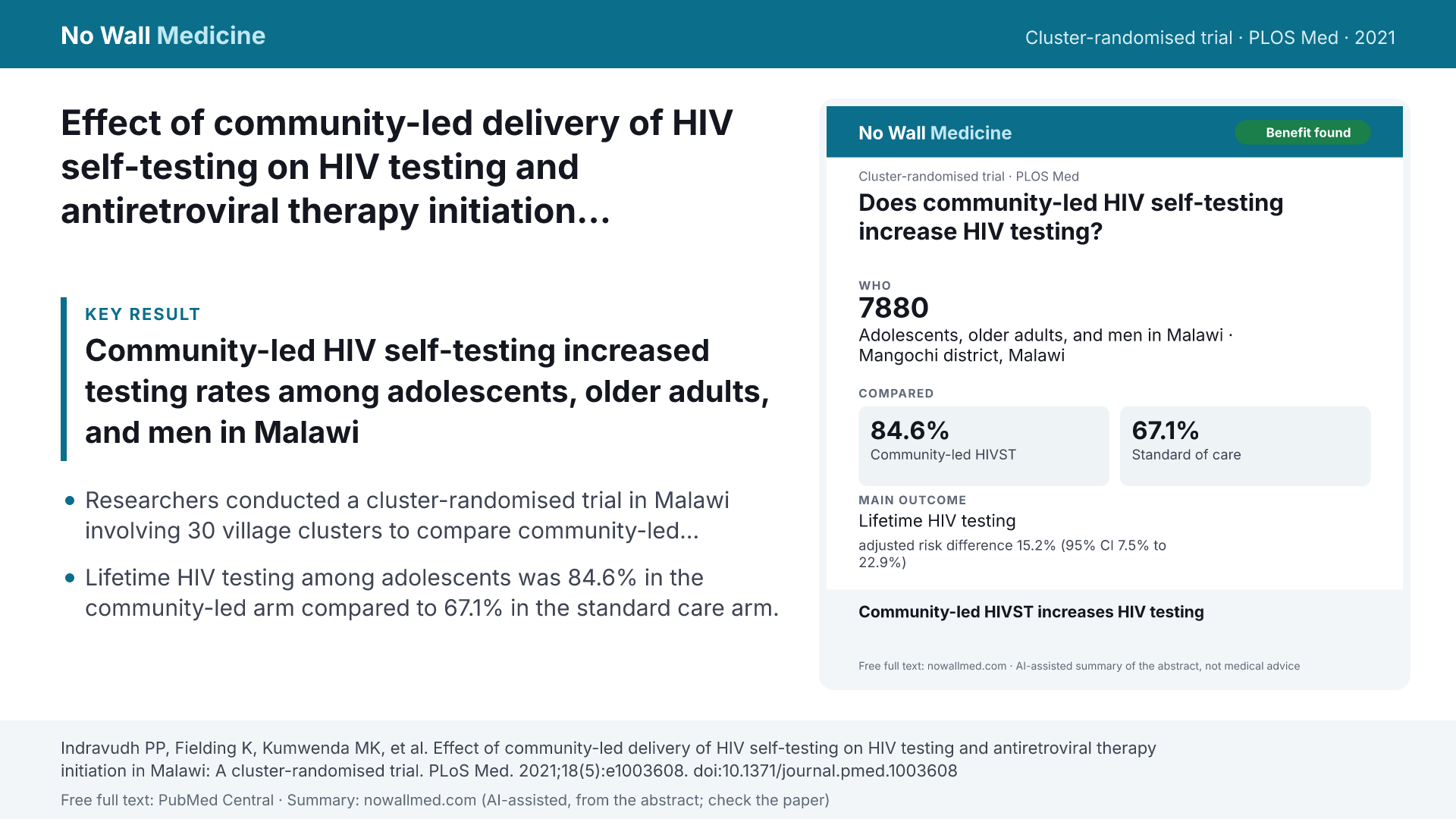
Community-led HIV self-testing increased testing rates among adolescents, older adults, and men in Malawi
Effect of community-led delivery of HIV self-testing on HIV testing and antiretroviral therapy initiation in Malawi: A cluster-randomised trial
Cluster-randomised trialBenefit found
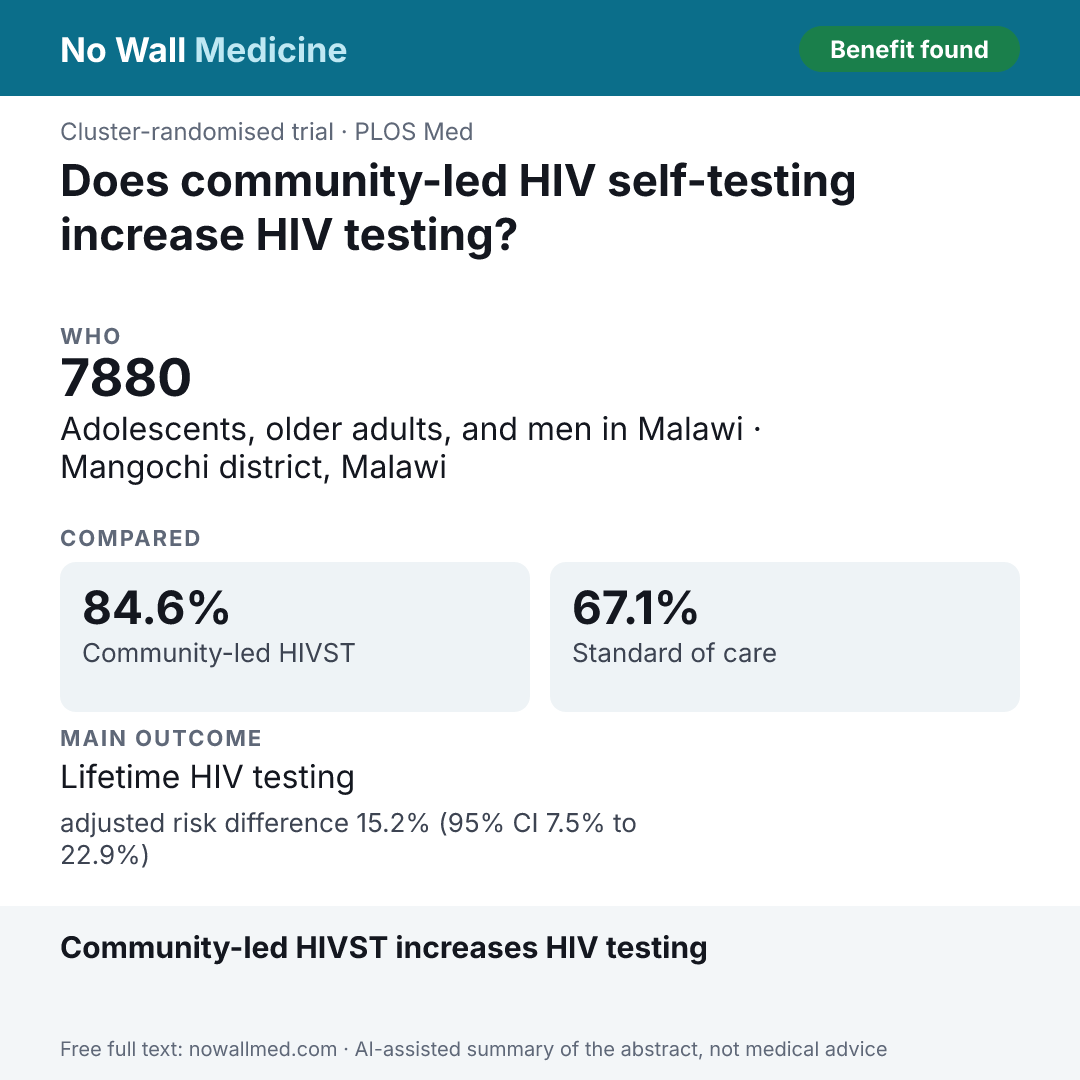
Does community-led HIV self-testing increase HIV testing?
Who
7880
Adolescents, older adults, and men in Malawi · Mangochi district, Malawi
Compared
84.6%Community-led HIVST (770/910)
67.1%Standard of care (582/867)
Main outcome
Lifetime HIV testing
Result: adjusted risk difference 15.2% (95% CI 7.5% to 22.9%)
Bottom line: Community-led HIVST increases HIV testing
Limitation: Self-reported outcomes, no baseline measurement
PLOS Med · 2021-05-11 · Save PNG
Clinical question: Does community-led HIV self-testing increase HIV testing?
Why it matters: Undiagnosed HIV infection remains high in subgroups like adolescents, older adults, and men, which drives ongoing transmission in sub-Saharan Africa.
In absolute numbers
Community-led HIVST: 84.6% · Standard of care: 67.1% → a difference of 17.5 percentage points, so about 6 people would need the treatment for 1 more to benefit (number needed to treat) over the trial’s follow-up.
Worked out by us from the two group results above, not reported by the authors. Check the paper for the exact outcome and timing.
Key points
- Researchers conducted a cluster-randomised trial in Malawi involving 30 village clusters to compare community-led HIV self-testing against standard care.
- Lifetime HIV testing among adolescents was 84.6% in the community-led arm compared to 67.1% in the standard care arm.
- Recent testing in the last 3 months was 74.5% for older adults and 74.6% for men in the community-led group, compared to 31.5% and 33.9% respectively in standard care.
Limitation the authors note: The authors noted the use of self-reported HIV testing outcomes and a lack of baseline measurement for the primary outcome.
Headline and key points written with AI from the paper’s abstract, with every number checked against it. Read the paper before relying on them.
Was this summary helpful?
Subject terms
Headline, design, result, key points, caveat and citation as plain text.
Cite this article
Indravudh PP, Fielding K, Kumwenda MK, et al. Effect of community-led delivery of HIV self-testing on HIV testing and antiretroviral therapy initiation in Malawi: A cluster-randomised trial. PLoS Med. 2021;18(5):e1003608. doi:10.1371/journal.pmed.1003608
Spotted a mistake? Suggest a correction