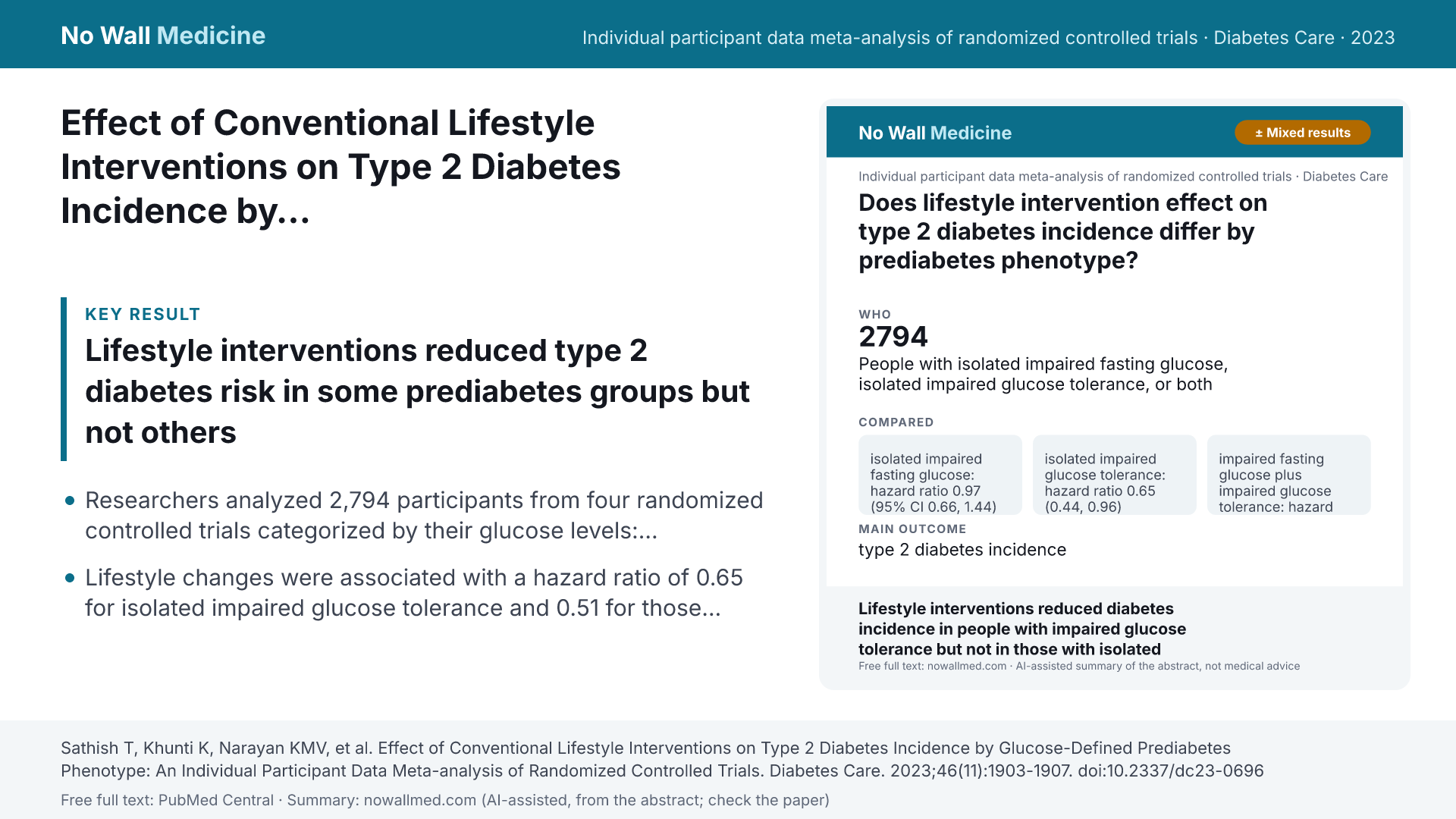
Lifestyle interventions reduced type 2 diabetes risk in some prediabetes groups but not others
Effect of Conventional Lifestyle Interventions on Type 2 Diabetes Incidence by Glucose-Defined Prediabetes Phenotype: An Individual Participant Data Meta-analysis of Randomized Controlled Trials
Individual participant data meta-analysis of randomized controlled trialsMixed results
Does lifestyle intervention effect on type 2 diabetes incidence differ by prediabetes phenotype?
Who
2794
People with isolated impaired fasting glucose, isolated impaired glucose tolerance, or both
Compared
isolated impaired fasting glucose: hazard ratio 0.97 (95% CI 0.66, 1.44)
isolated impaired glucose tolerance: hazard ratio 0.65 (0.44, 0.96)
impaired fasting glucose plus impaired glucose tolerance: hazard ratio 0.51 (0.38, 0.68)
Main outcome
type 2 diabetes incidence
Result: Pinteraction = 0.01
Bottom line: Lifestyle interventions reduced diabetes incidence in people with impaired glucose tolerance but not in those with isolated impaired fasting glucose.
Diabetes Care · 2023-08-31Download image
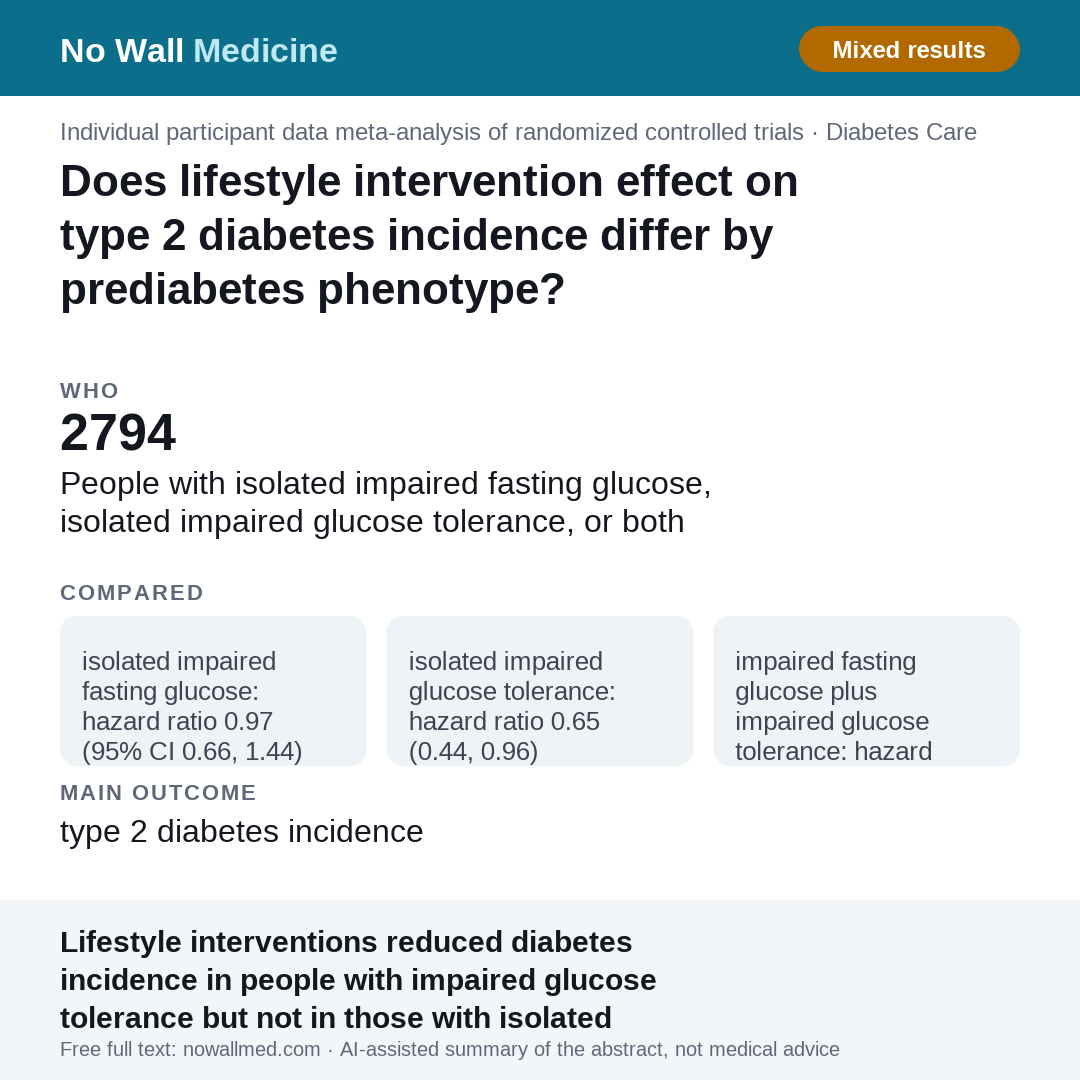
Clinical question: Does lifestyle intervention effect on type 2 diabetes incidence differ by prediabetes phenotype?
Key points
- Researchers analyzed 2,794 participants from four randomized controlled trials categorized by their glucose levels: isolated impaired fasting glucose, isolated impaired glucose tolerance, or both.
- Lifestyle changes were associated with a hazard ratio of 0.65 for isolated impaired glucose tolerance and 0.51 for those with both glucose abnormalities.
- The intervention was not associated with a reduction in diabetes incidence for the 1,240 participants with isolated impaired fasting glucose, which had a hazard ratio of 0.97.
Headline and key points written with AI from the paper’s abstract, with every number checked against it. Read the paper before relying on them.
Was this summary helpful?
Subject terms
Cite this article
Sathish T, Khunti K, Narayan KMV, et al. Effect of Conventional Lifestyle Interventions on Type 2 Diabetes Incidence by Glucose-Defined Prediabetes Phenotype: An Individual Participant Data Meta-analysis of Randomized Controlled Trials. Diabetes Care. 2023. doi:10.2337/dc23-0696
Spotted a mistake? Suggest a correction