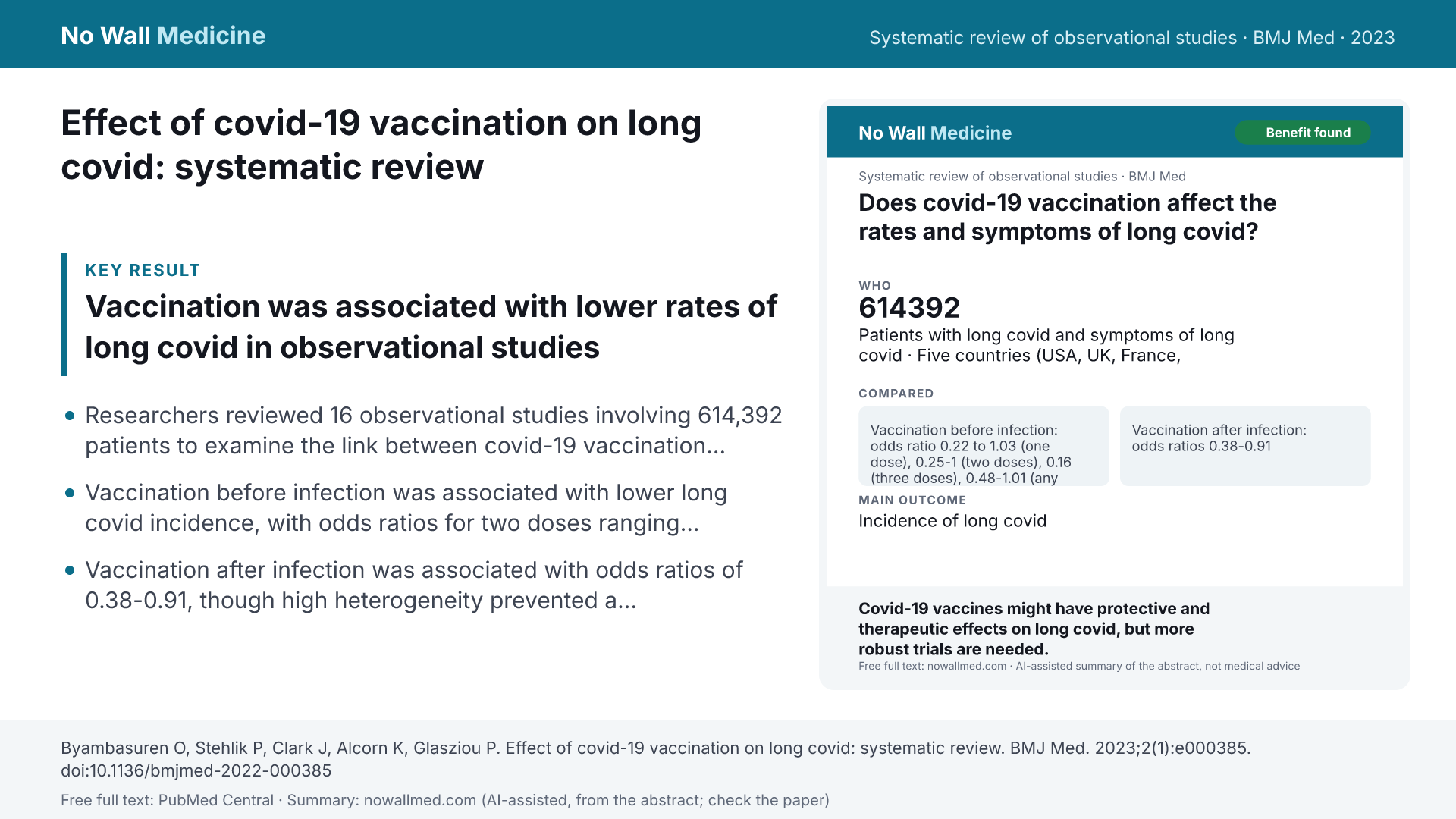
Vaccination was associated with lower rates of long covid in observational studies
Effect of covid-19 vaccination on long covid: systematic review
Systematic review of observational studiesBenefit found
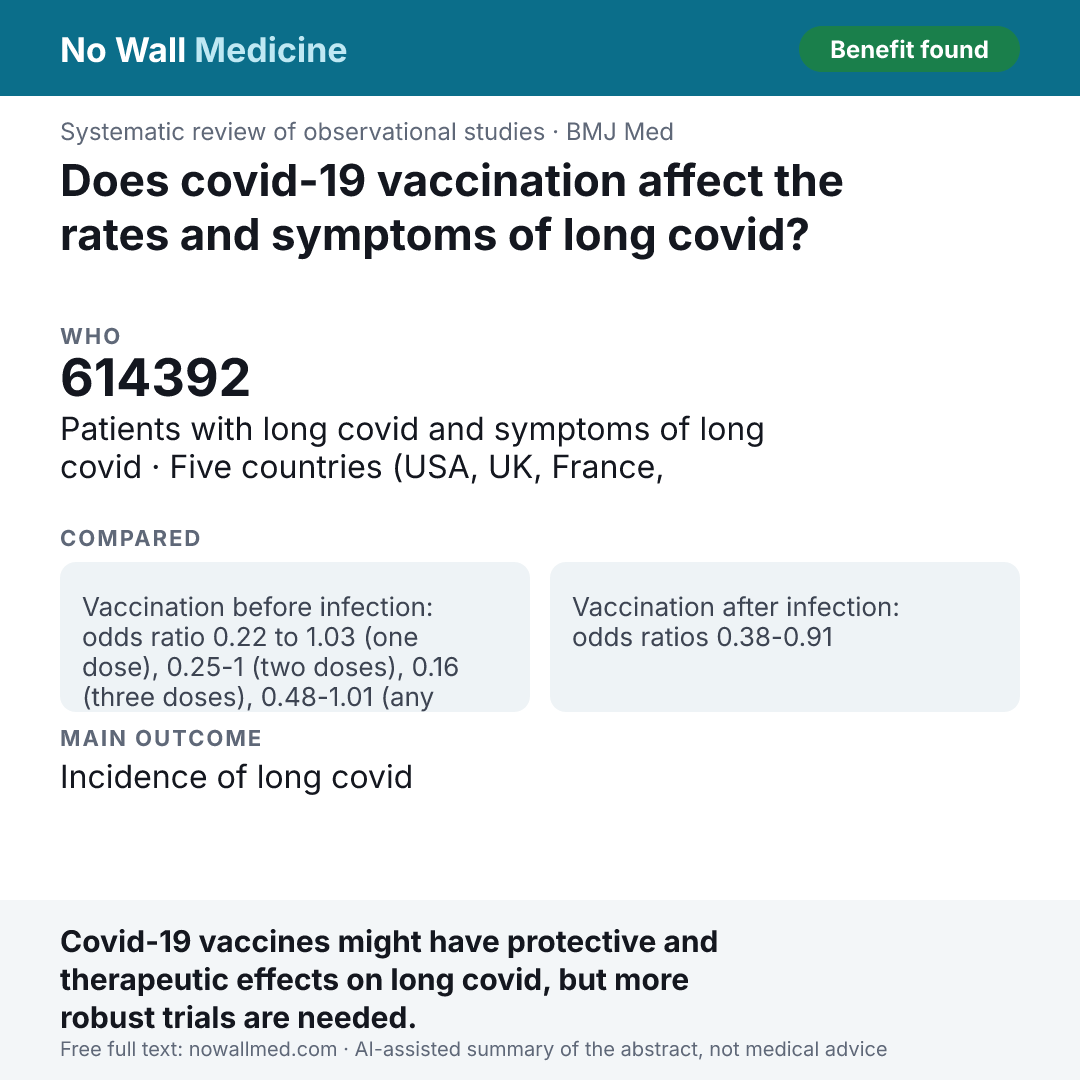
Does covid-19 vaccination affect the rates and symptoms of long covid?
Who
614392
Patients with long covid and symptoms of long covid · Five countries (USA, UK, France, Italy, and the Netherlands)
Compared
Vaccination before infection: odds ratio 0.22 to 1.03 (one dose), 0.25-1 (two doses), 0.16 (three doses), 0.48-1.01 (any dose)
Vaccination after infection: odds ratios 0.38-0.91
Main outcome
Incidence of long covid
Bottom line: Covid-19 vaccines might have protective and therapeutic effects on long covid, but more robust trials are needed.
Limitation: High heterogeneity between studies and failure to adjust for potential confounders increased risk of bias.
BMJ Med · 2023-02-01 · Save PNG
Clinical question: Does covid-19 vaccination affect the rates and symptoms of long covid?
Key points
- Researchers reviewed 16 observational studies involving 614,392 patients to examine the link between covid-19 vaccination and long covid symptoms.
- Vaccination before infection was associated with lower long covid incidence, with odds ratios for two doses ranging from 0.25-1 and three doses at 0.16.
- Vaccination after infection was associated with odds ratios of 0.38-0.91, though high heterogeneity prevented a meaningful meta-analysis.
Limitation the authors note: The studies failed to adjust for potential confounders, such as other protective behaviours and missing data, resulting in low certainty of evidence.
Headline and key points written with AI from the paper’s abstract, with every number checked against it. Read the paper before relying on them.
Was this summary helpful?
Abstract
Objective
To determine the effect of covid-19 vaccination, given before and after acute infection with the SARS-CoV-2 virus, or after a diagnosis of long covid, on the rates and symptoms of long covid. Design
Systematic review. Data sources
PubMed, Embase, and Cochrane covid-19 trials, and Europe PubMed Central (Europe PMC) for preprints, from 1 January 2020 to 3 August 2022. Eligibility criteria for selecting studies
Trials, cohort studies, and case-control studies reporting on patients with long covid and symptoms of long covid, with vaccination before and after infection with the SARS-CoV-2 virus, or after a diagnosis of long covid. Risk of bias was assessed with the ROBINS-I tool. Results
1645 articles were screened but no randomised controlled trials were found. 16 observational studies from five countries (USA, UK, France, Italy, and the Netherlands) were identified that reported on 614 392 patients. The most common symptoms of long covid that were studied were fatigue, cough, loss of sense of smell, shortness of breath, loss of taste, headache, muscle ache, difficulty sleeping, difficulty concentrating, worry or anxiety, and memory loss or confusion. 12 studies reported data on vaccination before infection with the SARS-CoV-2 virus, and 10 showed a significant reduction in the incidence of long covid: the odds ratio of developing long covid with one dose of vaccine ranged from 0.22 to 1.03; with two doses, odds ratios were 0.25-1; with three doses, 0.16; and with any dose, 0.48-1.01. Five studies reported on vaccination after infection, with odds ratios of 0.38-0.91. The high heterogeneity between studies precluded any meaningful meta-analysis. The studies failed to adjust for potential confounders, such as other protective behaviours and missing data, thus increasing the risk of bias and decreasing the certainty of evidence to low. Conclusions
Current studies suggest that covid-19 vaccines might have protective and therapeutic effects on long covid. More robust comparative observational studies and trials are needed, however, to clearly determine the effectiveness of vaccines in preventing and treating long covid. Protocol registration
Open Science Framework https://osf.io/e8jdy.
Abstract reproduced under the article’s CC BY NC licence.
Headline, design, result, key points, caveat and citation as plain text.
Cite this article
Byambasuren O, Stehlik P, Clark J, Alcorn K, Glasziou P. Effect of covid-19 vaccination on long covid: systematic review. BMJ Med. 2023;2(1):e000385. doi:10.1136/bmjmed-2022-000385
Spotted a mistake? Suggest a correction