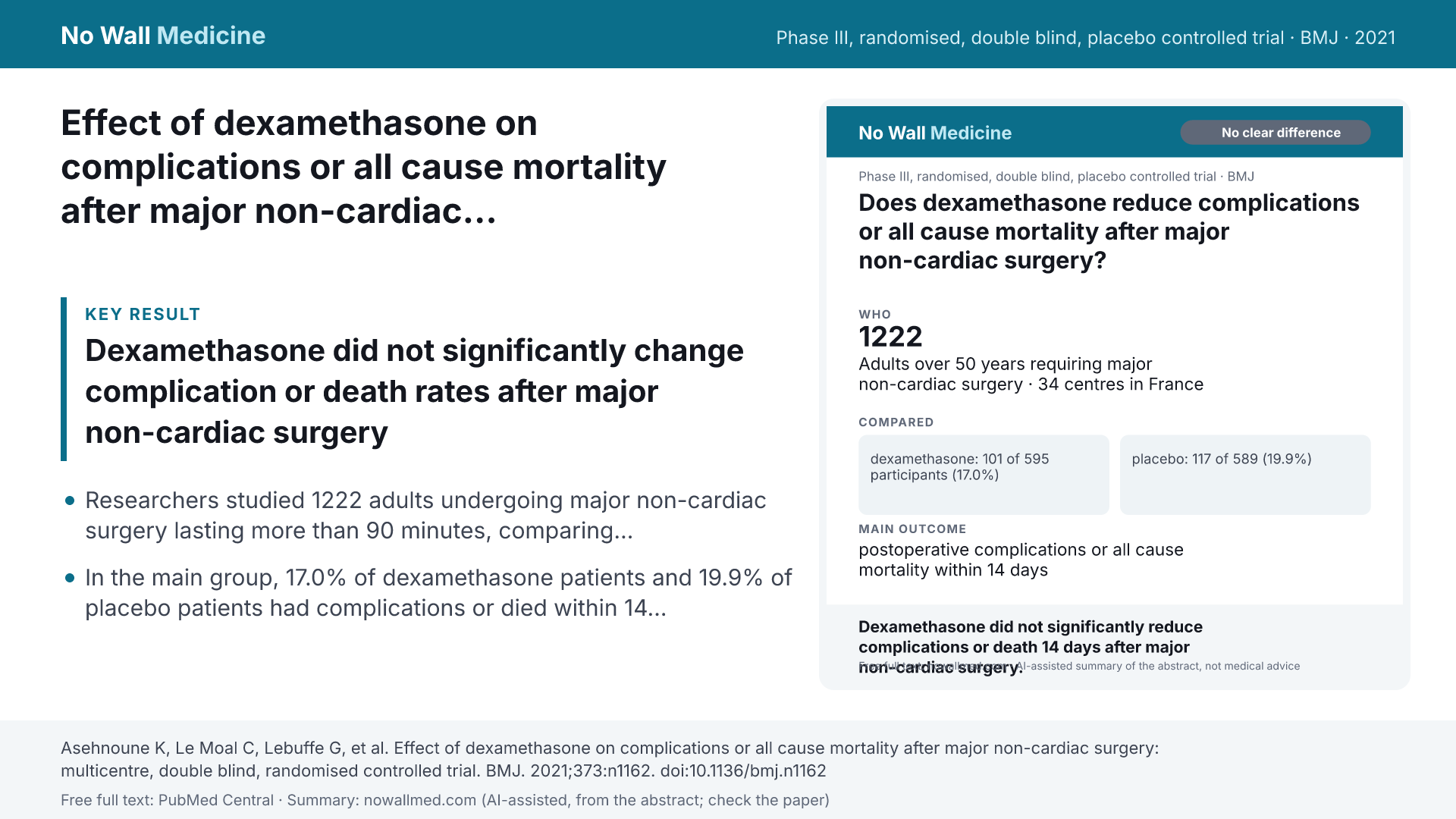
Dexamethasone did not significantly change complication or death rates after major non-cardiac surgery
Effect of dexamethasone on complications or all cause mortality after major non-cardiac surgery: multicentre, double blind, randomised controlled trial
Phase III, randomised, double blind, placebo controlled trialNo clear difference
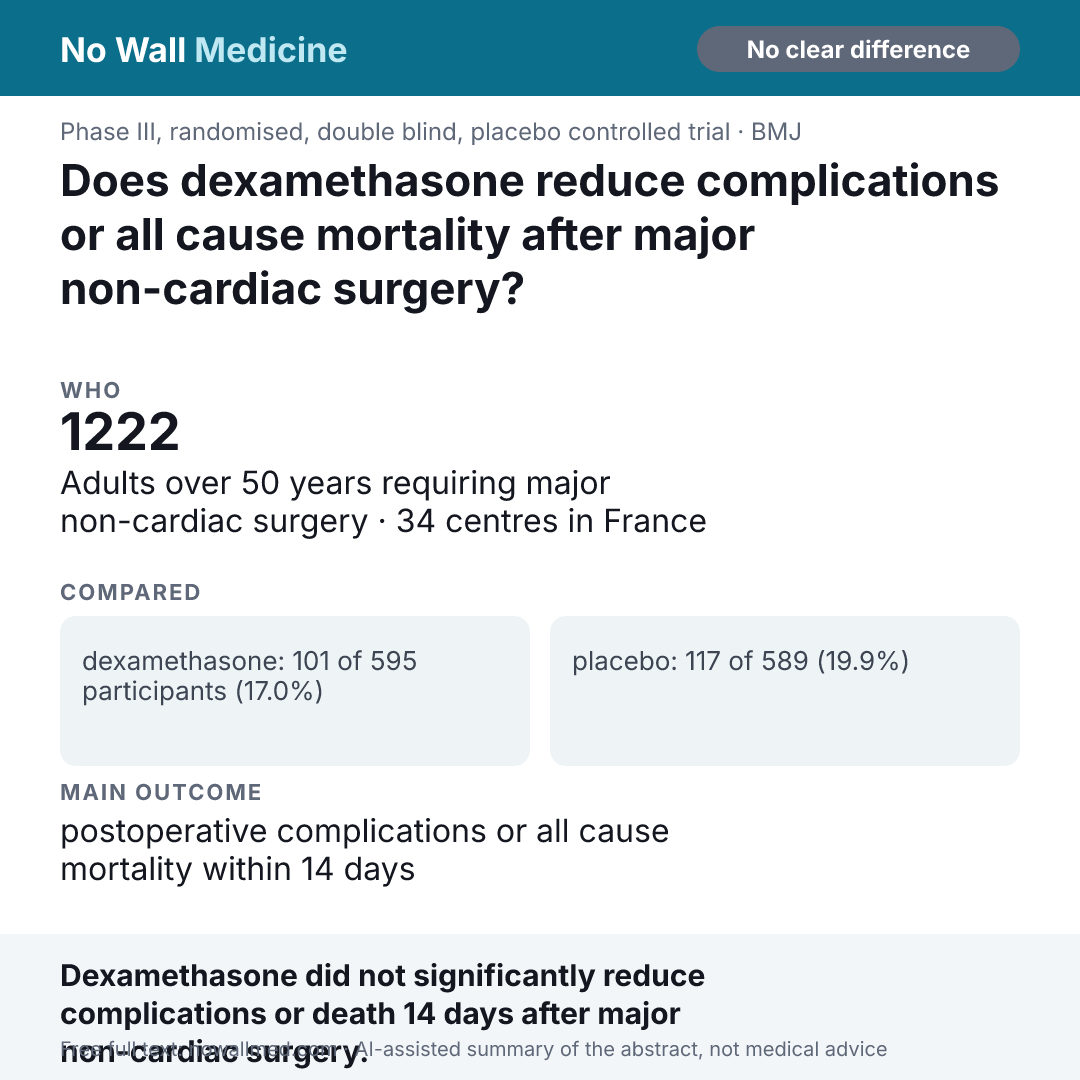
Does dexamethasone reduce complications or all cause mortality after major non-cardiac surgery?
Who
1222
Adults over 50 years requiring major non-cardiac surgery · 34 centres in France
Compared
dexamethasone: 101 of 595 participants (17.0%)
placebo: 117 of 589 (19.9%)
Main outcome
postoperative complications or all cause mortality within 14 days
Result: adjusted odds ratio 0.81 (95% confidence interval 0.60 to 1.08)
Bottom line: Dexamethasone did not significantly reduce complications or death 14 days after major non-cardiac surgery.
Limitation: The wide confidence interval suggests the possibility of important clinical effectiveness.
BMJ · 2021-06-02 · Save PNG
Clinical question: Does dexamethasone reduce complications or all cause mortality after major non-cardiac surgery?
Key points
- Researchers studied 1222 adults undergoing major non-cardiac surgery lasting more than 90 minutes, comparing dexamethasone to a placebo.
- In the main group, 17.0% of dexamethasone patients and 19.9% of placebo patients had complications or died within 14 days (P=0.15).
- Among patients undergoing non-thoracic surgery, the primary outcome occurred in 13.3% of the dexamethasone group and 18% of the placebo group.
Headline and key points written with AI from the paper’s abstract, with every number checked against it. Read the paper before relying on them.
Was this summary helpful?
Abstract
Objective
To assess the effect of dexamethasone on complications or all cause mortality after major non-cardiac surgery. Design
Phase III, randomised, double blind, placebo controlled trial. Setting
34 centres in France, December 2017 to March 2019. Participants
1222 adults (>50 years) requiring major non-cardiac surgery with an expected duration of more than 90 minutes. The anticipated time frame for recruitment was 24 months. Interventions
Participants were randomised to receive either dexamethasone (0.2 mg/kg immediately after the surgical procedure, and on day 1) or placebo. Randomisation was stratified on the two prespecified criteria of cancer and thoracic procedure. Main outcomes measures
The primary outcome was a composite of postoperative complications or all cause mortality within 14 days after surgery, assessed in the modified intention-to-treat population (at least one treatment administered). Results
Of the 1222 participants who underwent randomisation, 1184 (96.9%) were included in the modified intention-to-treat population. 14 days after surgery, 101 of 595 participants (17.0%) in the dexamethasone group and 117 of 589 (19.9%) in the placebo group had complications or died (adjusted odds ratio 0.81, 95% confidence interval 0.60 to 1.08; P=0.15). In the stratum of participants who underwent non-thoracic surgery (n=1038), the primary outcome occurred in 69 of 520 participants (13.3%) in the dexamethasone group and 93 of 518 (18%) in the placebo group (adjusted odds ratio 0.70, 0.50 to 0.99). Adverse events were reported in 288 of 613 participants (47.0%) in the dexamethasone group and 296 of 609 (48.6%) in the placebo group (P=0.46). Conclusions
Dexamethasone was not found to significantly reduce the incidence of complications and death in patients 14 days after major non-cardiac surgery. The 95% confidence interval for the main result was, however, wide and suggests the possibility of important clinical effectiveness. Trial registration
ClinicalTrials.gov NCT03218553.
Abstract reproduced under the article’s CC BY NC licence.
Subject terms
Headline, design, result, key points, caveat and citation as plain text.
Cite this article
Asehnoune K, Le Moal C, Lebuffe G, et al. Effect of dexamethasone on complications or all cause mortality after major non-cardiac surgery: multicentre, double blind, randomised controlled trial. BMJ. 2021;373:n1162. doi:10.1136/bmj.n1162
Spotted a mistake? Suggest a correction