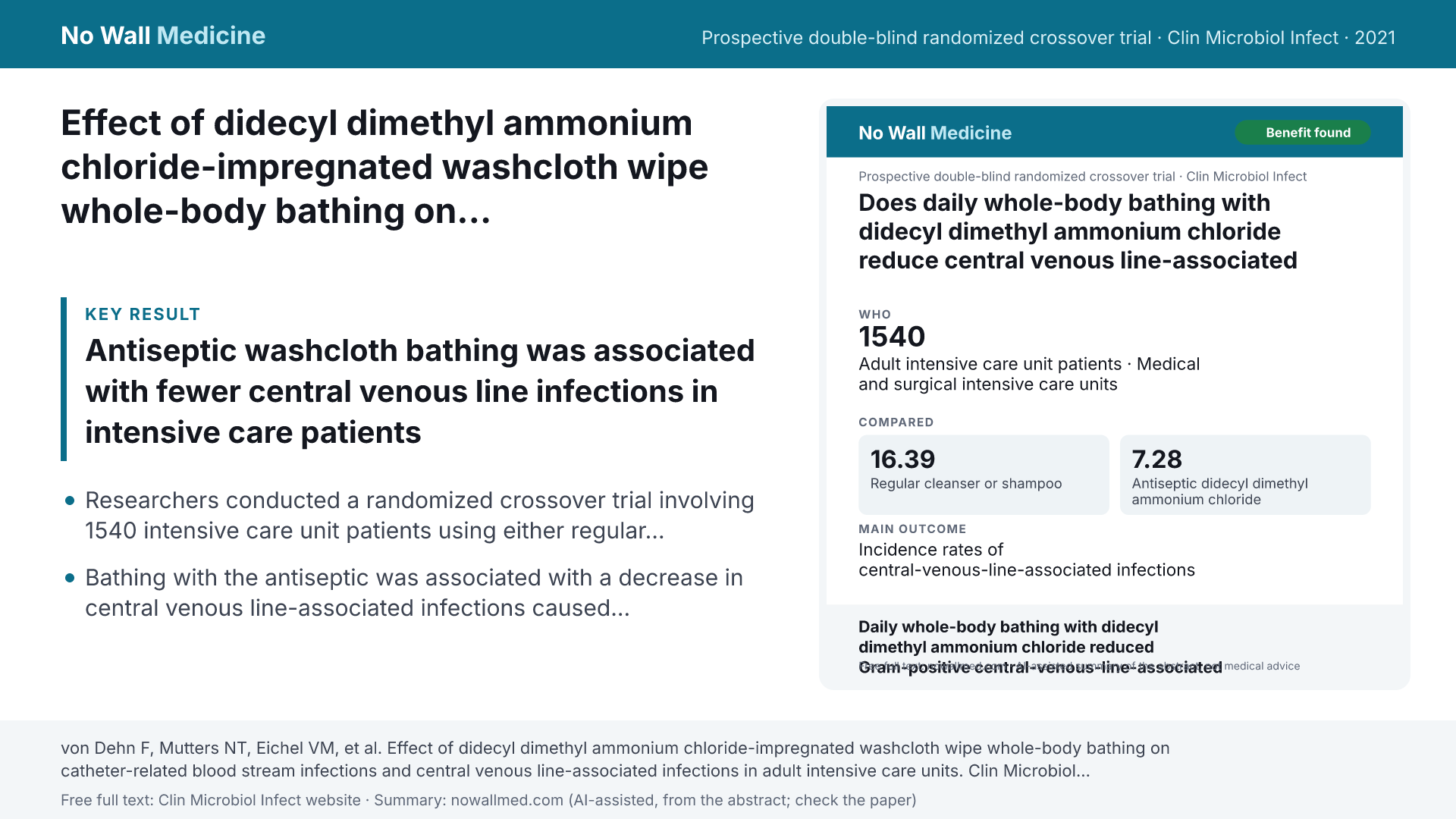
Antiseptic washcloth bathing was associated with fewer central venous line infections in intensive care patients
Effect of didecyl dimethyl ammonium chloride-impregnated washcloth wipe whole-body bathing on catheter-related blood stream infections and central venous line-associated infections in adult intensive care units
Prospective double-blind randomized crossover trialBenefit found
Does daily whole-body bathing with didecyl dimethyl ammonium chloride reduce central venous line-associated infections?
Who
1540
Adult intensive care unit patients · Medical and surgical intensive care units
Compared
16.39Regular cleanser or shampoo (95%CI 13.1-20.3)
7.28Antiseptic didecyl dimethyl ammonium chloride (95%CI 5.2-9.9)
Main outcome
Incidence rates of central-venous-line-associated infections caused by Gram-positive bacteria
Bottom line: Daily whole-body bathing with didecyl dimethyl ammonium chloride reduced Gram-positive central-venous-line-associated infection rates in intensive care patients.
Limitation: Carry-over effects and small numbers prevented statistical significance for bloodstream infection reductions.
Clin Microbiol Infect · 2021-07-30 · Save PNG
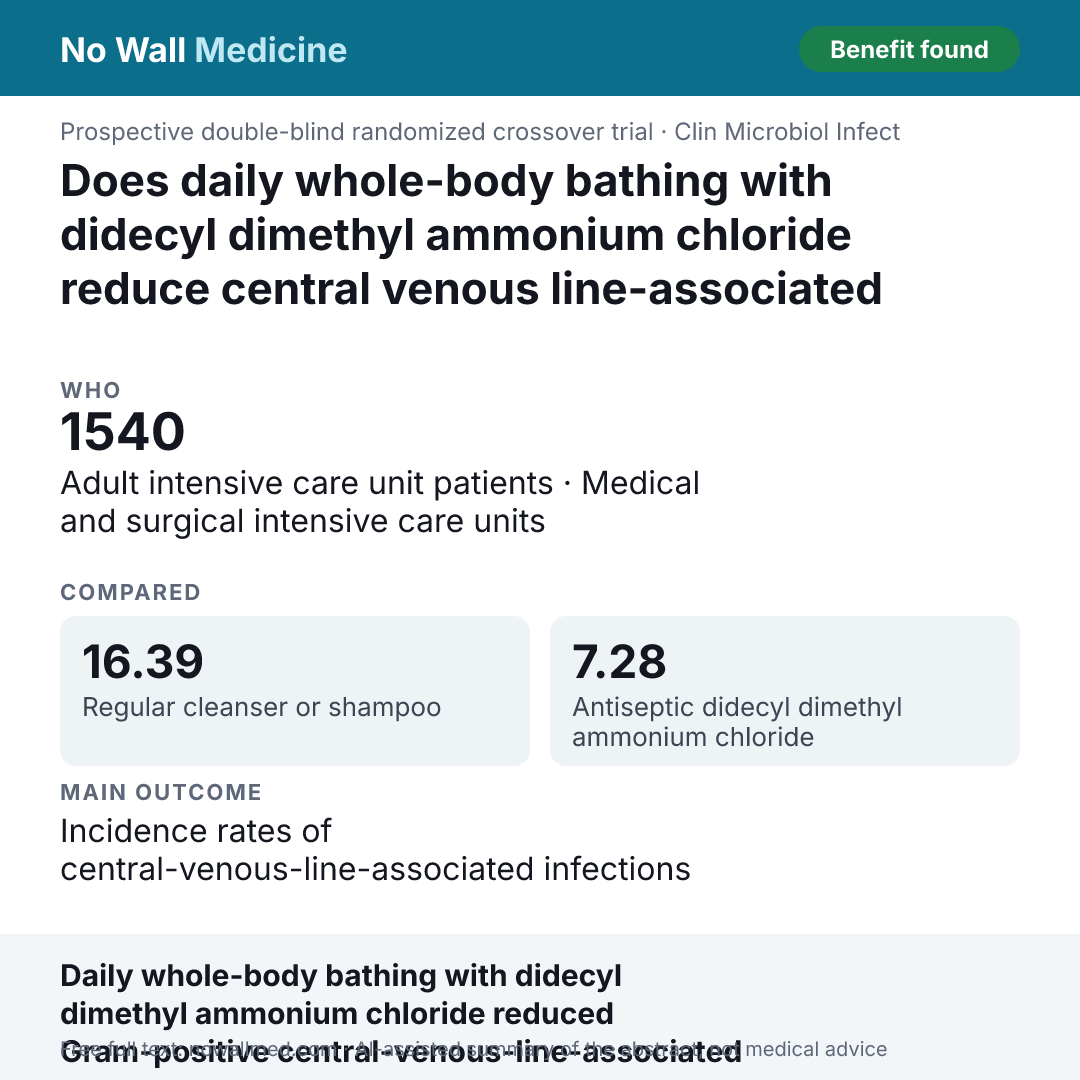
Clinical question: Does daily whole-body bathing with didecyl dimethyl ammonium chloride reduce central venous line-associated infections?
Key points
- Researchers conducted a randomized crossover trial involving 1540 intensive care unit patients using either regular cleanser or wipes containing the antiseptic didecyl dimethyl ammonium chloride.
- Bathing with the antiseptic was associated with a decrease in central venous line-associated infections caused by Gram-positive bacteria from 16.39 to 7.28 per 1000 patient days.
- The intervention was associated with lower infection rates in both medical and surgical intensive care units, though results for catheter-related bloodstream infections did not reach statistical significance.
Limitation the authors note: The study did not reach statistical significance for certain infection types due to carry-over effects and small numbers.
Headline and key points written with AI from the paper’s abstract, with every number checked against it. Read the paper before relying on them.
Was this summary helpful?
Subject terms
Headline, design, result, key points, caveat and citation as plain text.
Cite this article
von Dehn F, Mutters NT, Eichel VM, et al. Effect of didecyl dimethyl ammonium chloride-impregnated washcloth wipe whole-body bathing on catheter-related blood stream infections and central venous line-associated infections in adult intensive care units. Clin Microbiol Infect. 2022;28(4):564-569. doi:10.1016/j.cmi.2021.07.029
Spotted a mistake? Suggest a correction