Isocaloric diets with supplements were associated with lower inflammatory markers in fatty liver disease patients
Effect of Dietary Intervention, with or without Cointerventions, on Inflammatory Markers in Patients with Nonalcoholic Fatty Liver Disease: A Systematic Review and Meta-Analysis
Systematic review and meta-analysisBenefit found
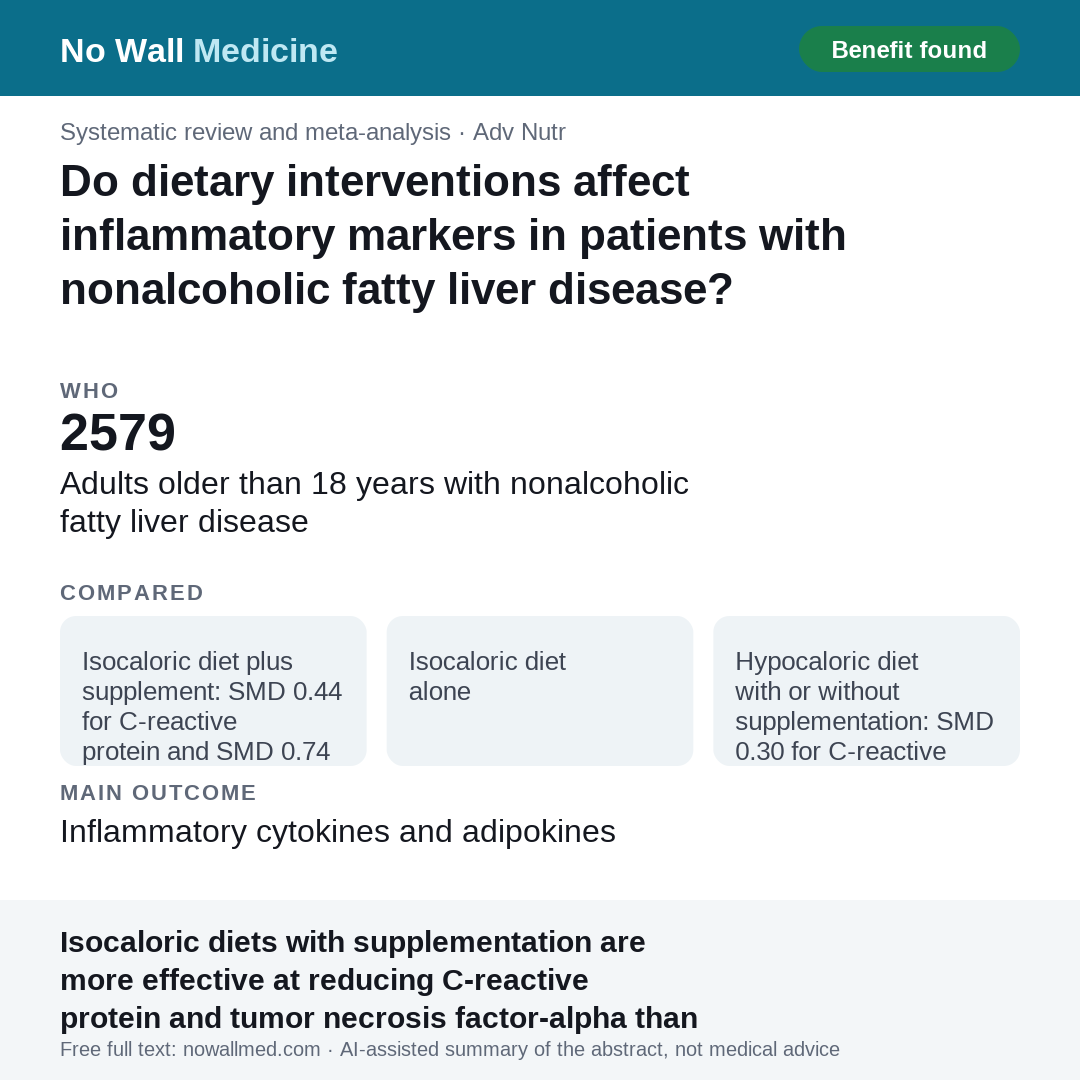
Do dietary interventions affect inflammatory markers in patients with nonalcoholic fatty liver disease?
Who
2579
Adults older than 18 years with nonalcoholic fatty liver disease
Compared
Isocaloric diet plus supplement: SMD 0.44 for C-reactive protein and SMD 0.74 for tumor necrosis factor-alpha
Isocaloric diet alone
Hypocaloric diet with or without supplementation: SMD 0.30 for C-reactive protein and SMD 0.01 for tumor necrosis factor-alpha
Main outcome
Inflammatory cytokines and adipokines
Result: SMD 0.44 (95% CI 0.20, 0.68) for C-reactive protein; SMD 0.74 (95% CI 0.02, 1.46) for tumor necrosis factor-alpha
Bottom line: Isocaloric diets with supplementation are more effective at reducing C-reactive protein and tumor necrosis factor-alpha than isocaloric diets alone.
Limitation: Further investigations of longer durations, with larger sample sizes are required.
Adv Nutr · 2023-02-01Download image
Clinical question: Do dietary interventions affect inflammatory markers in patients with nonalcoholic fatty liver disease?
Why it matters: The effects of specific dietary patterns on inflammatory cytokines and adipokines in patients with nonalcoholic fatty liver disease remain largely unknown.
Key points
- Researchers analyzed 44 studies involving 2579 adults with nonalcoholic fatty liver disease to evaluate how different diets affect inflammatory markers.
- An isocaloric diet (same calorie intake) plus supplements was associated with lower C-reactive protein (SMD: 0.44; 95% CI: 0.20, 0.68; P = 0.0003) and tumor necrosis factor-alpha (SMD: 0.74; 95% CI: 0.02, 1.46; P = 0.03).
- No significant difference was found for C-reactive protein (SMD: 0.30; 95% CI: -0.84, 1.44; P = 0.60) or tumor necrosis factor-alpha (SMD: 0.01; 95% CI: -0.43, 0.45; P = 0.97) when using hypocaloric diets with or without supplements.
Limitation the authors note: Further investigations of longer durations and larger sample sizes are required to determine the effectiveness of dietary intervention alone.
Headline and key points written with AI from the paper’s abstract, with every number checked against it. Read the paper before relying on them.
Was this summary helpful?
Subject terms
Cite this article
Hall RL, George ES, Tierney AC, Reddy AJ. Effect of Dietary Intervention, with or without Cointerventions, on Inflammatory Markers in Patients with Nonalcoholic Fatty Liver Disease: A Systematic Review and Meta-Analysis. Adv Nutr. 2023. doi:10.1016/j.advnut.2023.01.001
Spotted a mistake? Suggest a correction
Top studies every Monday
The week’s key trials and guidelines in your specialties, plus any topics you follow. By email, free.
Get the weekly digest