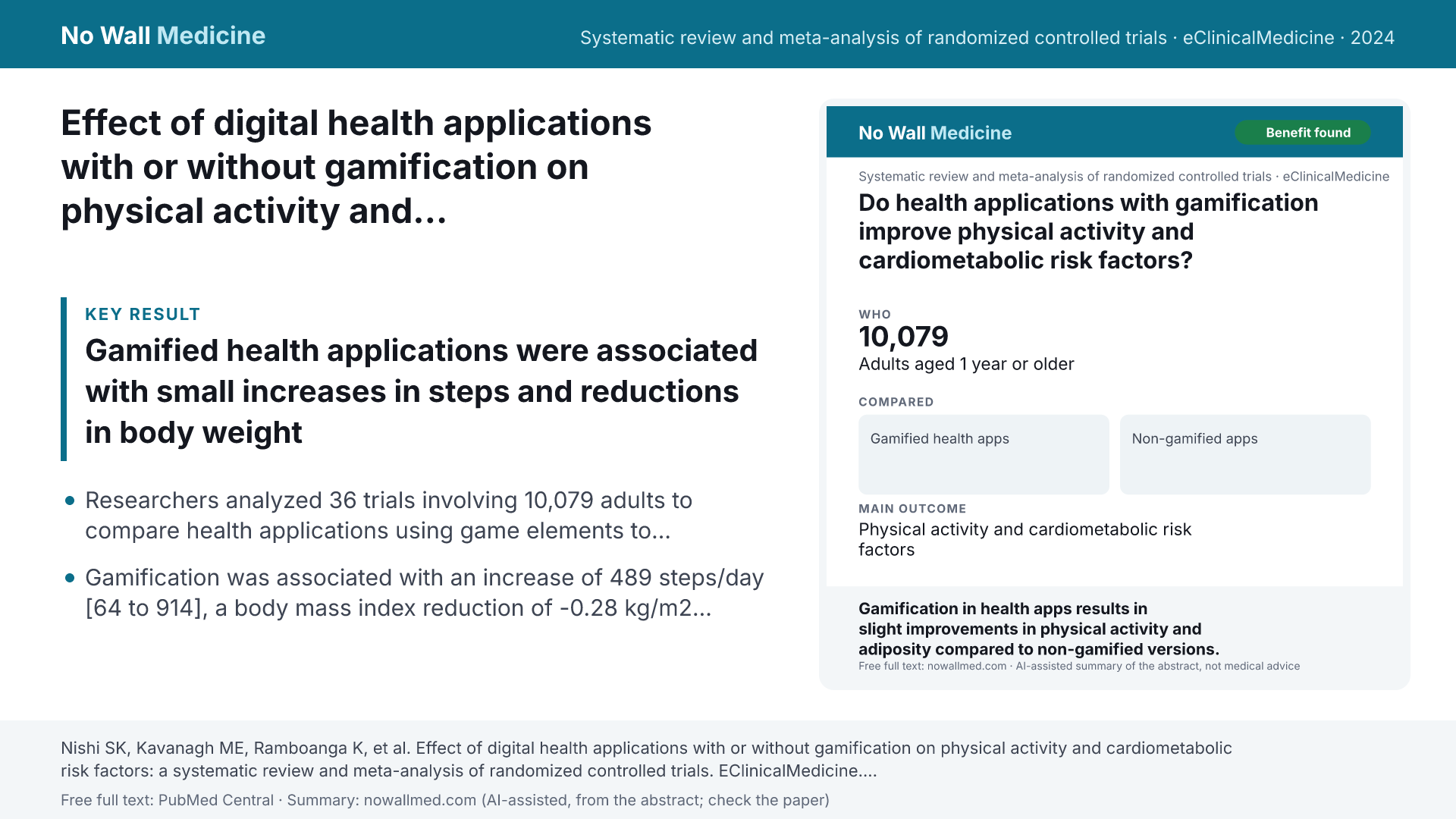
Gamified health applications were associated with small increases in steps and reductions in body weight
Effect of digital health applications with or without gamification on physical activity and cardiometabolic risk factors: a systematic review and meta-analysis of randomized controlled trials
Systematic review and meta-analysis of randomized controlled trialsBenefit found
Do health applications with gamification improve physical activity and cardiometabolic risk factors?
Who
10,079
Adults aged 1 year or older
Compared
Gamified health apps
Non-gamified apps
Main outcome
Physical activity and cardiometabolic risk factors
Result: steps 489 steps/day (95% CI 64 to 914); body mass index -0.28 kg/m2 (95% CI -0.44 to -0.12); body weight -0.70 kg (95% CI -1.18 to -0.22); body fat -1.92% (95% CI -2.71 to -1.14); waist circumference -1.16 cm (95% CI -1.93 to -0.39)
Bottom line: Gamification in health apps results in slight improvements in physical activity and adiposity compared to non-gamified versions.
Limitation: Certainty of evidence for some outcomes was very low to high.
eClinicalMedicine · 2024-09-25Download image
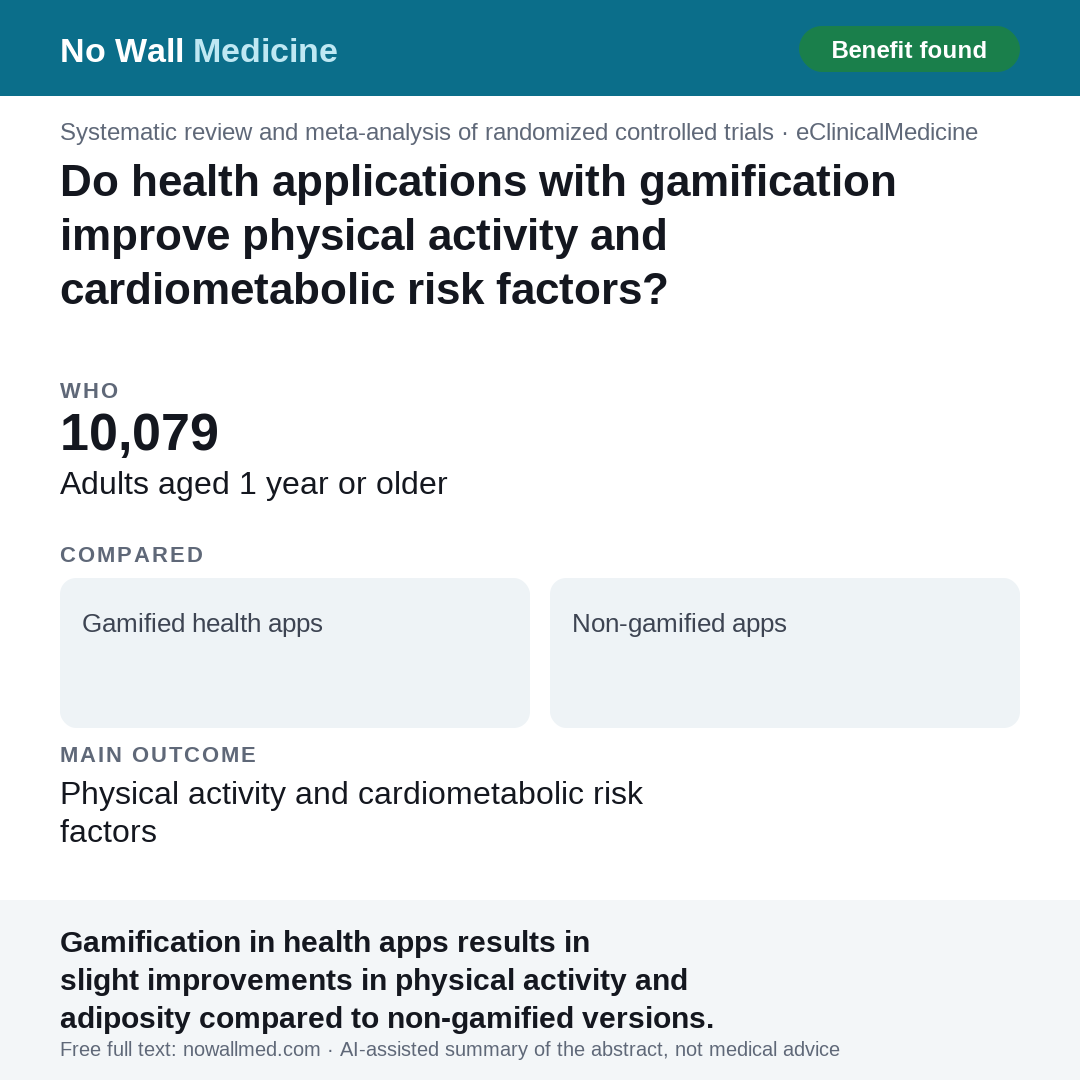
Clinical question: Do health applications with gamification improve physical activity and cardiometabolic risk factors?
Why it matters: It was unknown whether adding game elements to health applications could impact behavior change and cardiometabolic risk factors like blood pressure or blood sugar.
Key points
- Researchers analyzed 36 trials involving 10,079 adults to compare health applications using game elements to those without them.
- Gamification was associated with an increase of 489 steps/day [64 to 914], a body mass index reduction of -0.28 kg/m2 [-0.44 to -0.12], and a body weight reduction of -0.70 kg [-1.18 to -0.22].
- The use of game elements was also associated with reductions in body fat of -1.92% [-2.71 to -1.14] and waist circumference of -1.16 cm [-1.93 to -0.39].
Headline and key points written with AI from the paper’s abstract, with every number checked against it. Read the paper before relying on them.
Was this summary helpful?
Cite this article
Nishi SK, Kavanagh ME, Ramboanga K, et al. Effect of digital health applications with or without gamification on physical activity and cardiometabolic risk factors: a systematic review and meta-analysis of randomized controlled trials. eClinicalMedicine. 2024. doi:10.1016/j.eclinm.2024.102798
Spotted a mistake? Suggest a correction