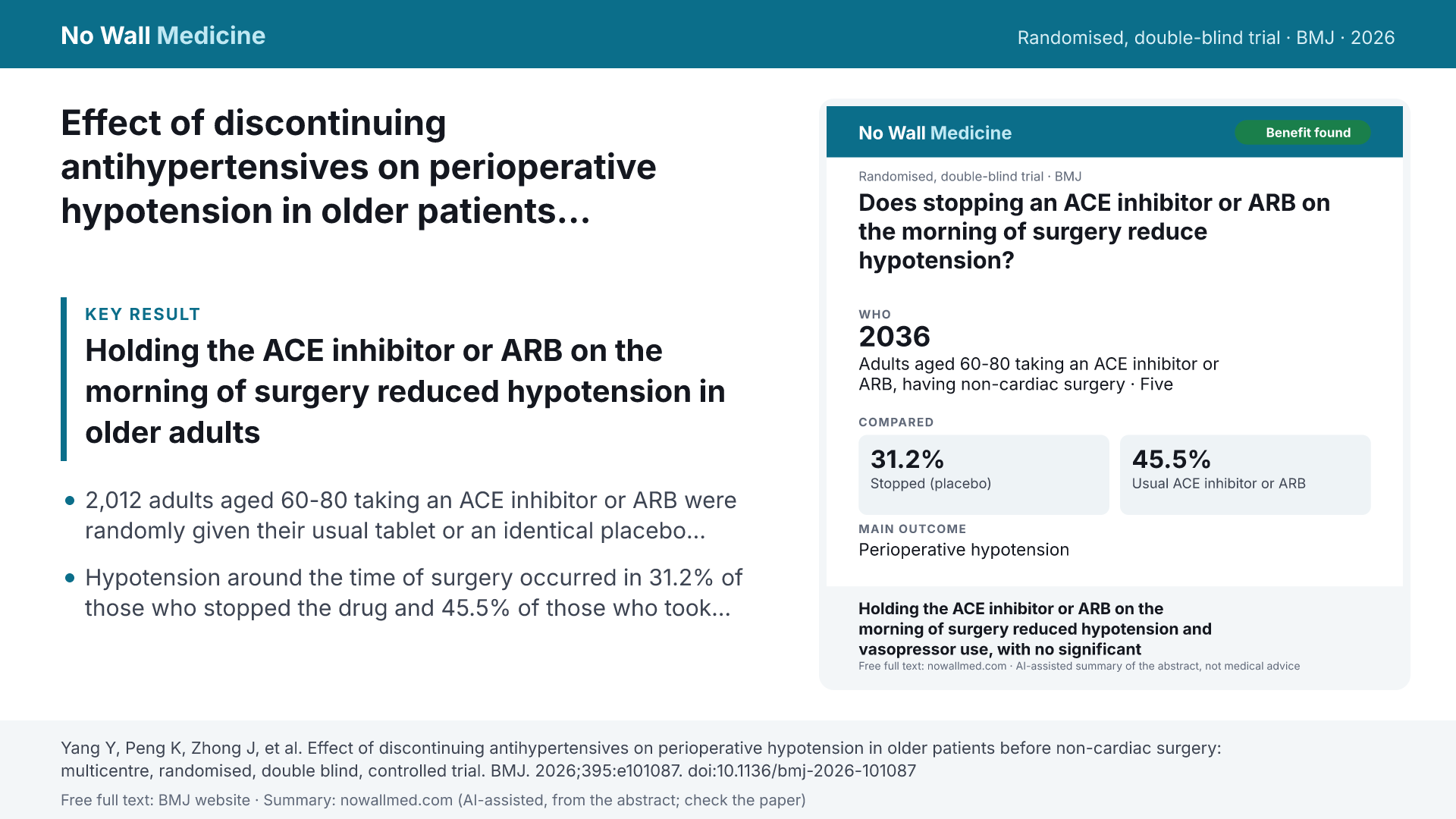
Holding the ACE inhibitor or ARB on the morning of surgery reduced hypotension in older adults
Effect of discontinuing antihypertensives on perioperative hypotension in older patients before non-cardiac surgery: multicentre, randomised, double blind, controlled trial
Randomised, double-blind trialBenefit found
Does stopping an ACE inhibitor or ARB on the morning of surgery reduce hypotension?
Who
2036
Adults aged 60-80 taking an ACE inhibitor or ARB, having non-cardiac surgery · Five hospitals in China
Compared
31.2%Stopped (placebo) (314/1008)
45.5%Usual ACE inhibitor or ARB (457/1004)
Main outcome
Perioperative hypotension
Result: adjusted odds ratio 0.52 (95% CI 0.43 to 0.63)
Bottom line: Holding the ACE inhibitor or ARB on the morning of surgery reduced hypotension and vasopressor use, with no significant difference in 30-day complications or death
BMJ · 2026-11-11 · Save PNG
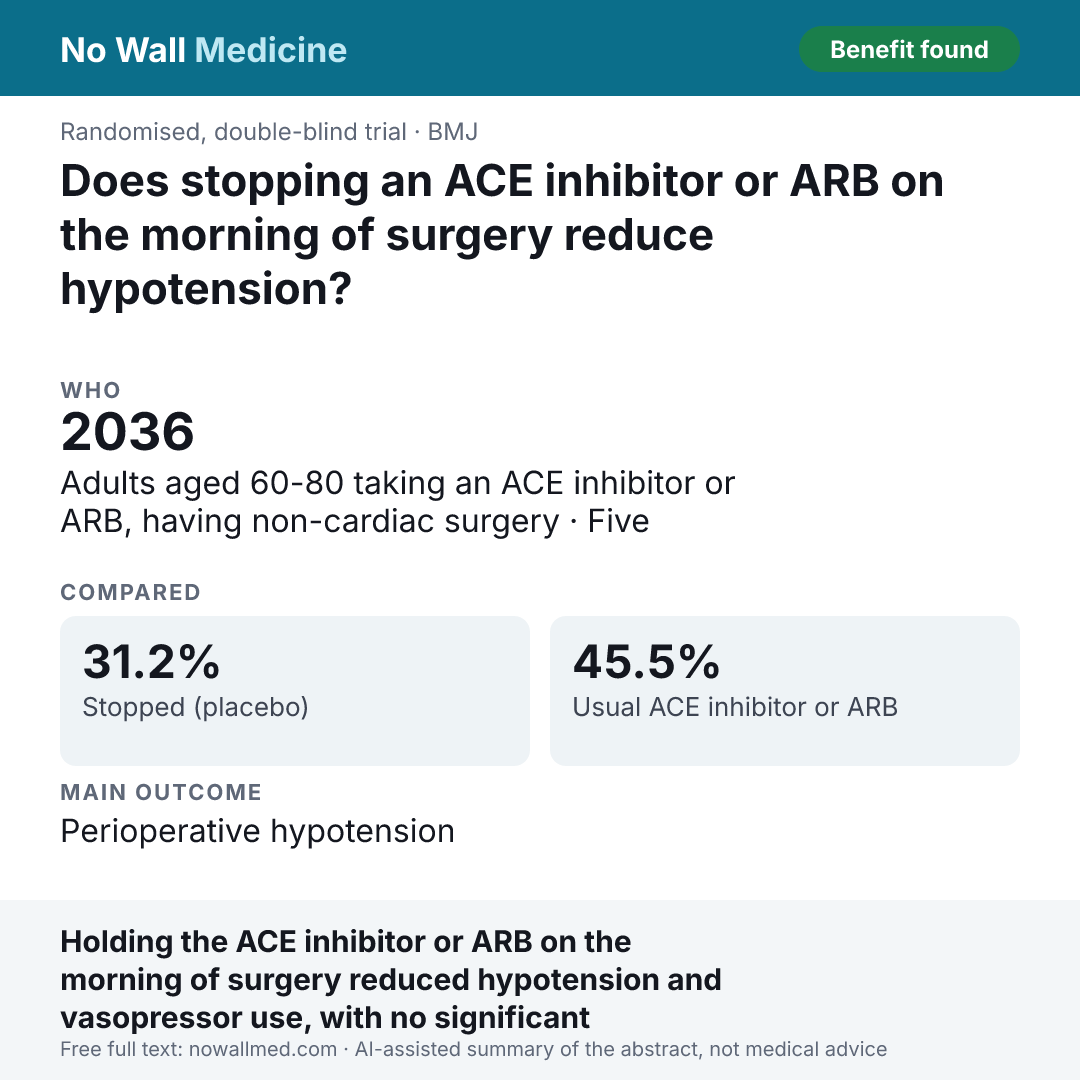
Clinical question: Does stopping an ACE inhibitor or ARB on the morning of surgery reduce hypotension?
Why it matters: A large double-blind trial of a simple pre-operative choice, with no significant difference in 30-day complications or death, in adults aged 60 to 80 having non-cardiac surgery.
In absolute numbers
Stopped (placebo): 31.2% · Usual ACE inhibitor or ARB: 45.5% → a difference of 14.3 percentage points, so about 7 people would need the treatment for 1 more to benefit (number needed to treat) over the trial’s follow-up.
Worked out by us from the two group results above, not reported by the authors. Check the paper for the exact outcome and timing.
Key points
- 2,012 adults aged 60-80 taking an ACE inhibitor or ARB were randomly given their usual tablet or an identical placebo on the morning of non-cardiac surgery.
- Hypotension around the time of surgery occurred in 31.2% of those who stopped the drug and 45.5% of those who took it (adjusted odds ratio 0.52).
- Fewer patients who stopped needed a vasopressor, a drug to raise blood pressure (28.5% versus 41.1%), and 30-day complications and deaths did not differ significantly between groups.
Headline and key points written with AI from the paper’s abstract, with every number checked against it. Read the paper before relying on them.
Was this summary helpful?
Abstract
Objective
To determine whether discontinuing versus continuing angiotensin converting enzyme (ACE) inhibitors or angiotensin receptor blockers (ARBs) on the morning of surgery reduces perioperative hypotension in older patients undergoing non-cardiac surgery. Design
Multicentre, randomised, double blind, placebo controlled trial. Setting
Five tertiary teaching hospitals in China, November 2020 to December 2023. Participants
2036 older patients (60-80 years) using ACE inhibitors or ARBs for at least two weeks and scheduled for non-cardiac surgery under general anaesthesia. Interventions
Patients were randomised to receive their usual ACE inhibitor or ARB or a placebo in identical capsules on the morning of surgery. Main outcome measures
The primary outcome was the incidence of perioperative hypotension (mean blood pressure <65 mm Hg or a ≥30% decrease from baseline requiring treatment). Secondary outcomes included duration of hypotension, requirement for a vasopressor, intraoperative fluid volume, postoperative hypotension, and 30 day complications (neurocognitive disorders, major cardiocerebral events) or mortality. Results
2012 patients (mean age 68.8 years; 54.4% male) completed the study: 1004 were included in the antihypertensive group and 1008 in the no antihypertensive group. The incidence of perioperative hypotension was lower in the no antihypertensive group (314/1008, 31.2%) versus antihypertensive group (457/1004, 45.5%): adjusted odds ratio 0.52 (95% confidence interval (CI) 0.43 to 0.63); absolute risk difference -14.4% (95% CI -18.5% to -10.1%); P<0.001. The duration of hypotension and requirement for a vasopressor were both reduced in the no antihypertensive group: adjusted mean difference -1.3 minutes (95% CI -1.8 to -0.8 minutes) and 28.5% v 41.1%; adjusted odds ratio 0.54 (95% CI 0.44 to 0.66). Intraoperative fluid volume, postoperative hypotension, 30 day complications, and mortality did not differ significantly between groups. Conclusions
Discontinuing ACE inhibitors or ARBs on the morning of surgery in older patients with hypertension statistically significantly reduced perioperative hypotension and the requirement for vasopressors without increasing 30 day complications or mortality. This simple strategy provides high certainty evidence for preoperative drug management in this patient population. Trial registration
Chinese Clinical Trial Registry ChiCTR2000039376.
Abstract reproduced under the article’s CC BY NC licence.
Subject terms
Headline, design, result, key points, caveat and citation as plain text.
Cite this article
Yang Y, Peng K, Zhong J, et al. Effect of discontinuing antihypertensives on perioperative hypotension in older patients before non-cardiac surgery: multicentre, randomised, double blind, controlled trial. BMJ. 2026;395:e101087. doi:10.1136/bmj-2026-101087
Spotted a mistake? Suggest a correction