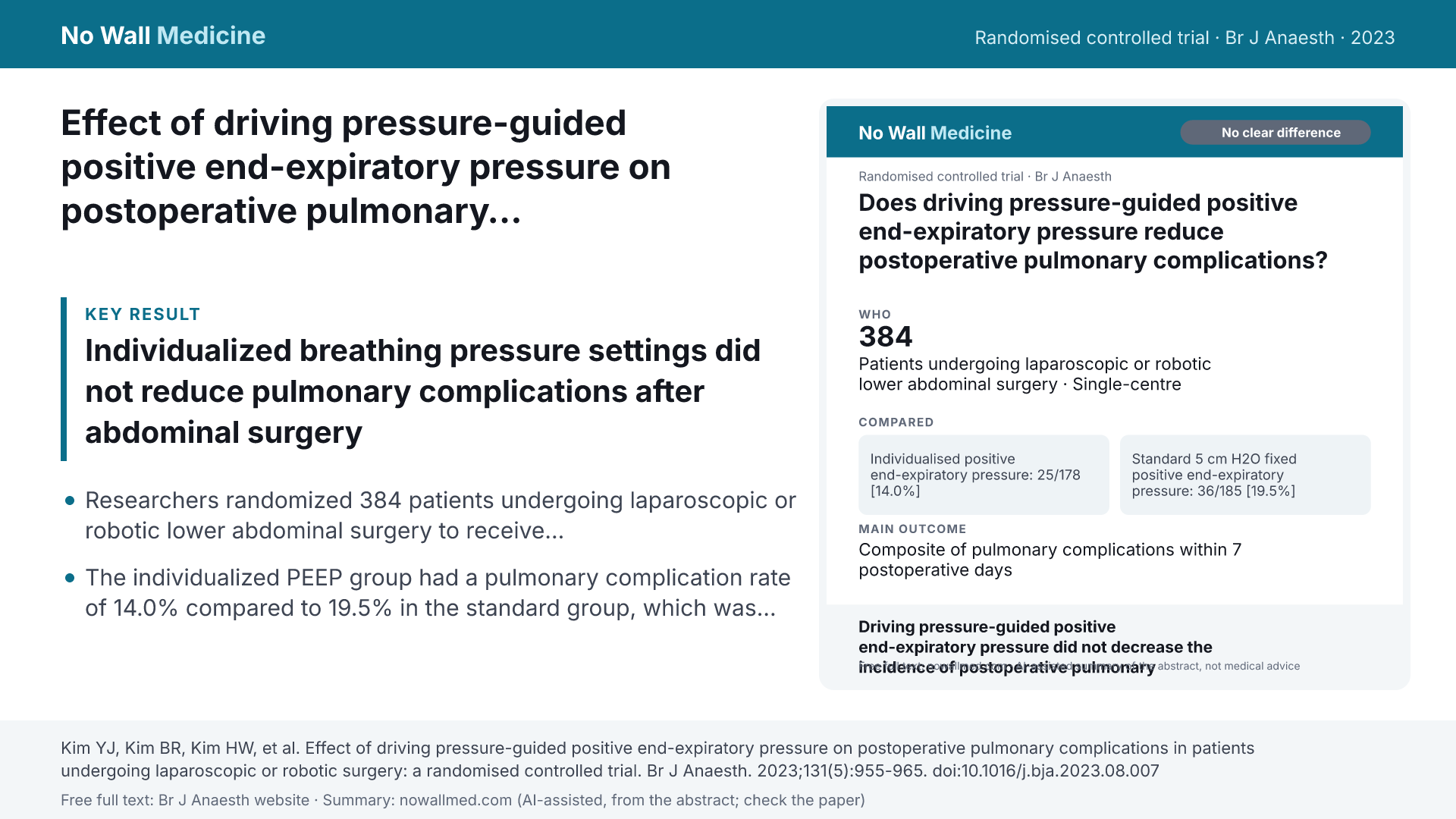
Individualized breathing pressure settings did not reduce pulmonary complications after abdominal surgery
Effect of driving pressure-guided positive end-expiratory pressure on postoperative pulmonary complications in patients undergoing laparoscopic or robotic surgery: a randomised controlled trial
Randomised controlled trialNo clear difference
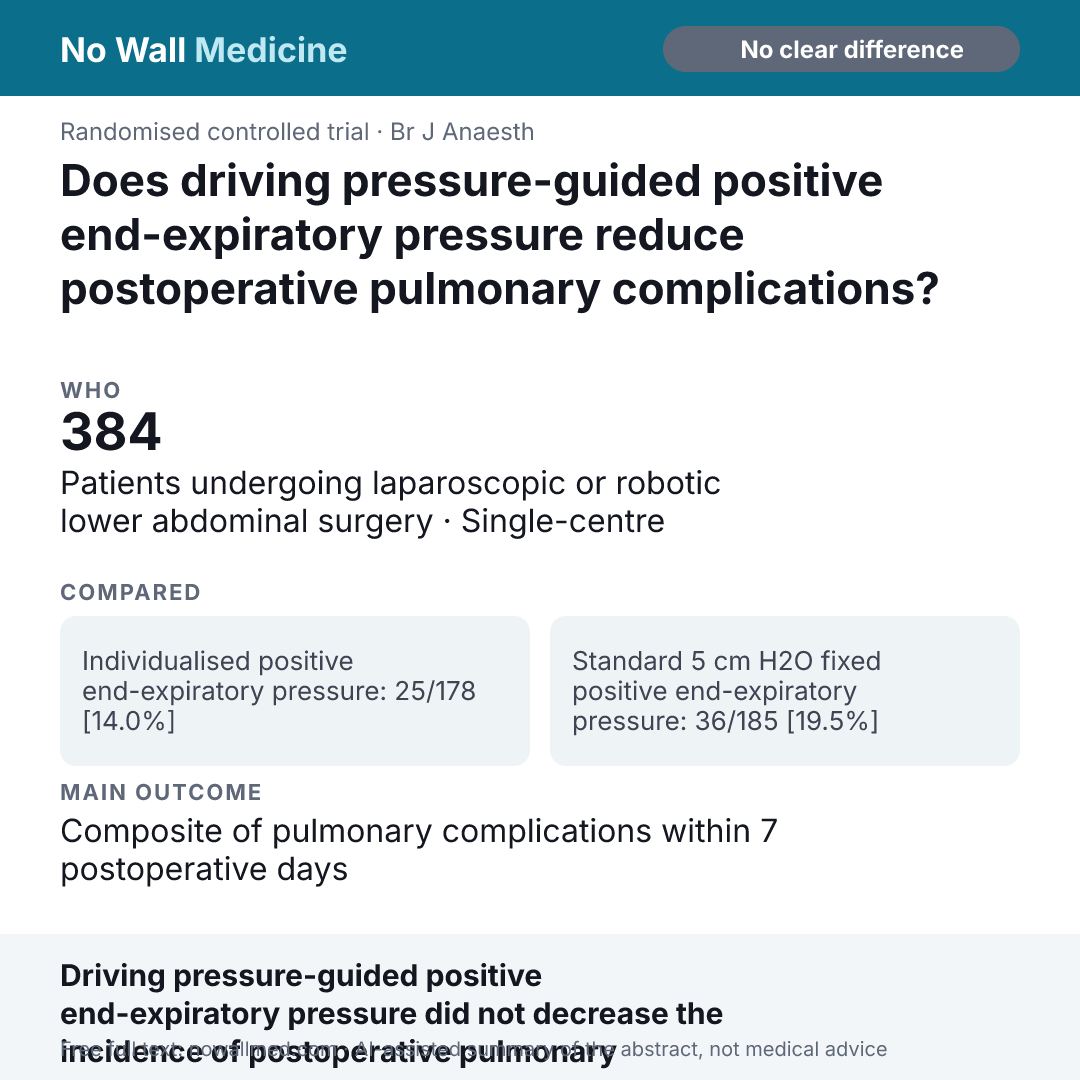
Does driving pressure-guided positive end-expiratory pressure reduce postoperative pulmonary complications?
Who
384
Patients undergoing laparoscopic or robotic lower abdominal surgery · Single-centre
Compared
Individualised positive end-expiratory pressure: 25/178 [14.0%]
Standard 5 cm H2O fixed positive end-expiratory pressure: 36/185 [19.5%]
Main outcome
Composite of pulmonary complications within 7 postoperative days
Result: risk ratio 0.72 (95% CI 0.45-1.15)
Bottom line: Driving pressure-guided positive end-expiratory pressure did not decrease the incidence of postoperative pulmonary complications.
Limitation: Lower than anticipated event rate for the primary outcome.
Br J Anaesth · 2023-09-09 · Save PNG
Clinical question: Does driving pressure-guided positive end-expiratory pressure reduce postoperative pulmonary complications?
Key points
- Researchers randomized 384 patients undergoing laparoscopic or robotic lower abdominal surgery to receive either individualized positive end-expiratory pressure (PEEP) or a fixed 5 cm H2O PEEP.
- The individualized PEEP group had a pulmonary complication rate of 14.0% compared to 19.5% in the standard group, which was not a statistically significant difference.
- Pulmonary complications caused by desaturation, or low blood oxygen levels, were less frequent in the individualized PEEP group at 4.5% compared to 16.2% in the standard group.
Limitation the authors note: The authors noted uncertainty due to a lower than anticipated event rate for the primary outcome.
Headline and key points written with AI from the paper’s abstract, with every number checked against it. Read the paper before relying on them.
Was this summary helpful?
Subject terms
Headline, design, result, key points, caveat and citation as plain text.
Cite this article
Kim YJ, Kim BR, Kim HW, et al. Effect of driving pressure-guided positive end-expiratory pressure on postoperative pulmonary complications in patients undergoing laparoscopic or robotic surgery: a randomised controlled trial. Br J Anaesth. 2023;131(5):955-965. doi:10.1016/j.bja.2023.08.007
Spotted a mistake? Suggest a correction