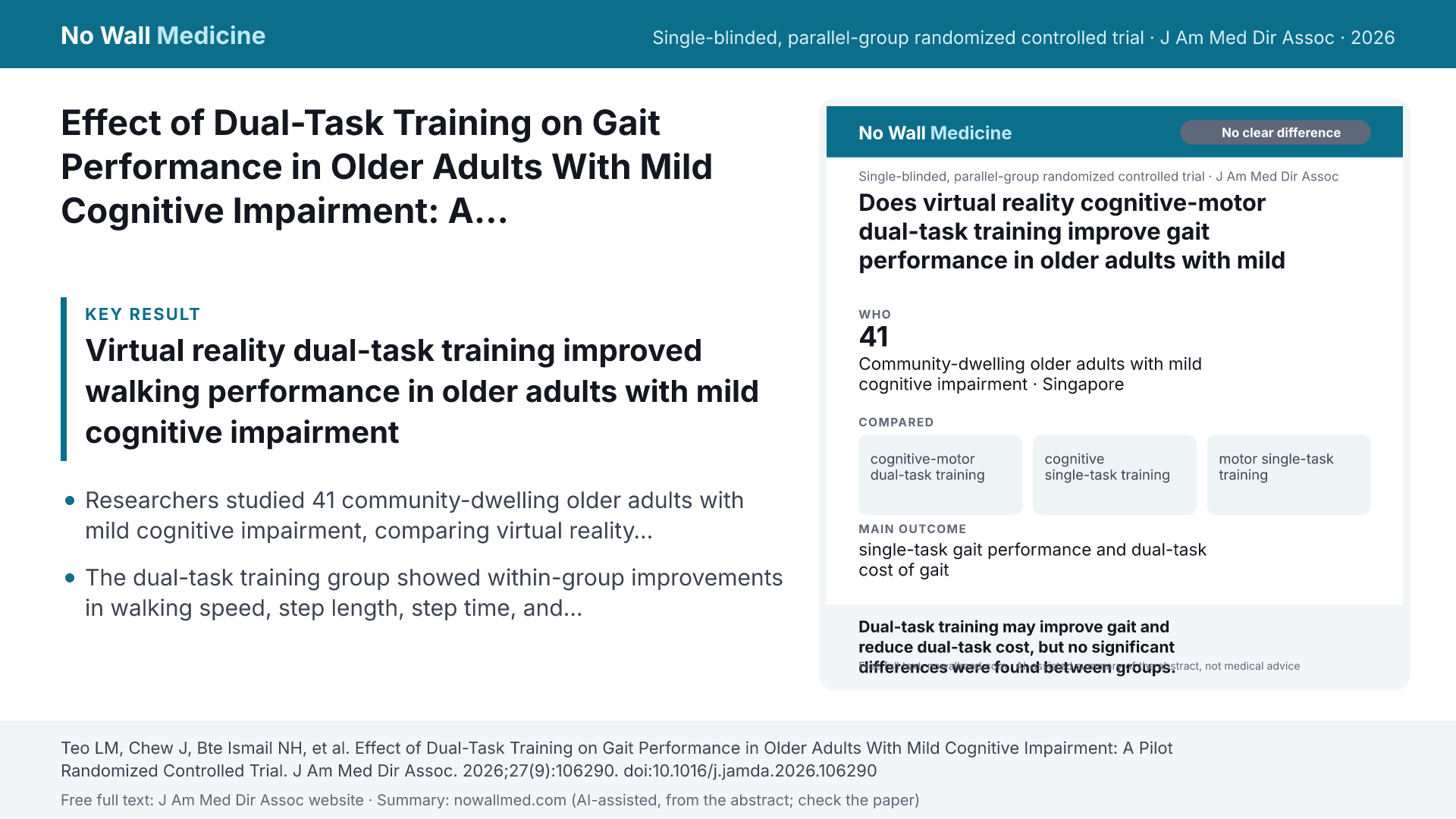
Virtual reality dual-task training improved walking performance in older adults with mild cognitive impairment
Effect of Dual-Task Training on Gait Performance in Older Adults With Mild Cognitive Impairment: A Pilot Randomized Controlled Trial
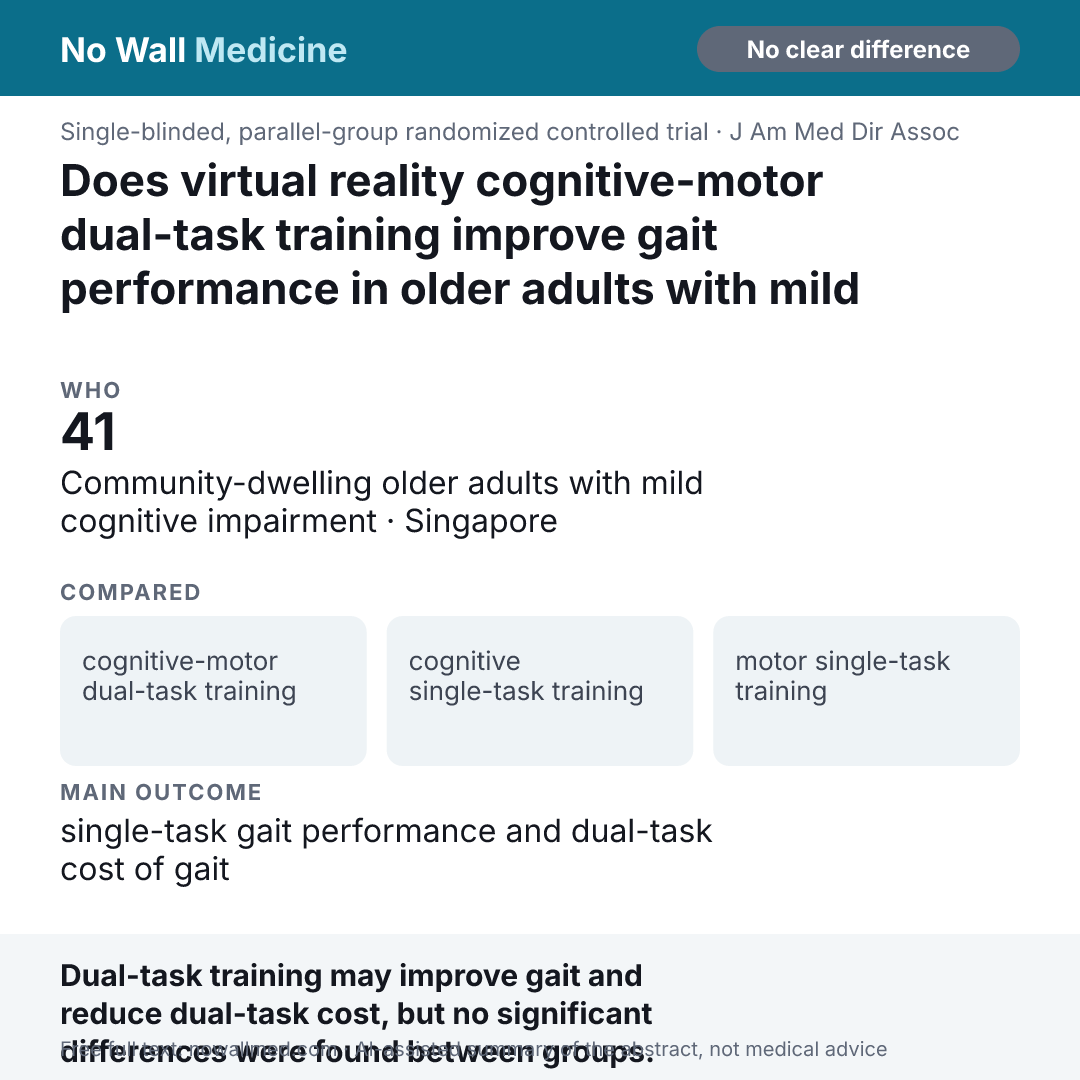
Single-blinded, parallel-group randomized controlled trialNo clear difference
Does virtual reality cognitive-motor dual-task training improve gait performance in older adults with mild cognitive impairment?
Who
41
Community-dwelling older adults with mild cognitive impairment · Singapore
Compared
cognitive-motor dual-task training
cognitive single-task training
motor single-task training
Main outcome
single-task gait performance and dual-task cost of gait
Bottom line: Dual-task training may improve gait and reduce dual-task cost, but no significant differences were found between groups.
J Am Med Dir Assoc · 2026-07-20 · Save PNG
Clinical question: Does virtual reality cognitive-motor dual-task training improve gait performance in older adults with mild cognitive impairment?
Key points
- Researchers studied 41 community-dwelling older adults with mild cognitive impairment, comparing virtual reality dual-task training to single-task cognitive and motor training.
- The dual-task training group showed within-group improvements in walking speed, step length, step time, and double-support time that lasted for 6 months.
- While the dual-task group saw reductions in dual-task cost, which is the performance drop when performing two tasks at once, between-group comparisons showed no significant difference.
Headline and key points written with AI from the paper’s abstract, with every number checked against it. Read the paper before relying on them.
Was this summary helpful?
Subject terms
Headline, design, result, key points, caveat and citation as plain text.
Cite this article
Teo LM, Chew J, Bte Ismail NH, et al. Effect of Dual-Task Training on Gait Performance in Older Adults With Mild Cognitive Impairment: A Pilot Randomized Controlled Trial. J Am Med Dir Assoc. 2026;27(9):106290. doi:10.1016/j.jamda.2026.106290
Spotted a mistake? Suggest a correction