Electroencephalogram-guided anesthesia was not associated with lower one-year mortality after surgery
Effect of electroencephalogram-guided anaesthesia administration on 1-yr mortality: follow-up of a randomised clinical trial
Randomized clinical trialNo clear difference
Does electroencephalogram-guided anaesthesia administration reduce 1-year mortality?
Who
1232
Subjects aged 60 years or older undergoing general anaesthesia · Single-centre
Compared
Electroencephalogram-guided anaesthesia: 57/591 (9.6%)
Usual care: 62/601 (10.3%)
Main outcome
All-cause 1-year mortality
Result: adjusted absolute risk difference, -0.7% (99.5% confidence interval, -5.8% to 4.3%)
Bottom line: Electroencephalogram-guided anaesthesia did not significantly decrease 1-year mortality compared to usual care.
Br J Anaesth · 2021-07-07Download image
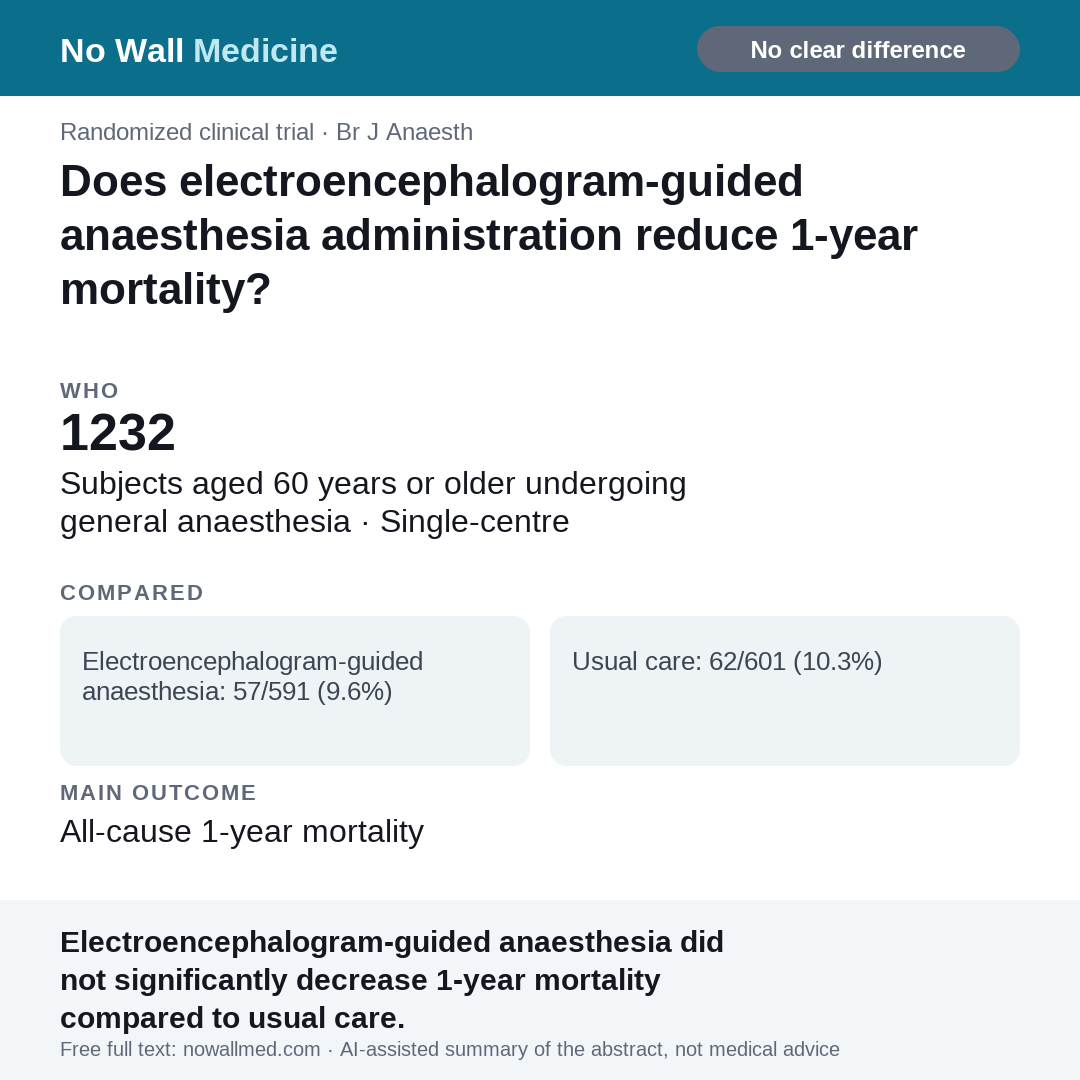
Clinical question: Does electroencephalogram-guided anaesthesia administration reduce 1-year mortality?
Why it matters: It was unknown whether titrating anesthesia using electroencephalogram monitoring to avoid brain wave suppression would influence one-year mortality rates.
Key points
- Researchers followed 1232 subjects aged 60 years or older who underwent surgery under general anesthesia and were randomized to either electroencephalogram-guided anesthesia or usual care.
- One-year mortality was 9.6% in the guided group and 10.3% in the usual-care group, which was not a statistically significant difference.
- The adjusted absolute risk difference for mortality was -0.7% with a 99.5% confidence interval of -5.8% to 4.3%.
Limitation the authors note: The study was a single-centre randomized clinical trial.
Headline and key points written with AI from the paper’s abstract, with every number checked against it. Read the paper before relying on them.
Was this summary helpful?
Subject terms
Cite this article
Fritz BA, King CR, Mickle AM, Wildes TS, Budelier TP, Oberhaus J. Effect of electroencephalogram-guided anaesthesia administration on 1-yr mortality: follow-up of a randomised clinical trial. Br J Anaesth. 2021. doi:10.1016/j.bja.2021.04.036
Spotted a mistake? Suggest a correction
Top studies every Monday
The week’s key trials and guidelines in your specialties, plus any topics you follow. By email, free.
Get the weekly digest