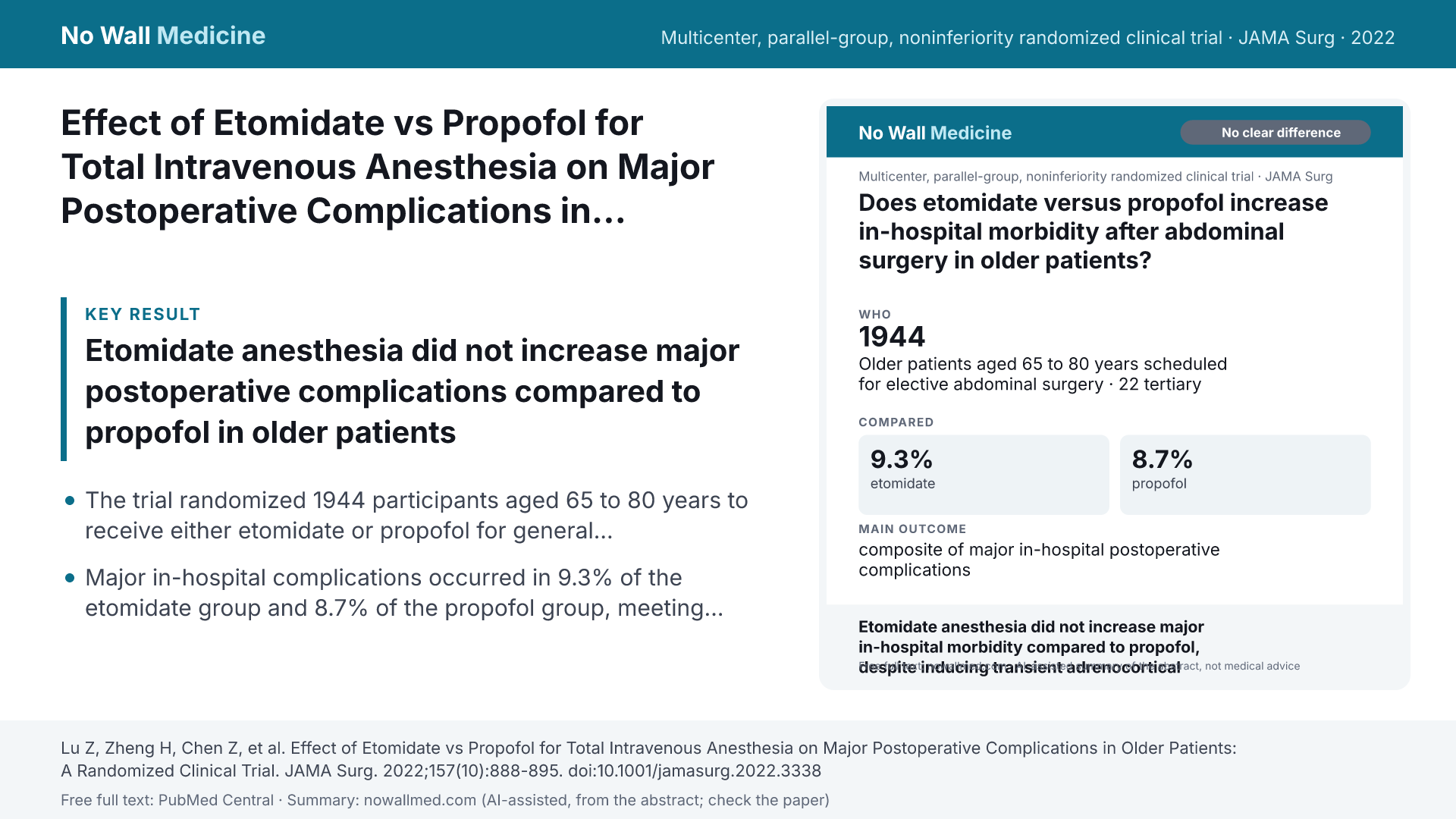
Etomidate anesthesia did not increase major postoperative complications compared to propofol in older patients
Effect of Etomidate vs Propofol for Total Intravenous Anesthesia on Major Postoperative Complications in Older Patients: A Randomized Clinical Trial
Multicenter, parallel-group, noninferiority randomized clinical trialNo clear difference
Does etomidate versus propofol increase in-hospital morbidity after abdominal surgery in older patients?
Who
1944
Older patients aged 65 to 80 years scheduled for elective abdominal surgery · 22 tertiary hospitals in China
Compared
9.3%etomidate (90/967)
8.7%propofol (83/950)
Main outcome
composite of major in-hospital postoperative complications
Result: risk difference 0.6% (95% CI, -1.6% to 2.7%)
Bottom line: Etomidate anesthesia did not increase major in-hospital morbidity compared to propofol, despite inducing transient adrenocortical suppression.
JAMA Surg · 2022-08-11Download image
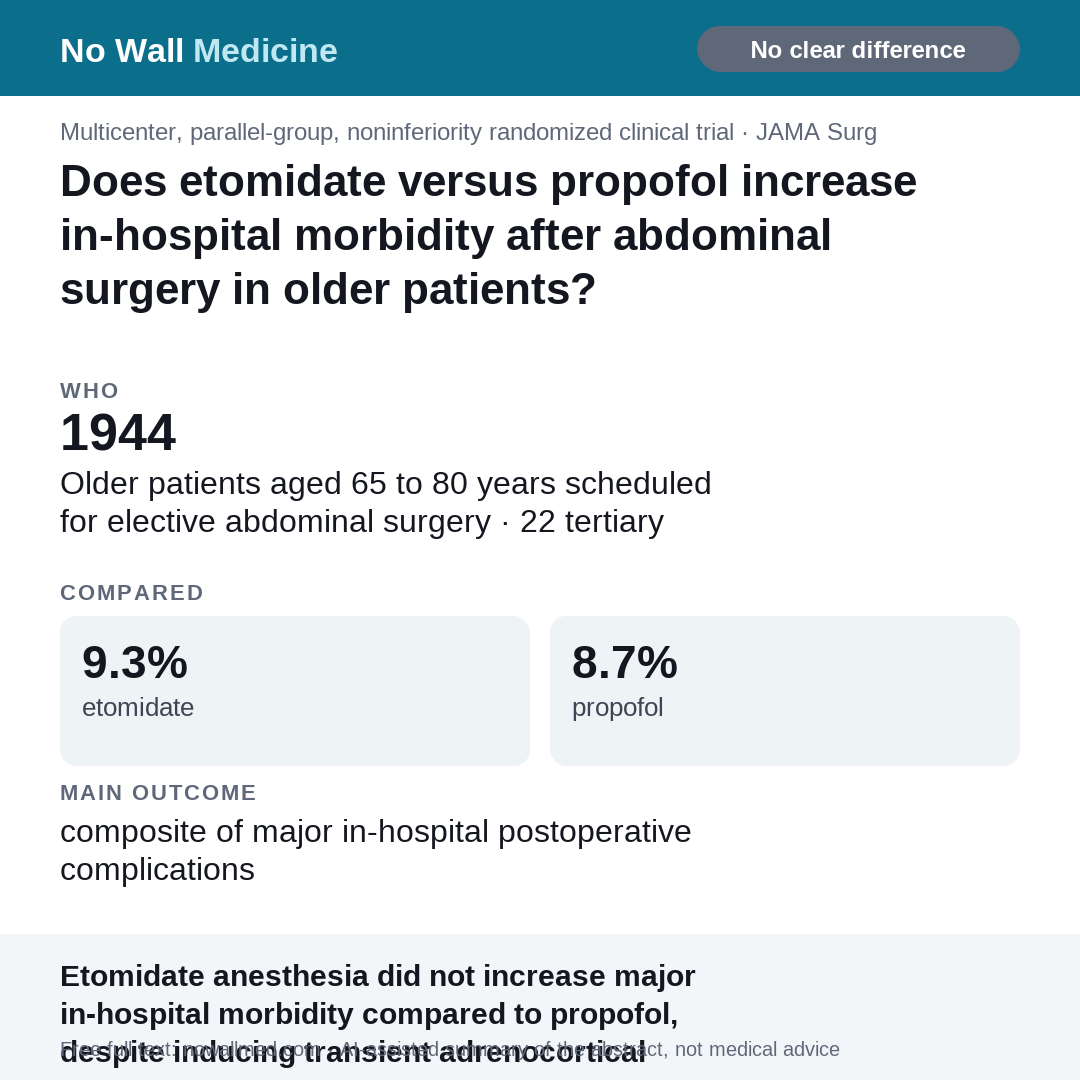
Clinical question: Does etomidate versus propofol increase in-hospital morbidity after abdominal surgery in older patients?
Key points
- The trial randomized 1944 participants aged 65 to 80 years to receive either etomidate or propofol for general anesthesia during elective abdominal surgery.
- Major in-hospital complications occurred in 9.3% of the etomidate group and 8.7% of the propofol group, meeting the noninferiority criterion.
- Etomidate was associated with lower cortisol and aldosterone levels and a higher rate of pneumonia at 2.0% compared to 0.3% for propofol.
Headline and key points written with AI from the paper’s abstract, with every number checked against it. Read the paper before relying on them.
Was this summary helpful?
Subject terms
Headline, design, result, key points, caveat and citation as plain text.
Cite this article
Lu Z, Zheng H, Chen Z, et al. Effect of Etomidate vs Propofol for Total Intravenous Anesthesia on Major Postoperative Complications in Older Patients: A Randomized Clinical Trial. JAMA Surg. 2022. doi:10.1001/jamasurg.2022.3338
Spotted a mistake? Suggest a correction