Haemoadsorption was not associated with better outcomes for patients with Staphylococcus aureus endocarditis
Effect of haemoadsorption during cardiac surgery for Staphylococcus aureus endocarditis: a REMOVE trial post hoc analysis
Post hoc analysis of a randomized trialNo clear difference
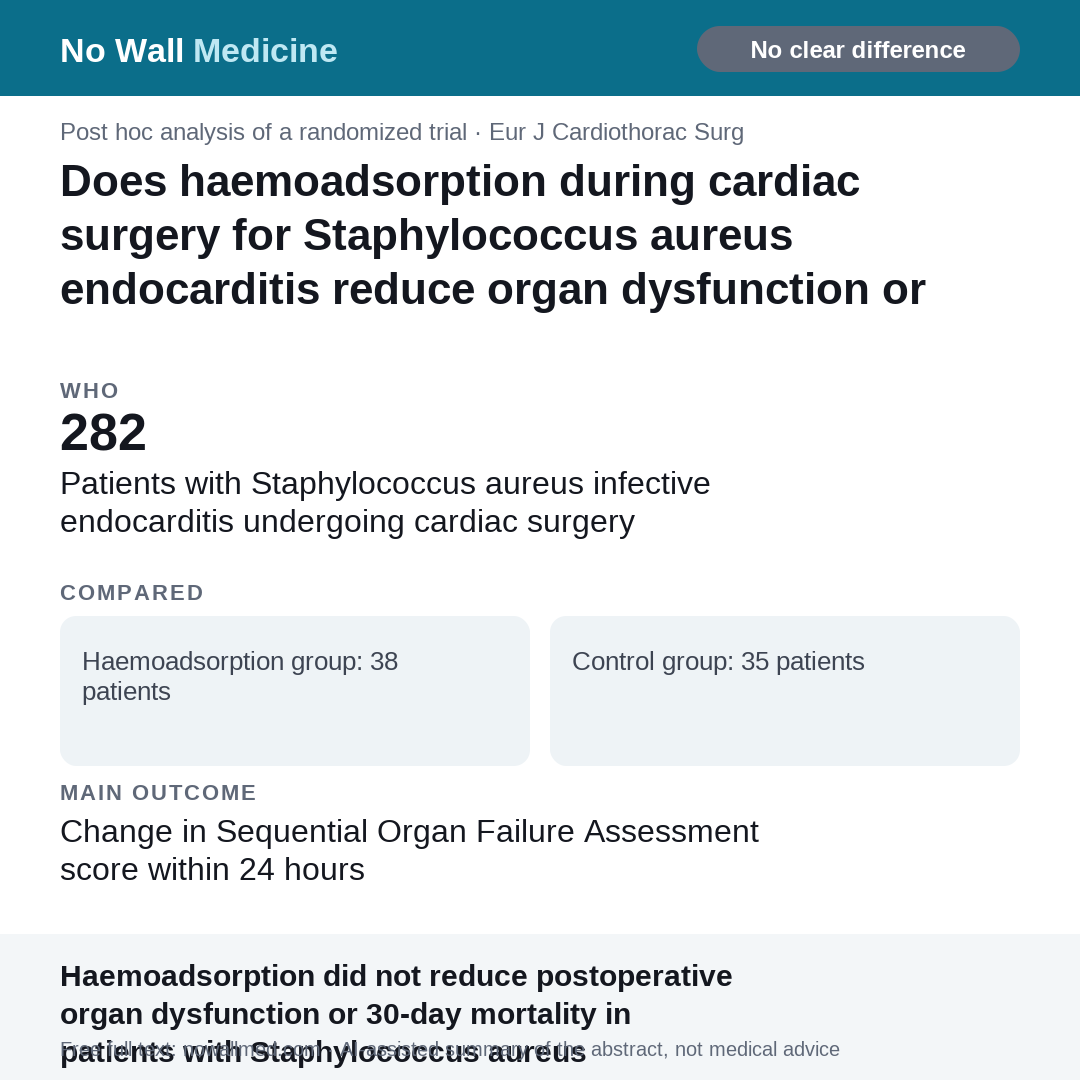
Does haemoadsorption during cardiac surgery for Staphylococcus aureus endocarditis reduce organ dysfunction or mortality?
Who
282
Patients with Staphylococcus aureus infective endocarditis undergoing cardiac surgery
Compared
Haemoadsorption group: 38 patients
Control group: 35 patients
Main outcome
Change in Sequential Organ Failure Assessment score within 24 hours
Result: mean difference -0.4 (95% confidence interval -2.3 to 1.4)
Bottom line: Haemoadsorption did not reduce postoperative organ dysfunction or 30-day mortality in patients with Staphylococcus aureus endocarditis.
Eur J Cardiothorac Surg · 2024-03-10Download image
Clinical question: Does haemoadsorption during cardiac surgery for Staphylococcus aureus endocarditis reduce organ dysfunction or mortality?
Why it matters: It was unknown if haemoadsorption provides benefits for the specific subgroup of patients with Staphylococcus aureus endocarditis, which is a known predictor of mortality.
Key points
- Researchers analyzed 282 patients from the REMOVE trial, including 73 patients with Staphylococcus aureus endocarditis, comparing haemoadsorption to a control group.
- The use of haemoadsorption was not associated with a difference in the change in Sequential Organ Failure Assessment scores, which measures organ dysfunction, within 24 hours.
- There were no differences observed between the groups regarding 30-day mortality or other secondary clinical outcomes.
Headline and key points written with AI from the paper’s abstract, with every number checked against it. Read the paper before relying on them.
Topics
Cite this article
Caldonazo T, Van den Eynde J, Doenst T, Kirov H, Franz M, Hagel S. Effect of haemoadsorption during cardiac surgery for Staphylococcus aureus endocarditis: a REMOVE trial post hoc analysis. Eur J Cardiothorac Surg. 2024. doi:10.1093/ejcts/ezae093
Spotted a mistake? Suggest a correction
Top studies every Monday
The week’s key trials and guidelines in your specialties, plus any topics you follow. By email, free.
Get the weekly digest