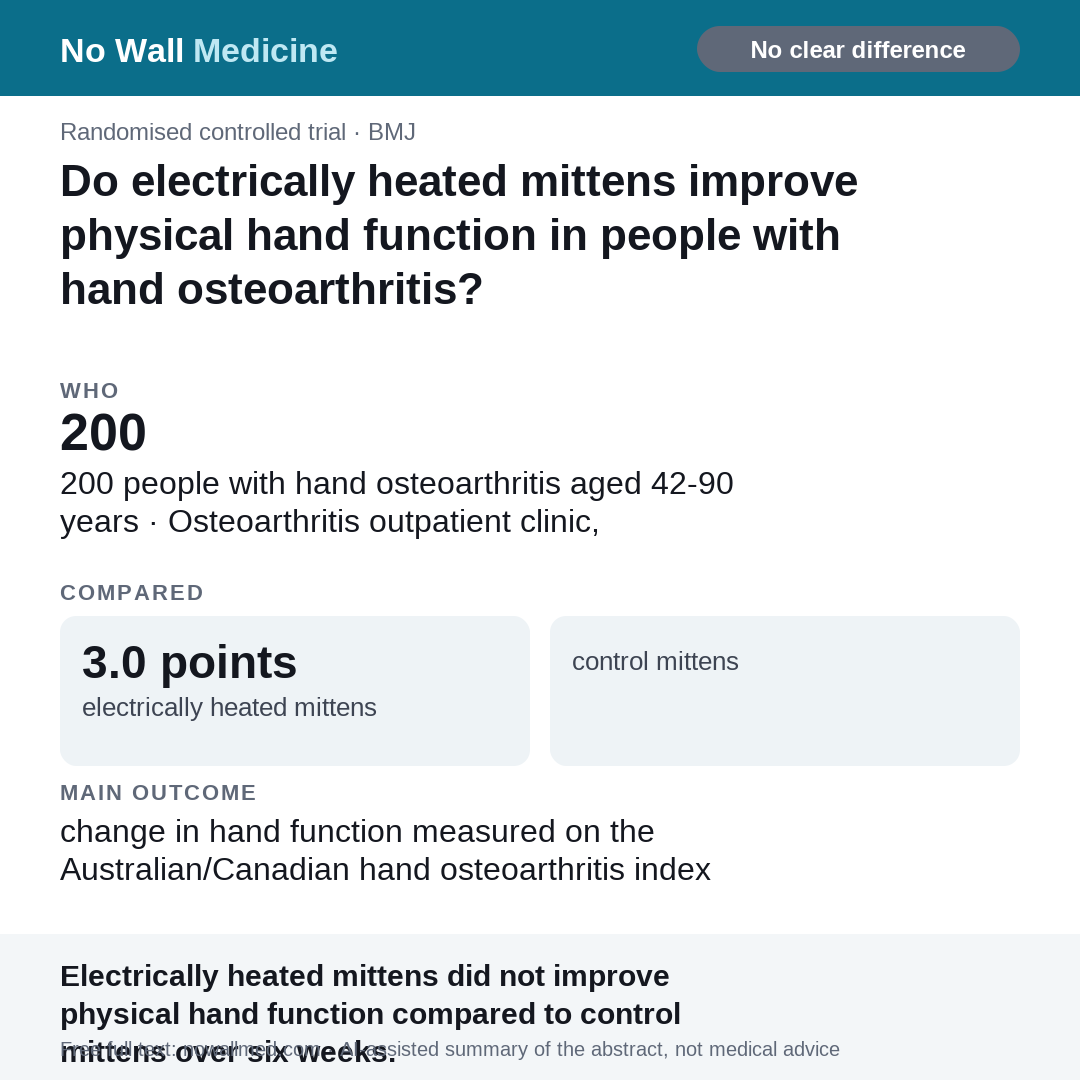
Electrically heated mittens did not improve physical hand function in people with hand osteoarthritis
Effect of heated mittens on physical hand function in people with hand osteoarthritis: randomised controlled trial
Randomised controlled trialNo clear difference
Do electrically heated mittens improve physical hand function in people with hand osteoarthritis?
Who
200
200 people with hand osteoarthritis aged 42-90 years · Osteoarthritis outpatient clinic, Copenhagen, Denmark
Compared
3.0 pointselectrically heated mittens (95% confidence interval -0.4 to 6.3)
control mittens
Main outcome
change in hand function measured on the Australian/Canadian hand osteoarthritis index
Result: 3.0 points (95% confidence interval -0.4 to 6.3)
Bottom line: Electrically heated mittens did not improve physical hand function compared to control mittens over six weeks.
BMJ · 2024-12-17Download image
Clinical question: Do electrically heated mittens improve physical hand function in people with hand osteoarthritis?
Why it matters: It is unclear if using electrically heated mittens can improve physical hand function or reduce pain for people living with hand osteoarthritis.
Key points
- Researchers conducted a randomized controlled trial with 200 people aged 42-90 years to compare electrically heated mittens with control mittens worn for 15 minutes daily.
- The difference in hand function scores at six weeks between groups was 3.0 points (95% CI -0.4 to 6.3; P=0.09), which was not statistically significant.
- Heated mittens showed a 5.9 point difference (95% CI 2.2 to 9.5) in hand pain scores, but no differences were found for grip strength or global problem ratings.
Headline and key points written with AI from the paper’s abstract, with every number checked against it. Read the paper before relying on them.
Abstract
Objective
To assess the effect of electrically heated mittens on physical hand function in people with osteoarthritis of the hands compared with control mittens. Design
Randomised controlled trial. Setting
Osteoarthritis outpatient clinic, Copenhagen, Denmark. Participants
200 people with hand osteoarthritis aged 42-90 years. 100 participants were assigned to the intervention group and 100 to the control group. Interventions
Electrically heated mittens or control mittens (heating elements disconnected) worn for at least 15 minutes daily for six weeks. Main outcome measures
The primary outcome was change in hand function measured on the function subscale of the Australian/Canadian hand osteoarthritis index (AUSCAN; score 0-100 points) at six weeks. Key secondary outcomes included changes in the AUSCAN hand pain subscale (score 0-100 points), global rating of hand osteoarthritis related problems (0-100 visual analogue scale), and grip strength (newtons) at six weeks. Analysis of secondary outcomes was performed using a hierarchical gatekeeping approach. Results
91 participants in the intervention group and 95 in the control group completed the trial. The mean age of participants was 71 years, 87% (n=173) were women, and mean body mass index was 24.9 (SD 4.4). Median disease duration was 10 years (interquartile range 5-15 years). The between group difference for change in AUSCAN function at week 6 was 3.0 points (95% confidence interval (CI) -0.4 to 6.3; P=0.09) in favour of heated mittens. For the key secondary outcome, change in AUSCAN hand pain score from baseline, a group difference was observed of 5.9 points (95% CI 2.2 to 9.5) in favour of heated mittens. Changes in global rating of hand osteoarthritis related problems and grip strength did not differ between the groups with an observed difference between groups of 2.8 points (95% CI -3.7 to 9.2) and 2.3 newtons (95% CI -16.3 to 21.0) in favour of heated mittens, respectively. Conclusion
Use of electrically heated mittens for six weeks was not related to a positive change in physical hand function compared with control mittens. Heated mittens provided no additional benefits on global rating of hand osteoarthritis related problems and grip strength. A small benefit was detected for hand pain, but this could have been overestimated. Trial registration
ClinicalTrials.gov NCT04576403.
Abstract reproduced under the article’s CC BY NC licence.
Topics
Cite this article
Bartholdy C, Døssing A, Stisen ZR, Nielsen SM, Christensen R, Danneskiold-Samsøe B. Effect of heated mittens on physical hand function in people with hand osteoarthritis: randomised controlled trial. BMJ. 2024. doi:10.1136/bmj-2023-078222
Spotted a mistake? Suggest a correction