High-flow nasal cannula therapy was noninferior to continuous positive airway pressure for liberating children from respiratory support
Effect of High-Flow Nasal Cannula Therapy vs Continuous Positive Airway Pressure Therapy on Liberation From Respiratory Support in Acutely Ill Children Admitted to Pediatric Critical Care Units: A Randomized Clinical Trial
Pragmatic, multicenter, randomized noninferiority clinical trialBenefit found
Is high-flow nasal cannula therapy noninferior to continuous positive airway pressure for liberation from respiratory support?
Who
600
Acutely ill children aged 0 to 15 years · 24 pediatric critical care units in the United Kingdom
Compared
High-flow nasal cannula therapy: 52.9 hours (95% CI, 46.0-60.9 hours)
Continuous positive airway pressure: 47.9 hours (95% CI, 40.5-55.7 hours)
Main outcome
Time from randomization to liberation from respiratory support
Result: adjusted hazard ratio 1.03 [1-sided 95% CI, 0.86-∞]
Bottom line: High-flow nasal cannula therapy is noninferior to continuous positive airway pressure for liberation from respiratory support in acutely ill children.
JAMA · 2022-06-17Download image
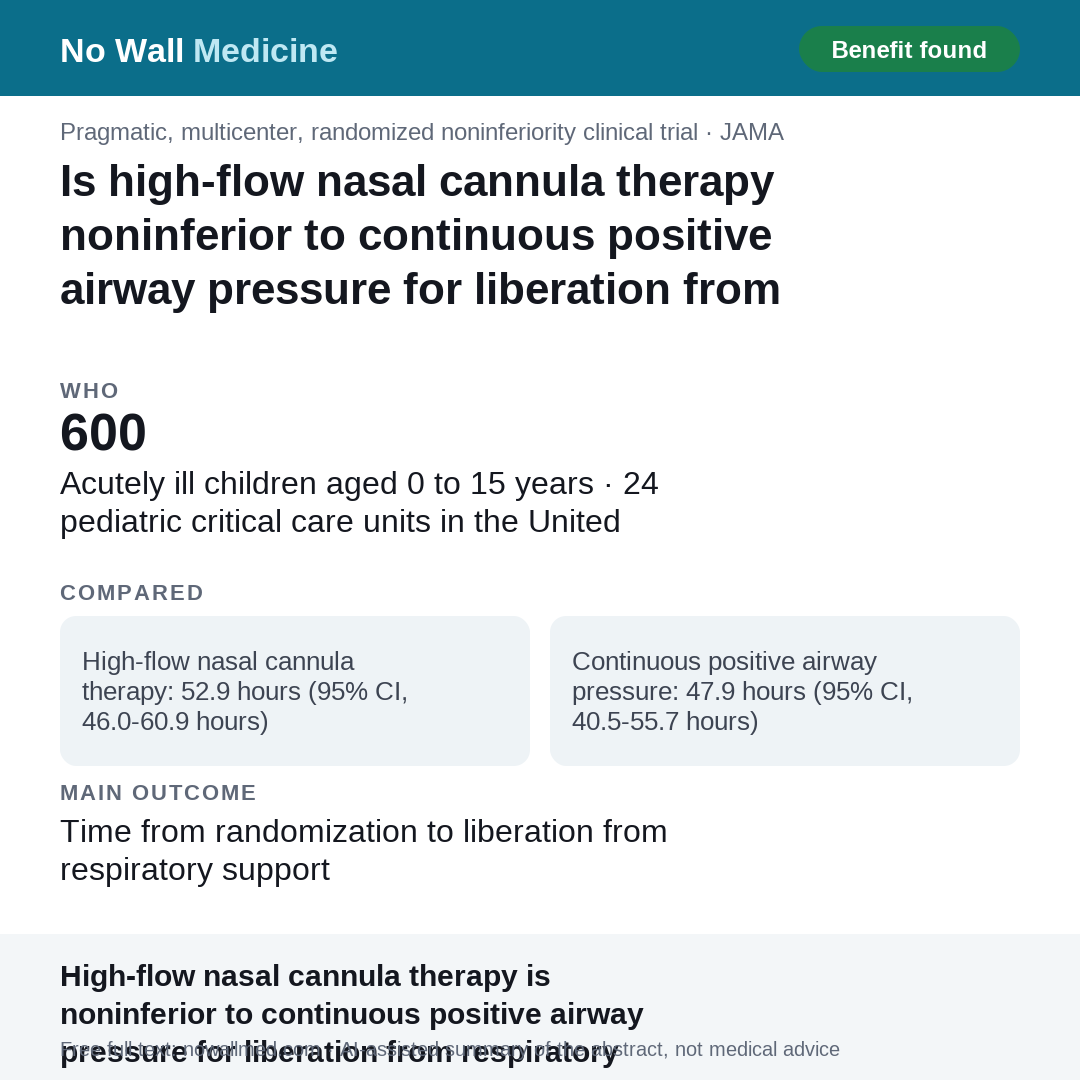
Clinical question: Is high-flow nasal cannula therapy noninferior to continuous positive airway pressure for liberation from respiratory support?
Why it matters: The optimal first-line mode of noninvasive respiratory support for acutely ill children is not known.
Key points
- Researchers randomized 573 acutely ill children aged 0 to 15 years to receive either high-flow nasal cannula therapy or continuous positive airway pressure.
- The median time to liberation from respiratory support was 52.9 hours for high-flow nasal cannula therapy versus 47.9 hours for continuous positive airway pressure.
- High-flow nasal cannula therapy was associated with lower sedation use (27.7% vs 37%) and shorter hospital stays (13.8 days vs 19.5 days).
Headline and key points written with AI from the paper’s abstract, with every number checked against it. Read the paper before relying on them.
Was this summary helpful?
Subject terms
Cite this article
Ramnarayan P, Richards-Belle A, Drikite L, Saull M, Orzechowska I, Darnell R. Effect of High-Flow Nasal Cannula Therapy vs Continuous Positive Airway Pressure Therapy on Liberation From Respiratory Support in Acutely Ill Children Admitted to Pediatric Critical Care Units: A Randomized Clinical Trial. JAMA. 2022. doi:10.1001/jama.2022.9615
Spotted a mistake? Suggest a correction
Top studies every Monday
The week’s key trials and guidelines in your specialties, plus any topics you follow. By email, free.
Get the weekly digest