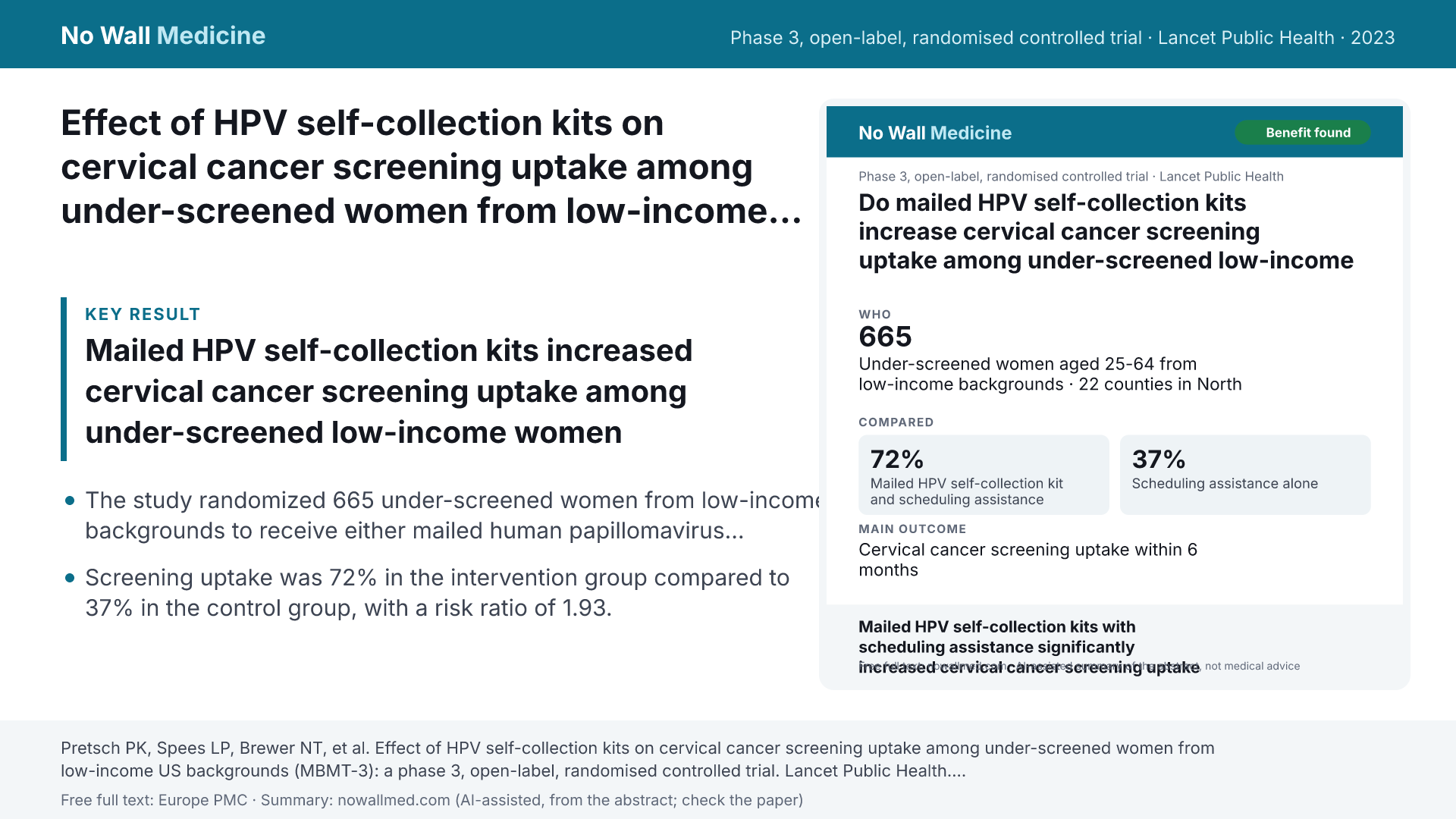
Mailed HPV self-collection kits increased cervical cancer screening uptake among under-screened low-income women
Effect of HPV self-collection kits on cervical cancer screening uptake among under-screened women from low-income US backgrounds (MBMT-3): a phase 3, open-label, randomised controlled trial
Phase 3, open-label, randomised controlled trialBenefit found
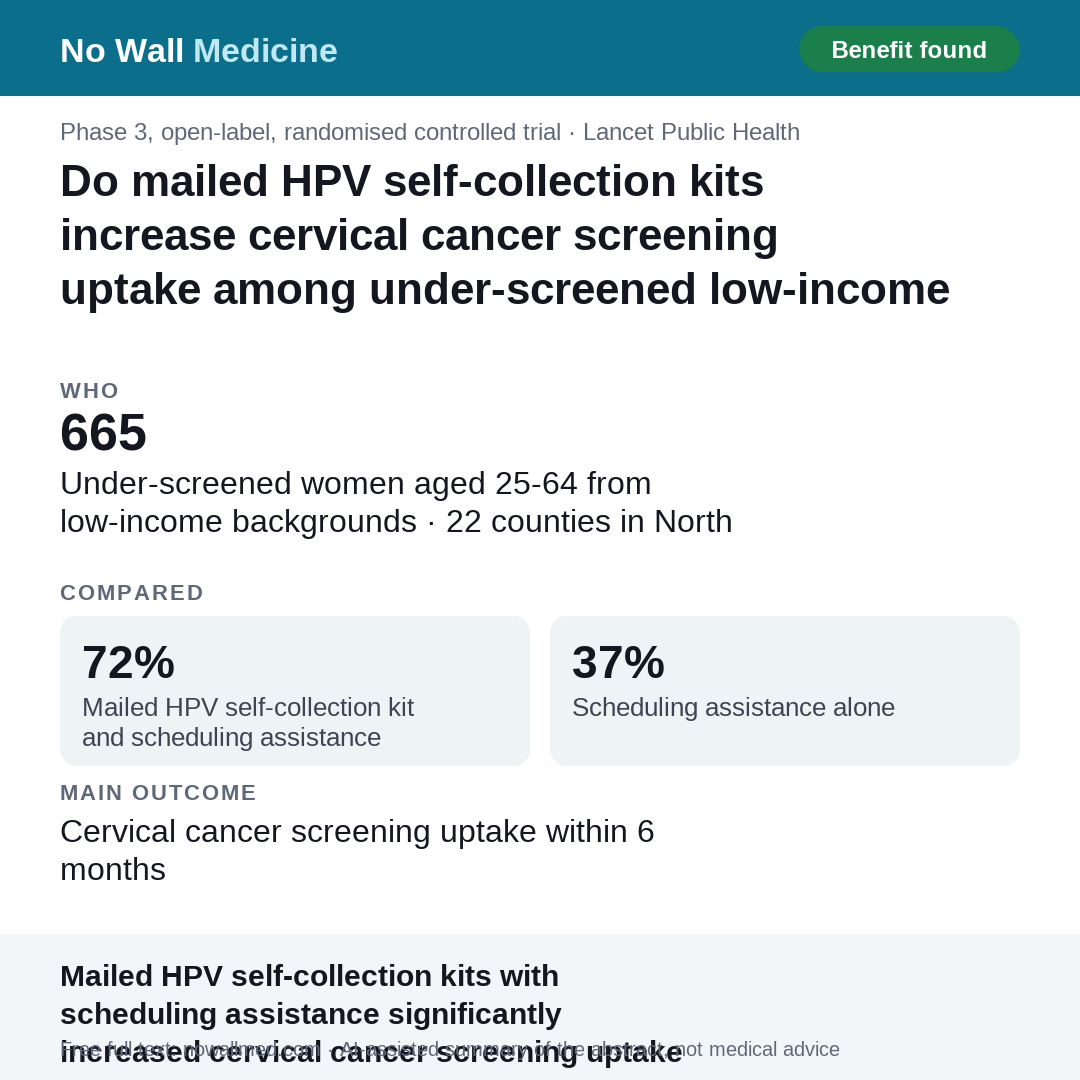
Do mailed HPV self-collection kits increase cervical cancer screening uptake among under-screened low-income women?
Who
665
Under-screened women aged 25-64 from low-income backgrounds · 22 counties in North Carolina, USA
Compared
72%Mailed HPV self-collection kit and scheduling assistance (317/438)
37%Scheduling assistance alone (85/227)
Main outcome
Cervical cancer screening uptake within 6 months
Result: risk ratio 1·93, 95% CI 1·62-2·31
Bottom line: Mailed HPV self-collection kits with scheduling assistance significantly increased cervical cancer screening uptake among under-screened low-income women.
Funded by: National Cancer Institute
Lancet Public Health · 2023-05-11Download image
Clinical question: Do mailed HPV self-collection kits increase cervical cancer screening uptake among under-screened low-income women?
Key points
- The study randomized 665 under-screened women from low-income backgrounds to receive either mailed human papillomavirus (HPV) self-collection kits with scheduling assistance or scheduling assistance alone.
- Screening uptake was 72% in the intervention group compared to 37% in the control group, with a risk ratio of 1.93.
- Among those in the intervention group, 78% of 438 participants returned a self-collection kit, and three participants reported hurt or injury during use.
Headline and key points written with AI from the paper’s abstract, with every number checked against it. Read the paper before relying on them.
Was this summary helpful?
Abstract
Background
Most cervical cancer in the USA occurs in under-screened women. The My Body, My Test-3 (MBMT-3) trial sought to assess the efficacy of mailed human papillomavirus (HPV) self-collection kits with appointment-scheduling assistance to increase uptake of cervical cancer screening among under-screened women from low-income backgrounds compared with scheduling assistance alone.Methods
MBMT-3 is a phase 3, open-label, two-arm, randomised controlled trial. Participants were recruited from 22 counties in North Carolina state, USA, and we partnered with 21 clinics across these counties. Participants were eligible for inclusion if they were aged 25-64 years, had an intact cervix, were uninsured or enrolled in Medicaid or Medicare, had an income of 250% or less of the US Federal Poverty Level, were living within the catchment area of a trial-associated clinic, and were overdue for screening (ie, Papanicolaou test ≥4 years ago or high-risk HPV test ≥6 years ago). Participants were randomly assigned (2:1) to receive a mailed HPV self-collection kit and assistance for scheduling a free screening appointment (intervention group) or to receive scheduling assistance alone (control group). Randomisation was conducted by county using permuted blocks of nine patients and assignment to group was not masked. Participants in the intervention group were mailed HPV self-collection kits to collect a cervical-vaginal sample and return it by mail for testing. Samples were tested with the Aptima HPV assay (Hologic, San Diego, CA, USA), and participants were informed of high-risk HPV results by telephone call. Trial staff made up to three telephone call attempts to provide scheduling assistance for in-clinic screening for all participants. The primary outcome was cervical cancer screening uptake (ie, attending an in-clinic screening appointment or testing negative for high-risk HPV with a returned self-collected sample) within 6 months of enrolment in the intention-to-treat population. This trial is registered with ClinicalTrials.gov, NCT02651883, and has been completed.Findings
Recruitment occurred between April 11, 2016, and Dec 16, 2019. 4256 women contacted the trial to participate, of whom 899 (21%) were eligible for inclusion and 697 (78%) returned consent forms. Of those who consented, 461 (66%) women were randomly assigned to the intervention group and 236 (34%) women were randomly assigned to the control group. We excluded 32 ineligible women post-randomisation, leaving 665 for primary analysis. Screening uptake was higher in the intervention group (317 [72%] of 438) than control group (85 [37%] of 227; risk ratio 1·93, 95% CI 1·62-2·31). Among intervention participants, 341 (78%) of 438 returned a self-collection kit. Three participants reported hurt or injury when using the self-collection kit; no participants withdrew due to adverse effects.Interpretation
Among under-screened women from low-income backgrounds, mailed HPV self-collection kits with scheduling assistance led to greater uptake of cervical cancer screening than scheduling assistance alone. At-home HPV self-collection testing has the potential to increase screening uptake among under-screened women.Funding
National Cancer Institute.
Abstract reproduced under the article’s CC BY-NC-ND licence.
Subject terms
Headline, design, result, key points, caveat and citation as plain text.
Cite this article
Pretsch PK, Spees LP, Brewer NT, et al. Effect of HPV self-collection kits on cervical cancer screening uptake among under-screened women from low-income US backgrounds (MBMT-3): a phase 3, open-label, randomised controlled trial. Lancet Public Health. 2023. doi:10.1016/S2468-2667(23)00076-2
Spotted a mistake? Suggest a correction