Human milk-based fortifier did not reduce serious complications in extremely preterm infants
Effect of human milk-based fortification in extremely preterm infants fed exclusively with breast milk: a randomised controlled trial
Multicentre, randomised controlled trialNo clear difference
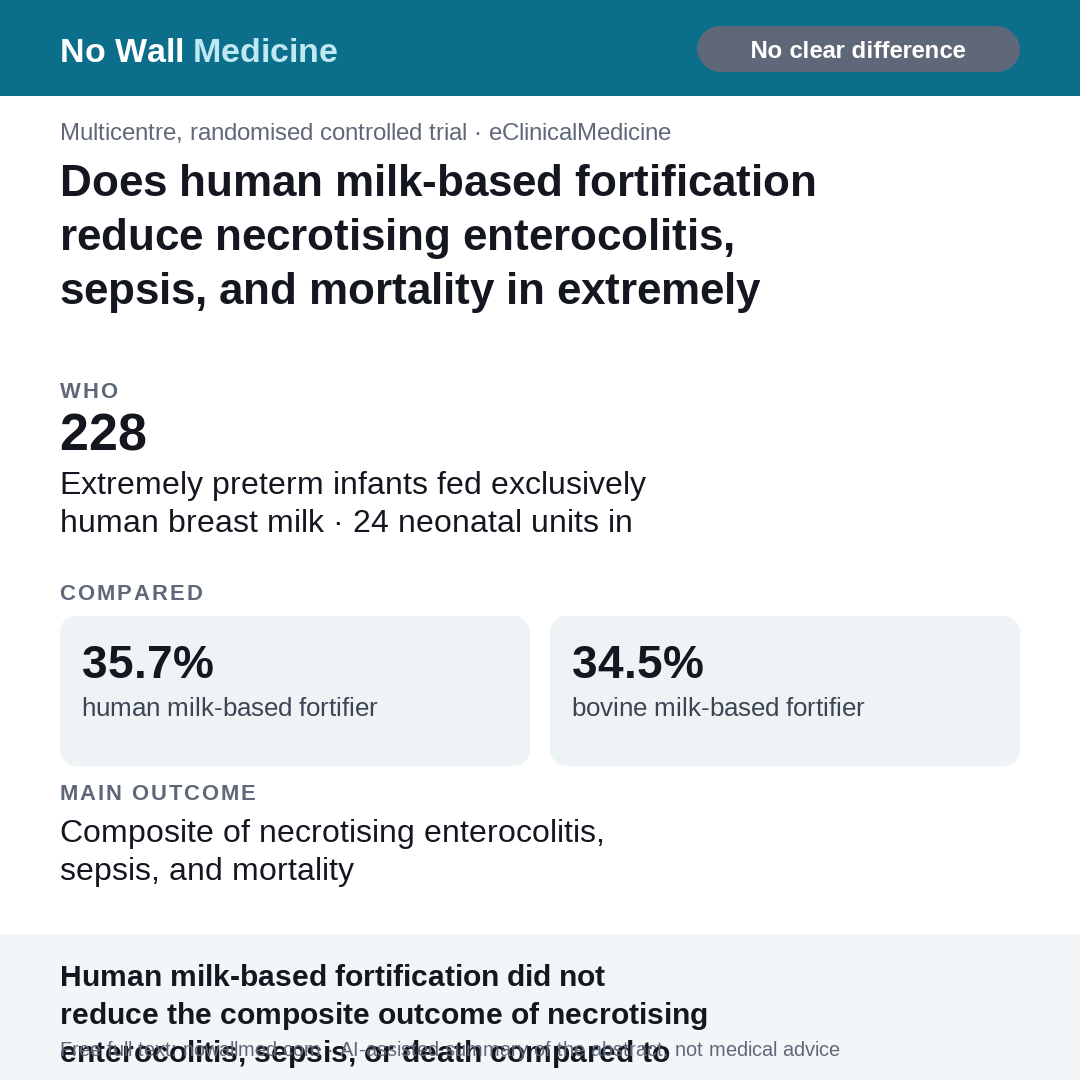
Does human milk-based fortification reduce necrotising enterocolitis, sepsis, and mortality in extremely preterm infants?
Who
228
Extremely preterm infants fed exclusively human breast milk · 24 neonatal units in Sweden
Compared
35.7%human milk-based fortifier
34.5%bovine milk-based fortifier
Main outcome
Composite of necrotising enterocolitis, sepsis, and mortality
Result: OR 1.05, 95% CI 0.61-1.81
Bottom line: Human milk-based fortification did not reduce the composite outcome of necrotising enterocolitis, sepsis, or death compared to bovine milk-based fortification.
Funded by: ALF grant, Prolacta Bioscience, Swedish Research Council, and Research Council for Southeast Sweden
eClinicalMedicine · 2024-01-02Download image
Clinical question: Does human milk-based fortification reduce necrotising enterocolitis, sepsis, and mortality in extremely preterm infants?
Why it matters: It is unknown if using human milk-based fortifiers instead of bovine milk-based fortifiers reduces the incidence of necrotising enterocolitis, sepsis, or death in extremely preterm infants fed exclusively with breast milk.
Key points
- Researchers studied 228 extremely preterm infants in Sweden who were randomly assigned to receive either human milk-based fortifier or bovine milk-based fortifier.
- The composite outcome of necrotising enterocolitis (a serious intestinal disease), sepsis (blood infection), or death occurred in 35.7% of the human milk-based group and 34.5% of the bovine milk-based group.
- There were no significant differences in adverse events between the two groups.
Headline and key points written with AI from the paper’s abstract, with every number checked against it. Read the paper before relying on them.
Was this summary helpful?
Cite this article
Jensen GB, Domellöf M, Ahlsson F, Elfvin A, Navér L, Abrahamsson T. Effect of human milk-based fortification in extremely preterm infants fed exclusively with breast milk: a randomised controlled trial. eClinicalMedicine. 2024. doi:10.1016/j.eclinm.2023.102375
Spotted a mistake? Suggest a correction
Top studies every Monday
The week’s key trials and guidelines in your specialties, plus any topics you follow. By email, free.
Get the weekly digest