Implantable loop recorders detected more atrial fibrillation than 30 days of external monitoring after stroke
Effect of Implantable vs Prolonged External Electrocardiographic Monitoring on Atrial Fibrillation Detection in Patients With Ischemic Stroke: The PER DIEM Randomized Clinical Trial
Randomized clinical trialBenefit found
Does implantable monitoring detect more atrial fibrillation
Who
300
Patients with recent ischemic stroke · Alberta, Canada
Compared
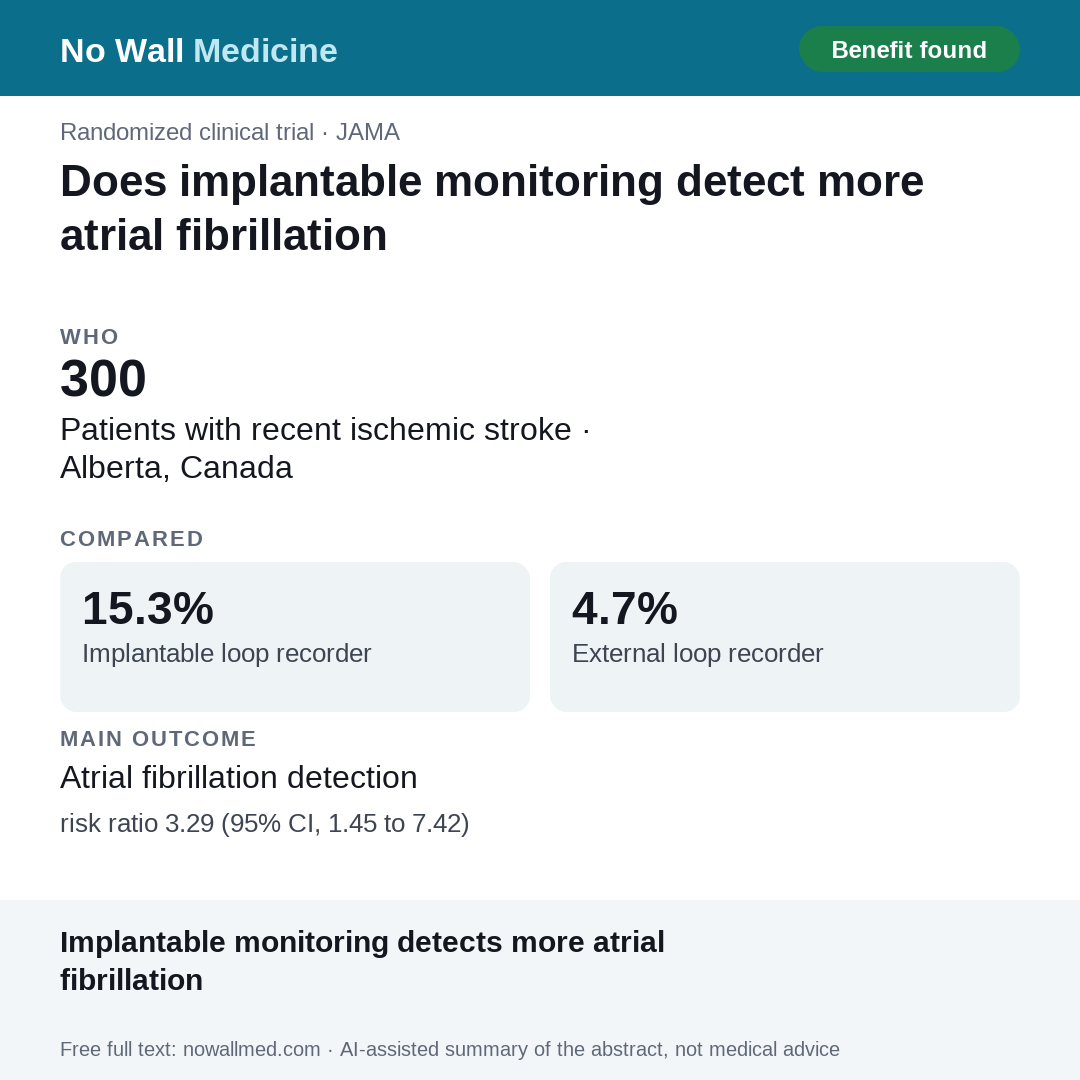
15.3%Implantable loop recorder (23/150)
4.7%External loop recorder (7/150)
Main outcome
Atrial fibrillation detection
Result: risk ratio 3.29 (95% CI, 1.45 to 7.42)
Bottom line: Implantable monitoring detects more atrial fibrillation
JAMA · 2021-06-01Download image
Why it matters: It is unknown if 12 months of monitoring with an implantable loop recorder detects more atrial fibrillation than 30 days of monitoring with an external loop recorder in patients after an ischemic stroke.
Key points
- Researchers randomized 300 patients who had a recent ischemic stroke to receive either an implantable loop recorder for 12 months or an external loop recorder for 30 days.
- The implantable loop recorder group had a 15.3% (23/150) detection rate of new atrial fibrillation compared to 4.7% (7/150) in the external loop recorder group.
- Six secondary outcomes, including recurrent stroke, death, and intracerebral hemorrhage, showed no significant difference between the two monitoring methods.
Headline and key points written with AI from the paper’s abstract, with every number checked against it. Read the paper before relying on them.
Was this summary helpful?
Subject terms
Cite this article
Buck BH, Hill MD, Quinn FR, Butcher KS, Menon BK, Gulamhusein S. Effect of Implantable vs Prolonged External Electrocardiographic Monitoring on Atrial Fibrillation Detection in Patients With Ischemic Stroke: The PER DIEM Randomized Clinical Trial. JAMA. 2021. doi:10.1001/jama.2021.6128
Spotted a mistake? Suggest a correction
Top studies every Monday
The week’s key trials and guidelines in your specialties, plus any topics you follow. By email, free.
Get the weekly digest