Increasing calligraphy practice time was associated with changes in brain network connectivity in older adults
Effect of increasing cognitive activity participation on default mode network in older adults with subjective cognitive decline: a randomised controlled trial
Randomised controlled trialBenefit found
Does increasing cognitive activity participation affect the default mode network in older adults?
Who
112
Chinese individuals aged 55-75 with subjective cognitive decline · Community-living, China
Compared
Intervention group
Control group
Main outcome
Functional connectivities of the default mode network
Result: group difference = 0.25 (95% CI 0.06-0.44) for mPFC and right lateral temporal cortex
Bottom line: Increasing calligraphy practice time improves functional connectivity within the default mode network in older adults.
Funded by: Research Grants Council, Hong Kong
eBioMedicine · 2024-03-25Download image
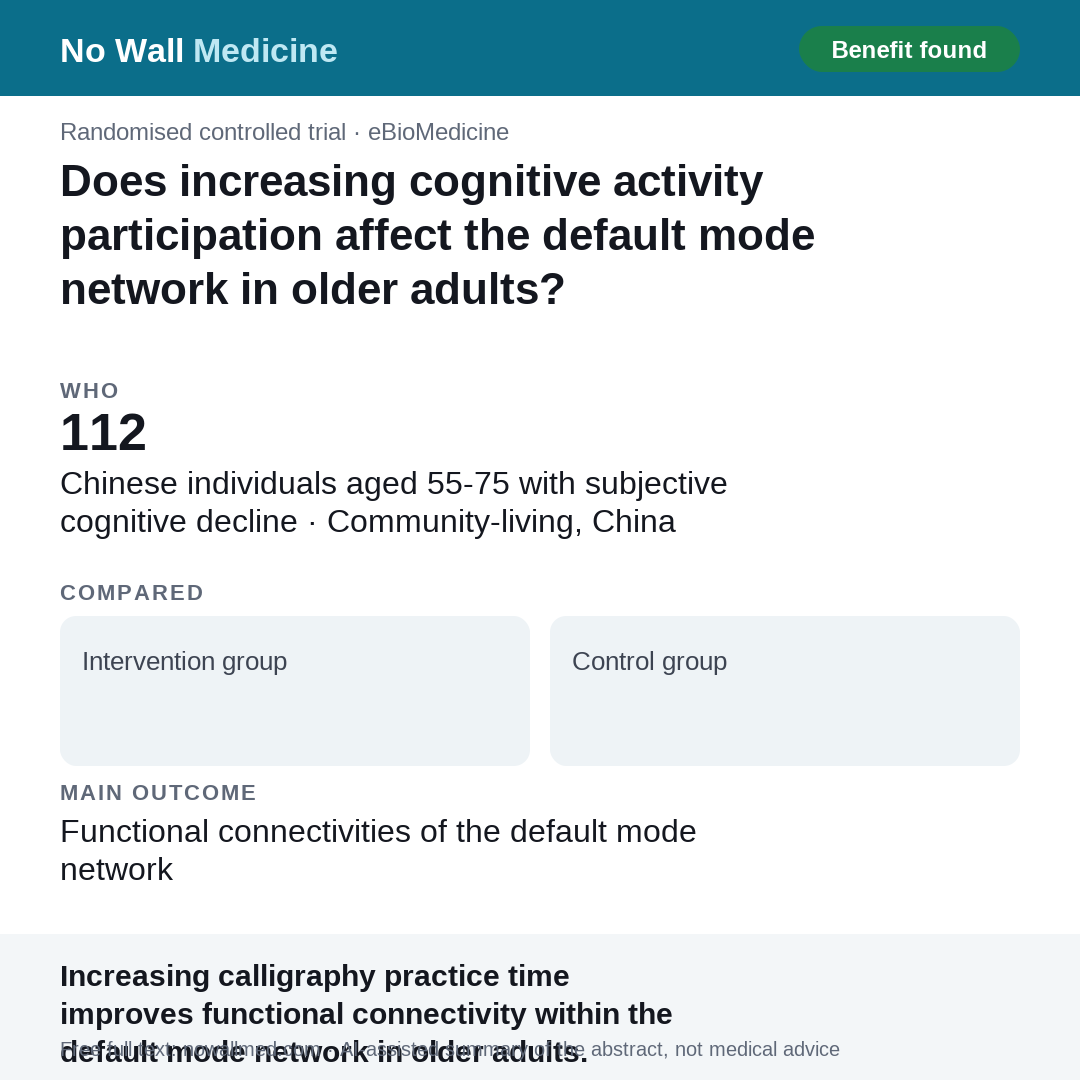
Clinical question: Does increasing cognitive activity participation affect the default mode network in older adults?
Why it matters: It was unknown if increasing participation in cognitive activities could modulate the functional brain networks of older adults experiencing subjective cognitive decline.
Key points
- The study followed 112 Chinese adults aged 55-75 years with subjective cognitive decline who practiced calligraphy.
- Doubling weekly calligraphy practice for 6 months was associated with significant changes in functional connectivity within the default mode network, a brain network active during rest.
- Specific connectivity changes occurred between the medial prefrontal cortex and the right lateral temporal cortex, right inferior parietal lobe, left hippocampal formation, and right inferior parietal lobe.
Headline and key points written with AI from the paper’s abstract, with every number checked against it. Read the paper before relying on them.
Topics
Cite this article
Lee ATC, Luo Y, Huo Z, Shi L, Chu WCW, Lam LCW. Effect of increasing cognitive activity participation on default mode network in older adults with subjective cognitive decline: a randomised controlled trial. eBioMedicine. 2024. doi:10.1016/j.ebiom.2024.105082
Spotted a mistake? Suggest a correction
Top studies every Monday
The week’s key trials and guidelines in your specialties, by email. Free.
Get the weekly digest