Continuous use of ARBs versus ACEIs showed no clear difference in cognitive outcomes
Effect of Initiation and Continuous Adherence to ARBs Versus ACEIs on Risk of Adjudicated Mild Cognitive Impairment or Dementia
Target trial emulation of a new-user cohort studyNo clear difference
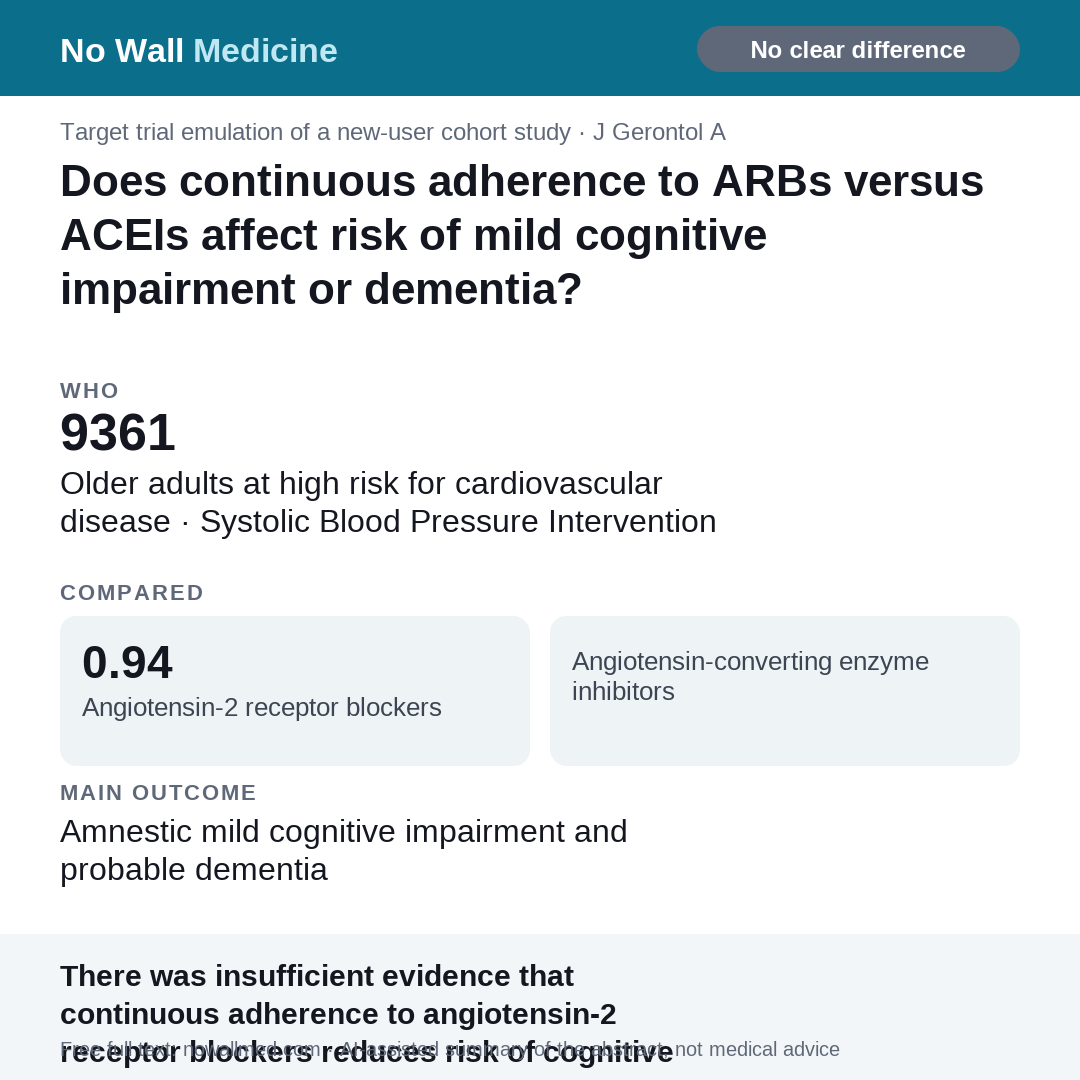
Does continuous adherence to ARBs versus ACEIs affect risk of mild cognitive impairment or dementia?
Who
9361
Older adults at high risk for cardiovascular disease · Systolic Blood Pressure Intervention Trial
Compared
0.94Angiotensin-2 receptor blockers (95% CI 0.66-1.29)
Angiotensin-converting enzyme inhibitors
Main outcome
Amnestic mild cognitive impairment and probable dementia
Result: risk ratio 0.94 (95% CI 0.66-1.29)
Bottom line: There was insufficient evidence that continuous adherence to angiotensin-2 receptor blockers reduces risk of cognitive outcomes versus angiotensin-converting enzyme inhibitors.
J Gerontol A · 2025-02-13Download image
Clinical question: Does continuous adherence to ARBs versus ACEIs affect risk of mild cognitive impairment or dementia?
Why it matters: It is unclear if the different ways ARBs and ACEIs affect the renin-angiotensin system lead to different clinical outcomes for cognitive health.
Key points
- Researchers studied 9,361 participants from the SPRINT trial to compare the effects of angiotensin-2 receptor blockers (ARBs) and angiotensin-converting enzyme inhibitors (ACEIs) on cognitive health.
- The 4-year weighted risk ratio for amnestic mild cognitive impairment or probable dementia was 0.94 (95% CI: 0.66-1.29) for ARBs compared to ACEIs.
- The 4-year weighted risk ratio for amnestic mild cognitive impairment, probable dementia, or death was 0.79 (95% CI: 0.58-1.06) for ARBs compared to ACEIs.
Headline and key points written with AI from the paper’s abstract, with every number checked against it. Read the paper before relying on them.
Was this summary helpful?
Subject terms
Cite this article
Derington CG, Berchie RO, Scharfstein DO, Andrews RM, Greene TH, Xu Y. Effect of Initiation and Continuous Adherence to ARBs Versus ACEIs on Risk of Adjudicated Mild Cognitive Impairment or Dementia. J Gerontol A. 2025. doi:10.1093/gerona/glaf028
Spotted a mistake? Suggest a correction
Top studies every Monday
The week’s key trials and guidelines in your specialties, plus any topics you follow. By email, free.
Get the weekly digest