Integrating tuberculosis services into child healthcare increased investigations but not overall case detection
Effect of integrating paediatric tuberculosis services into child healthcare services on case detection in Africa: the INPUT stepped-wedge cluster-randomised trial
Stepped-wedge cluster-randomised trialNo clear difference
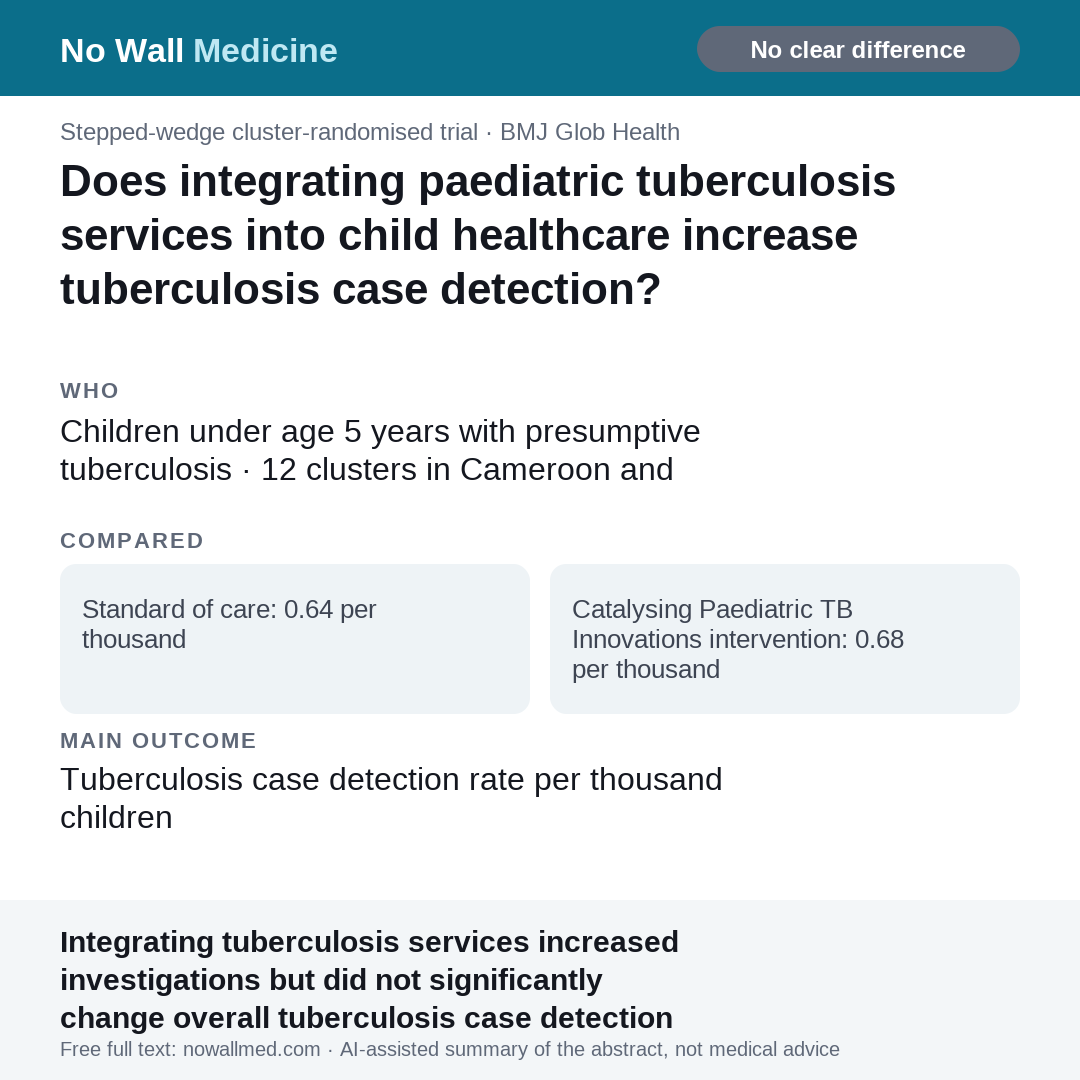
Does integrating paediatric tuberculosis services into child healthcare increase tuberculosis case detection?
Who
Children under age 5 years with presumptive tuberculosis · 12 clusters in Cameroon and Kenya
Compared
Standard of care: 0.64 per thousand
Catalysing Paediatric TB Innovations intervention: 0.68 per thousand
Main outcome
Tuberculosis case detection rate per thousand children
Result: adjusted rate ratio 1.32 (95% CI 0.66 to 2.61)
Bottom line: Integrating tuberculosis services increased investigations but did not significantly change overall tuberculosis case detection rates.
BMJ Glob Health · 2024-12-18Download image
Clinical question: Does integrating paediatric tuberculosis services into child healthcare increase tuberculosis case detection?
Why it matters: Paediatric tuberculosis underdiagnosis is a critical concern, and it is unknown if integrating tuberculosis services into general child healthcare improves case detection.
Key points
- Researchers conducted a trial in 12 clusters in Cameroon and Kenya involving 121,909 children in the control phase and 109,614 children in the intervention phase.
- The intervention increased tuberculosis investigations from 1.1 to 5.6 per thousand children, but the overall case detection rate was not statistically different at 0.64 versus 0.68 per thousand.
- In Cameroon, case detection was associated with a 9.75-fold increase, while no significant effect was found in Kenya.
Headline and key points written with AI from the paper’s abstract, with every number checked against it. Read the paper before relying on them.
Was this summary helpful?
Abstract
Introduction
Paediatric tuberculosis (TB) underdiagnosis is a critical concern. The INPUT stepped-wedge cluster-randomised trial assessed the impact of integrating child TB services into child healthcare on TB case detection among children under age 5 years. Methods
We compared the standard of care, providing TB care in specific TB clinics (control phase), with the Catalysing Paediatric TB Innovations (CaP-TB) intervention, integrating TB services across all child health services (intervention phase). 12 clusters in Cameroon and Kenya transitioned from the standard of care to the intervention at randomly assigned times. Children with presumptive TB were enrolled after obtaining their parents' consent and were followed throughout TB diagnostic procedures and treatment. Study outcomes included the rate of children with presumptive TB receiving TB investigations and that of children diagnosed with TB (the primary outcome was case detection), per thousand children under 5 years attending facilities. Generalised linear mixed Poisson models estimated the intervention's effect as adjusted rate ratios (aRR) and associated 95% CIs. Ad hoc country-stratified analyses were conducted. Results
During control and intervention phases, respectively, 121 909 and 109 614 children under 5 years attended paediatric entry points, 133 (1.1 per thousand) and 610 (5.6 per thousand) children with presumptive TB received TB investigations, and 79 and 74 were diagnosed with TB, corresponding to a case detection rate of 0.64 and 0.68 per thousand, respectively. CaP-TB significantly increased TB investigations in both countries overall (aRR=3.9, 95% CI 2.4 to 5.4), and in each. Overall, TB case detection was not statistically different between intervention and control (aRR 1.32, 95% CI 0.66 to 2.61, p=0.43). Country-stratified analysis revealed a 10-fold increase (aRR 9.75, 95% CI 1.04 to 91.84, p=0.046) in case detection with CaP-TB in Cameroon and no significant effect in Kenya (aRR 0.94, 95% CI 0.44 to 2.01, p=0.88). Conclusion
CaP-TB increased TB investigations in both study countries and markedly enhanced TB case detection in one, underlining integrated TB services' potential to address paediatric TB underdiagnosis.
Abstract reproduced under the article’s CC BY NC licence.
Subject terms
Cite this article
Denoeud-Ndam L, Tchounga BK, Masaba R, Herrera N, Machekano R, Siamba S. Effect of integrating paediatric tuberculosis services into child healthcare services on case detection in Africa: the INPUT stepped-wedge cluster-randomised trial. BMJ Glob Health. 2024. doi:10.1136/bmjgh-2024-016429
Spotted a mistake? Suggest a correction
Top studies every Monday
The week’s key trials and guidelines in your specialties, plus any topics you follow. By email, free.
Get the weekly digest