Effect of intensive care unit sedation strategy on patient-reported experience: secondary mediation analysis of the A2B randomised controlled trial
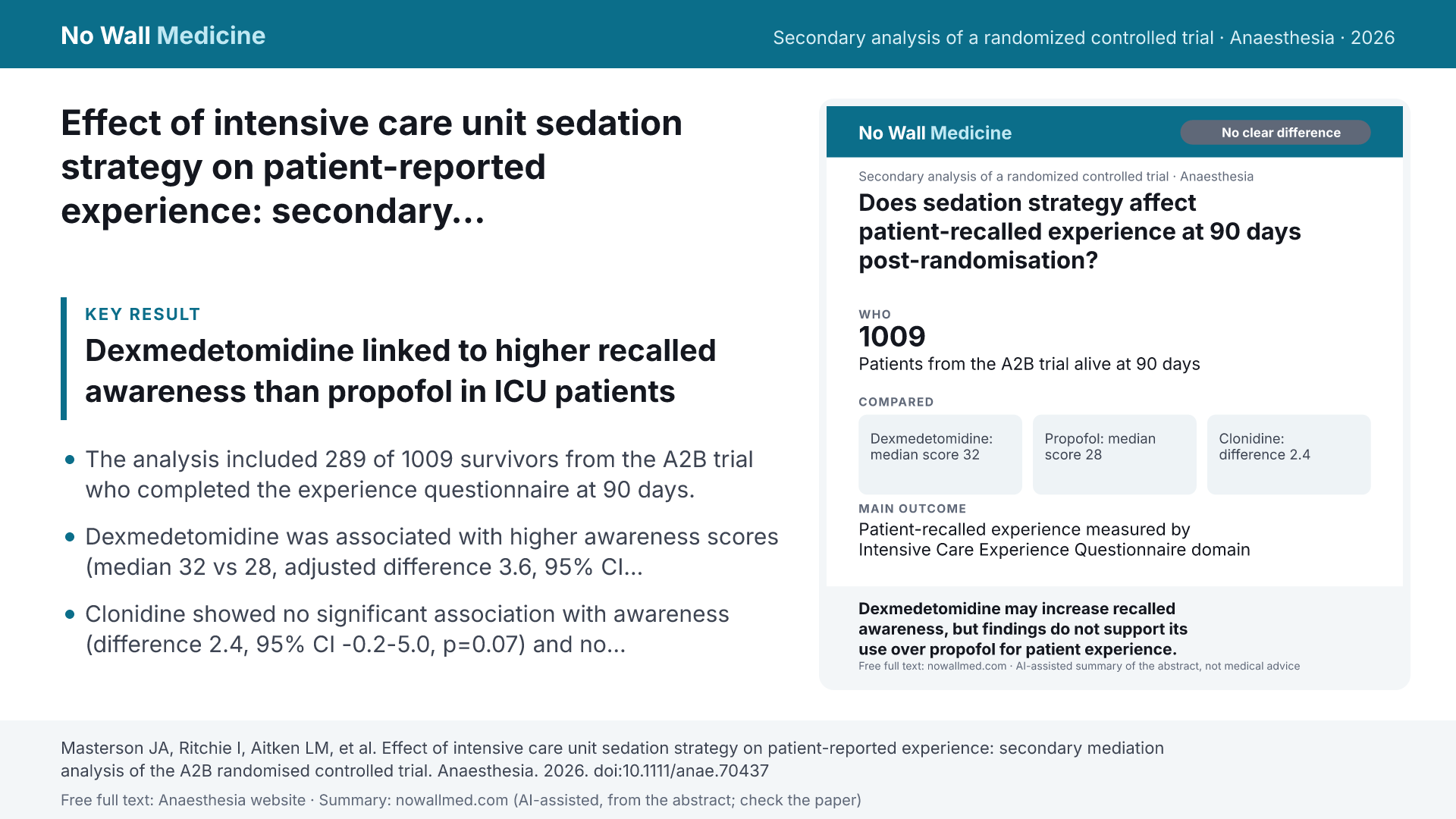
Key result: Dexmedetomidine linked to higher recalled awareness than propofol in ICU patients
Secondary analysis of a randomized controlled trialNo clear difference
Does sedation strategy affect patient-recalled experience at 90 days post-randomisation?
Who
1009
Patients from the A2B trial alive at 90 days
Compared
Dexmedetomidine: median score 32
Propofol: median score 28
Clonidine: difference 2.4
Main outcome
Patient-recalled experience measured by Intensive Care Experience Questionnaire domain scores
Result: adjusted mean difference 3.6, 95%CI 1.0-6.2
Bottom line: Dexmedetomidine may increase recalled awareness, but findings do not support its use over propofol for patient experience.
Limitation: Only 28.6% of patients alive at 90 days completed the questionnaire.
Anaesthesia · 2026-10-06
Key points
- The analysis included 289 of 1009 survivors from the A2B trial who completed the experience questionnaire at 90 days.
- Dexmedetomidine was associated with higher awareness scores (median 32 vs 28, adjusted difference 3.6, 95% CI 1.0-6.2, p=0.01) compared to propofol.
- Clonidine showed no significant association with awareness (difference 2.4, 95% CI -0.2-5.0, p=0.07) and no differences were found in other domains.
Limitation the authors note: The findings come from a subgroup of the A2B cohort where only 289 of 1009 survivors completed the questionnaire.
Discussion prompts
- Would these patients look like yours? Who was left out?
- Is the main outcome one that matters to patients?
- Is the difference large enough to change what you do?
Cite: Masterson JA, Ritchie I, Aitken LM, et al. Effect of intensive care unit sedation strategy on patient-reported experience: secondary mediation analysis of the A2B randomised controlled trial. Anaesthesia. 2026. doi:10.1111/anae.70437
Free full text: Anaesthesia website · Summary and visual abstract: nowallmed.com/a/effect-of-intensive-care-unit-sedation-strategy-on-patient-reported-11x6a2j/ (AI-assisted from the abstract; check the paper before relying on it).