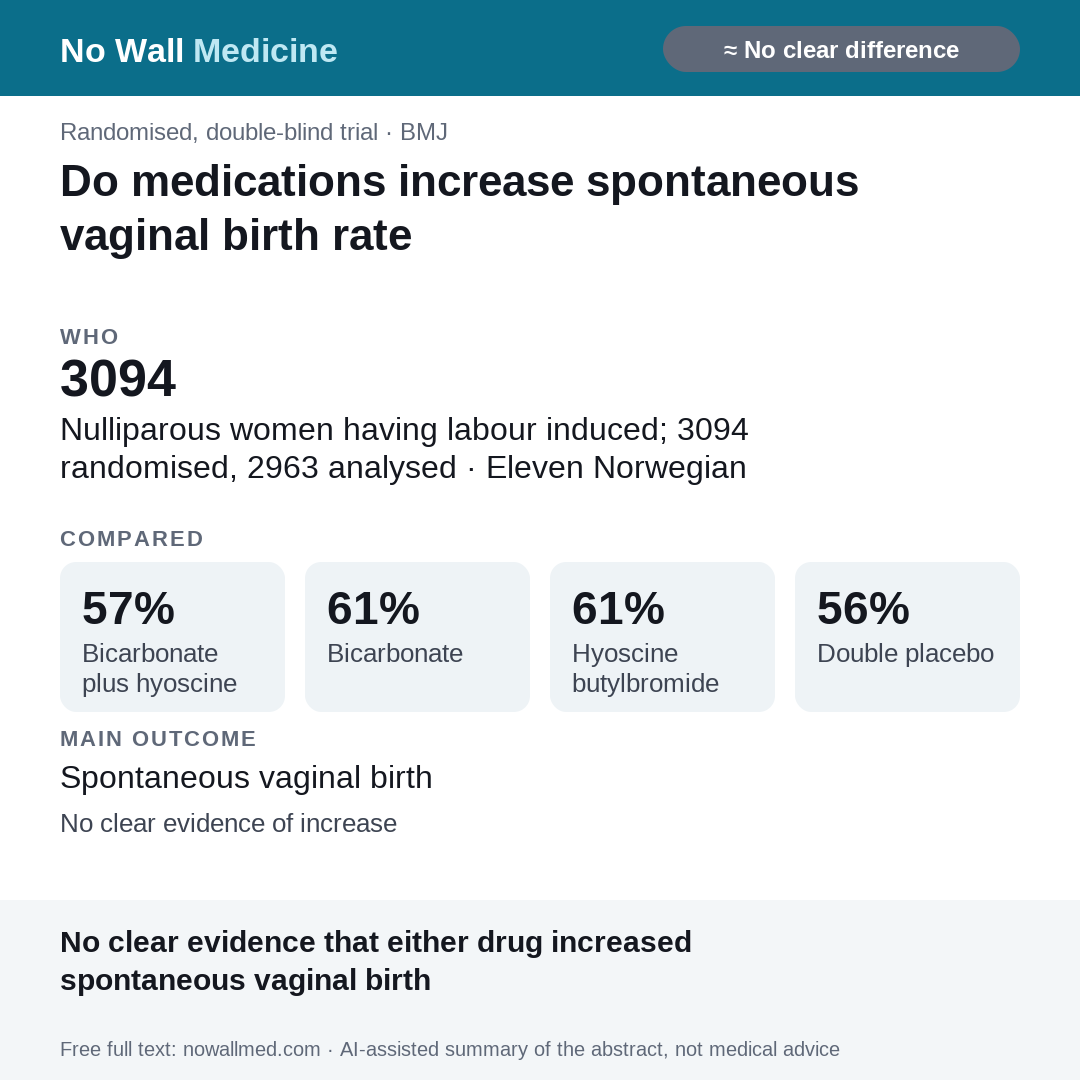
No increase in spontaneous vaginal births with hyoscine butylbromide or sodium bicarbonate
Effect of intrapartum hyoscine butylbromide and sodium bicarbonate on spontaneous vaginal birth in nulliparous women after induction of labour (SAINT): multicentre randomised placebo controlled factorial trial
Michelsen TM, Leeves LT, Solhoff AV, Nilsen NG, Kjøllesdal AM, Pettersen ÅTR, et al
Objective
To determine whether intrapartum hyoscine butylbromide, sodium bicarbonate, and their combination increase the rate of spontaneous vaginal birth in nulliparous women undergoing induction of labour. Design
Multicentre, randomised, double blind, placebo controlled, 2×2 factorial phase 3 trial (SAINT). Setting
11 Norwegian hospitals providing comprehensive obstetric care. Participants
Nulliparous women aged 18-50 years with a singleton live fetus in cephalic presentation at term with an indication for induction of labour. Interventions
Participants were randomly assigned (1:1:1:1) to oral sodium bicarbonate (4×1 g per dose) plus intravenous hyoscine butylbromide (20 mg per dose), oral sodium bicarbonate plus intravenous placebo, oral placebo plus intravenous hyoscine butylbromide, or double placebo. The investigational medicinal product was administered at the onset of active labour and repeated every four hours to a maximum of three doses. Main outcome measure
Spontaneous vaginal birth (no instrumental or caesarean delivery). Results
Between 4 January 2023 and 29 January 2025, 3094 nulliparous women were randomised, and 2963 comprised the full analysis set. Spontaneous vaginal birth occurred in 57% (422/741) in the bicarbonate plus hyoscine butylbromide arm, 61% (445/734) in the bicarbonate arm, 61% (449/741) in the hyoscine butylbromide arm, and 56% (422/747) in the double placebo arm. Marginal risk differences for spontaneous vaginal birth compared with double placebo were -0.2 (95% confidence interval -5.1 to 4.7; P=0.93) percentage points for combined treatment, 3.1 (-1.7 to 8.0; P=0.21) percentage points for bicarbonate, and 4.0 (-0.8 to 8.9; P=0.10) percentage points for hyoscine butylbromide. Serious adverse events were similar between groups, and no treatment related serious morbidity or deaths were observed. Conclusions
No clear evidence was found that intrapartum hyoscine butylbromide, sodium bicarbonate, or their combination increased spontaneous vaginal birth compared with placebo. Although small beneficial effects cannot be excluded, the findings do not support routine intrapartum use of either agent to facilitate spontaneous vaginal birth after induction of labour. Trial registration
European Clinical Trials Database (EudraCT; 2021-000392-37); EU Clinical Trials Information System (CTIS; EU CT number 2024-511848-55-00); ClinicalTrials.gov (NCT05719467).
Abstract reproduced under the article’s CC BY NC licence.