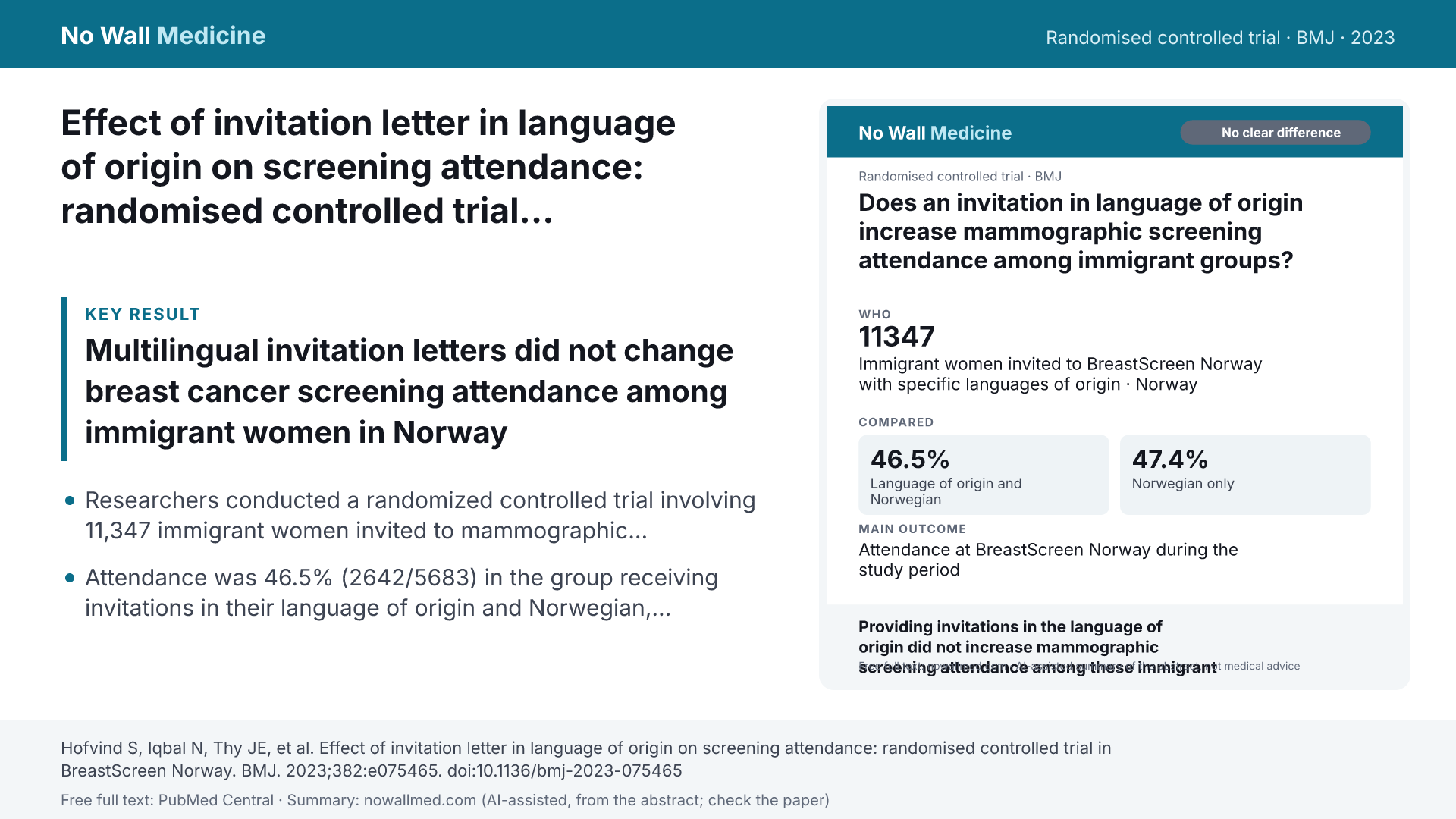
Multilingual invitation letters did not change breast cancer screening attendance among immigrant women in Norway
Effect of invitation letter in language of origin on screening attendance: randomised controlled trial in BreastScreen Norway
Randomised controlled trialNo clear difference
Does an invitation in language of origin increase mammographic screening attendance among immigrant groups?
Who
11347
Immigrant women invited to BreastScreen Norway with specific languages of origin · Norway
Compared
46.5%Language of origin and Norwegian (2642/5683)
47.4%Norwegian only (2682/5664)
Main outcome
Attendance at BreastScreen Norway during the study period
Bottom line: Providing invitations in the language of origin did not increase mammographic screening attendance among these immigrant groups.
BMJ · 2023-09-19 · Save PNG
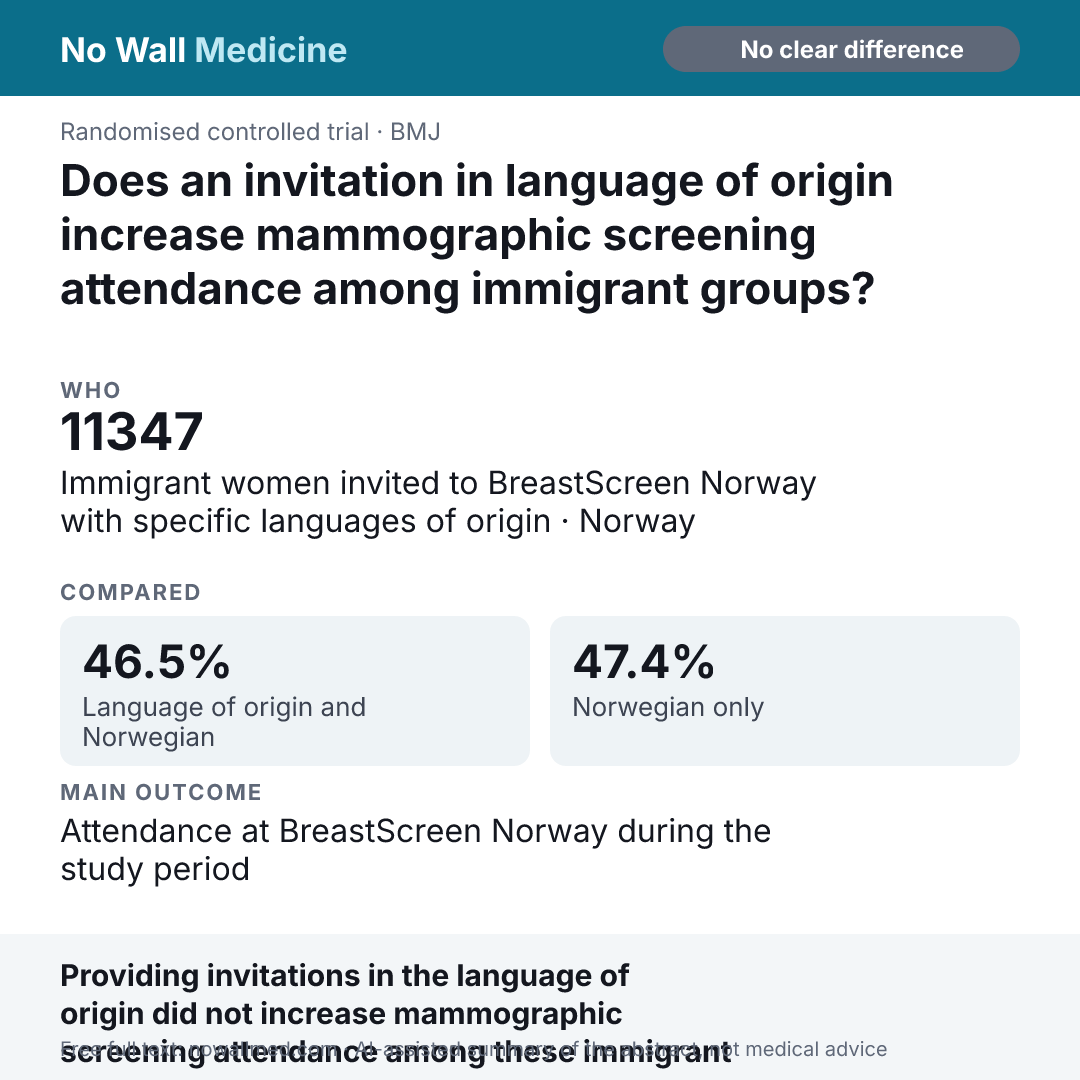
Clinical question: Does an invitation in language of origin increase mammographic screening attendance among immigrant groups?
Key points
- Researchers conducted a randomized controlled trial involving 11,347 immigrant women invited to mammographic screening (breast imaging) in Norway.
- Attendance was 46.5% (2642/5683) in the group receiving invitations in their language of origin and Norwegian, compared to 47.4% (2682/5664) in the Norwegian-only group.
- No statistical differences in attendance were observed when results were analyzed by language, age, or years since immigration.
Headline and key points written with AI from the paper’s abstract, with every number checked against it. Read the paper before relying on them.
Was this summary helpful?
Abstract
Objective
To explore attendance at organised mammographic screening among immigrant groups that received an invitation letter and information leaflet (invitation) in their language of origin and Norwegian compared with Norwegian only. Design
Randomised controlled trial. Setting
Population based screening programme for breast cancer in Norway (BreastScreen Norway), which invites women aged 50-69 to two-view mammographic screening biennially. Participants
All women invited to BreastScreen Norway in the study period April 2021 to June 2022 whose language of origin was Arabic (women born in Algeria, Egypt, Lebanon, Iraq, Palestine, Sudan, Syria, Tunisia, or Morocco), English (women born in the Philippines), Polish (women born in Poland), Somali (women born in Somalia), or Urdu (women born in Pakistan) (n=11 347). Intervention
The study group received an invitation to screening in their language of origin and in Norwegian, whereas the control group received an invitation in Norwegian only during the study period. Main outcome measure
Attendance at BreastScreen Norway during the study period. Results
Overall attendance was 46.5% (2642/5683) in the study group and 47.4% (2682/5664) in the control group. No statistical differences in attendance were observed after stratification by language of invitation, age at invitation, or years since immigration. Conclusions
No difference in attendance was observed between immigrant women invited to BreastScreen Norway in their language of origin and in Norwegian compared with Norwegian only. Several barriers to cancer screening may exist among immigrants, and translating the invitation is probably only a part of a complex explanation. Trial registration
NCT04672265. Clinicaltrials
gov NCT04672265.
Abstract reproduced under the article’s CC BY NC licence.
Subject terms
Headline, design, result, key points, caveat and citation as plain text.
Cite this article
Hofvind S, Iqbal N, Thy JE, et al. Effect of invitation letter in language of origin on screening attendance: randomised controlled trial in BreastScreen Norway. BMJ. 2023;382:e075465. doi:10.1136/bmj-2023-075465
Spotted a mistake? Suggest a correction