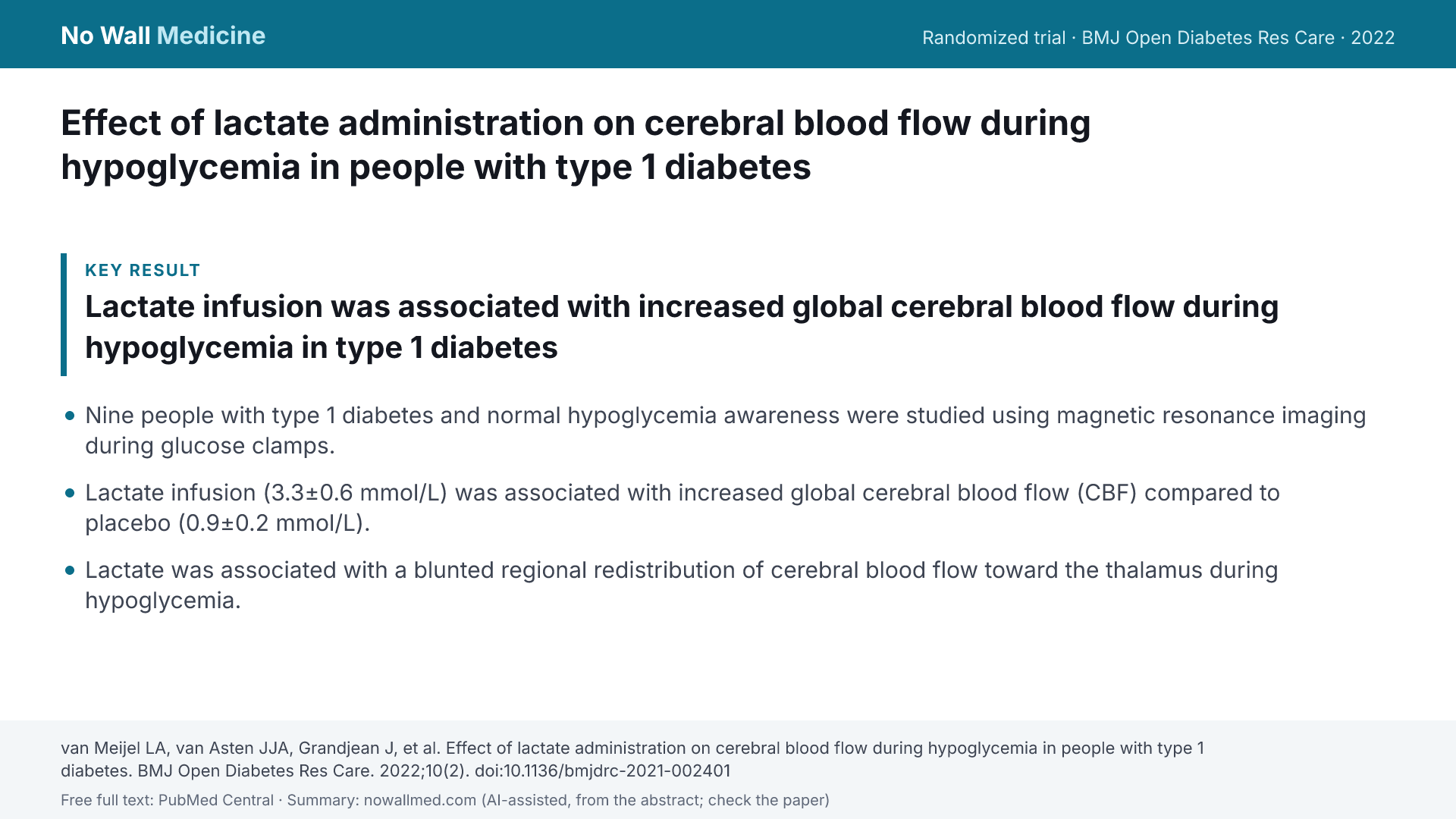
Lactate infusion was associated with increased global cerebral blood flow during hypoglycemia in type 1 diabetes
Effect of lactate administration on cerebral blood flow during hypoglycemia in people with type 1 diabetes
Why it matters: It is unknown how lactate levels affect cerebral blood flow, which is a measure of blood delivery to the brain, during hypoglycemia.
Key points
- Nine people with type 1 diabetes and normal hypoglycemia awareness were studied using magnetic resonance imaging during glucose clamps.
- Lactate infusion (3.3±0.6 mmol/L) was associated with increased global cerebral blood flow (CBF) compared to placebo (0.9±0.2 mmol/L).
- Lactate was associated with a blunted regional redistribution of cerebral blood flow toward the thalamus during hypoglycemia.
Headline and key points written with AI from the paper’s abstract, with every number checked against it. Read the paper before relying on them.
Was this summary helpful?
Abstract
Introduction
Impaired awareness of hypoglycemia, clinically reflected by the inability to timely detect hypoglycemia, affects approximately 25% of the people with type 1 diabetes. Both altered brain lactate handling and increased cerebral blood flow (CBF) during hypoglycemia appear to be involved in the pathogenesis of impaired awareness of hypoglycemia. Here we examine the effect of lactate on CBF during hypoglycemia. Research design and methods
Nine people with type 1 diabetes and normal awareness of hypoglycemia underwent two hyperinsulinemic euglycemic-hypoglycemic (3.0 mmol/L) glucose clamps in a 3T MR system, once with sodium lactate infusion and once with sodium chloride infusion. Global and regional changes in CBF were determined using pseudocontinuous arterial spin labeling. Results
Lactate (3.3±0.6 vs 0.9±0.2 mmol/L during lactate infusion vs placebo infusion, respectively) suppressed the counter-regulatory hormone responses to hypoglycemia. Global CBF increased considerably in response to intravenous lactate infusion but did not further increase during hypoglycemia. Lactate also blunted the hypoglycemia-induced regional redistribution of CBF towards the thalamus. Conclusions
Elevated lactate levels enhance global CBF and blunt the thalamic CBF response during hypoglycemia in patients with type 1 diabetes, mimicking observations of impaired awareness of hypoglycemia. These findings suggest that alteration of CBF associated with lactate may play a role in some aspects of the development of impaired awareness of hypoglycemia. Trial registration number
NCT03730909.
Abstract reproduced under the article’s CC BY NC licence.
Subject terms
Cite this article
van Meijel LA, van Asten JJA, Grandjean J, Heerschap A, Tack CJ, van der Graaf M. Effect of lactate administration on cerebral blood flow during hypoglycemia in people with type 1 diabetes. BMJ Open Diabetes Res Care. 2022. doi:10.1136/bmjdrc-2021-002401
Spotted a mistake? Suggest a correction