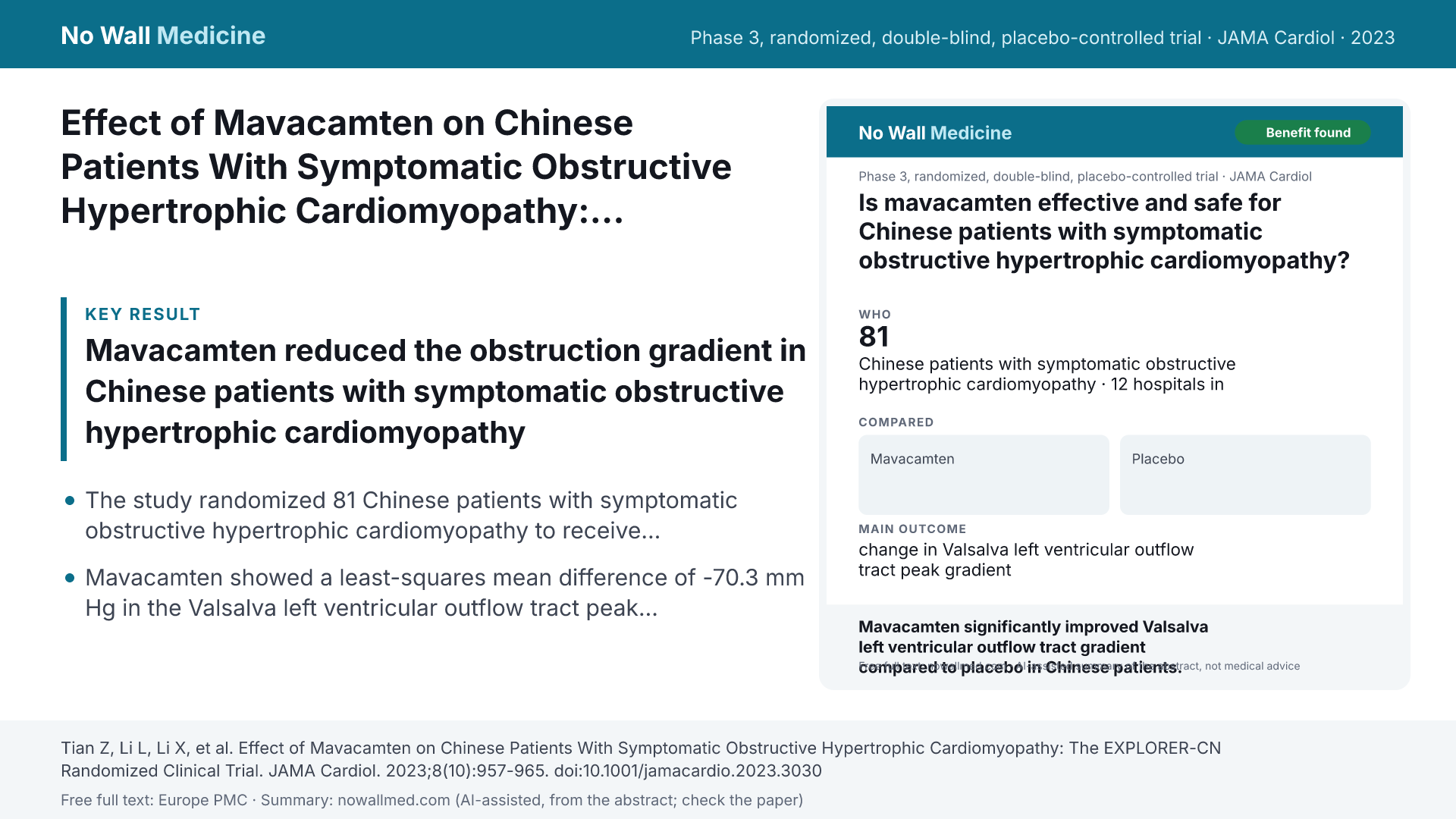
Mavacamten reduced the obstruction gradient in Chinese patients with symptomatic obstructive hypertrophic cardiomyopathy
Effect of Mavacamten on Chinese Patients With Symptomatic Obstructive Hypertrophic Cardiomyopathy: The EXPLORER-CN Randomized Clinical Trial
Phase 3, randomized, double-blind, placebo-controlled trialBenefit found
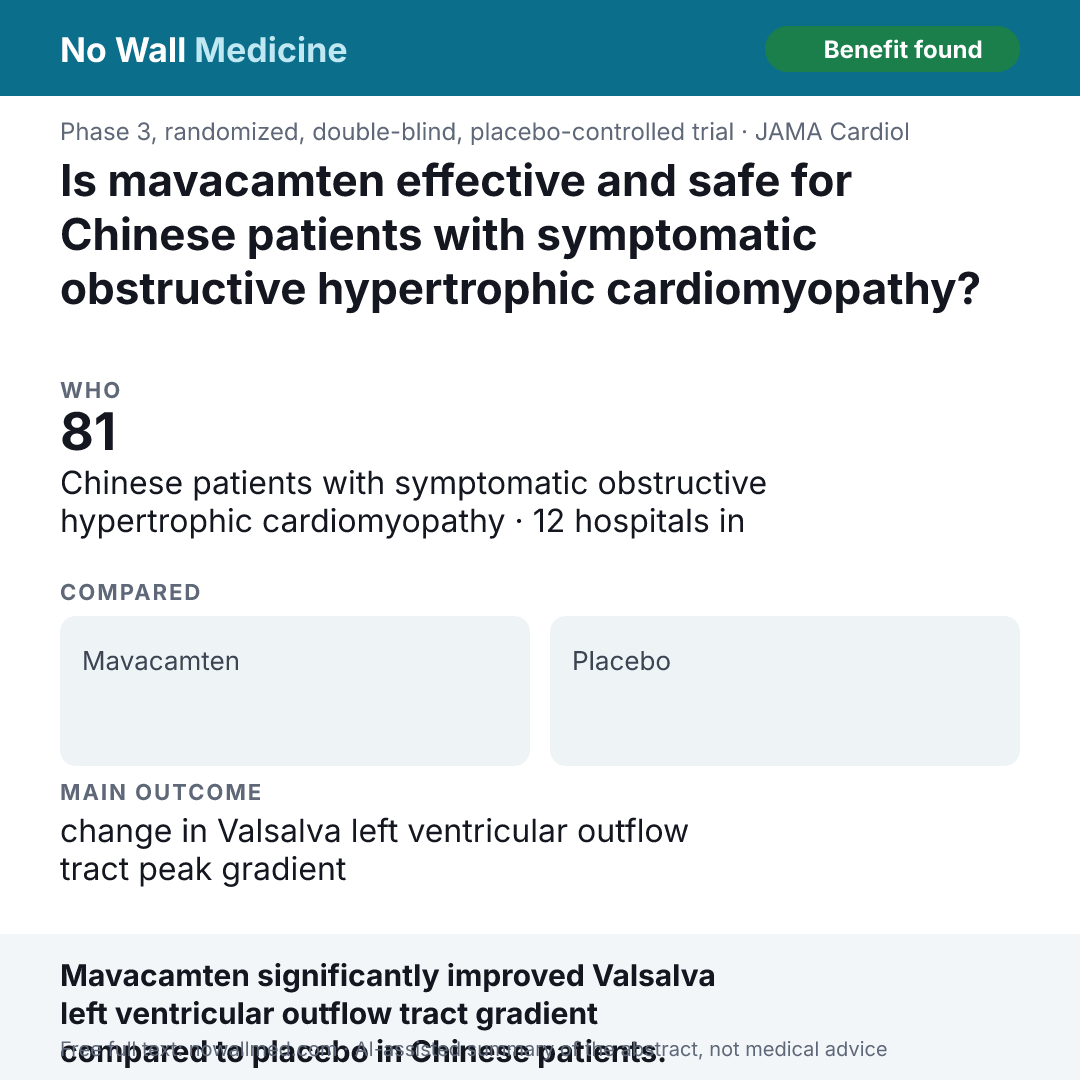
Is mavacamten effective and safe for Chinese patients with symptomatic obstructive hypertrophic cardiomyopathy?
Who
81
Chinese patients with symptomatic obstructive hypertrophic cardiomyopathy · 12 hospitals in China
Compared
Mavacamten
Placebo
Main outcome
change in Valsalva left ventricular outflow tract peak gradient
Result: least-squares mean difference -70.3 mm Hg (95% CI -89.6 to -50.9 mm Hg)
Bottom line: Mavacamten significantly improved Valsalva left ventricular outflow tract gradient compared to placebo in Chinese patients.
JAMA Cardiol · 2023-08-28 · Save PNG
Same trial (NCT05174416)
Papers we list that report this registered trial, oldest first. Read a secondary analysis alongside the main results.
- Main results Benefit found
This paper JAMA Cardiol 2023-08 - Related analysis
Mavacamten treatment maintained improvements in heart function at 78 weeks J Am Heart Assoc 2026-05
Clinical question: Is mavacamten effective and safe for Chinese patients with symptomatic obstructive hypertrophic cardiomyopathy?
Why it matters: Clinical evidence regarding the safety and efficacy of mavacamten in the Asian population was lacking.
Key points
- The study randomized 81 Chinese patients with symptomatic obstructive hypertrophic cardiomyopathy to receive either mavacamten or a placebo for 30 weeks.
- Mavacamten showed a least-squares mean difference of -70.3 mm Hg in the Valsalva left ventricular outflow tract peak gradient compared to placebo.
- All secondary efficacy end points were improved and the medication was well tolerated with no new safety signals.
Headline and key points written with AI from the paper’s abstract, with every number checked against it. Read the paper before relying on them.
Was this summary helpful?
Abstract
Importance
Mavacamten has shown clinical benefits in global studies for patients with obstructive hypertrophic cardiomyopathy (oHCM), but evidence in the Asian population is lacking.Objective
To evaluate the safety and efficacy of mavacamten compared with placebo for Chinese patients with symptomatic oHCM.Design, setting, and participants
This phase 3, randomized, double-blind, placebo-controlled clinical trial was conducted at 12 hospitals in China. Between January 4 and August 5, 2022, patients with oHCM and a left ventricular outflow tract (LVOT) gradient of 50 mm Hg or more and New York Heart Association (NYHA) class II or III symptoms were enrolled and received treatment for 30 weeks.Interventions
Patients were randomized 2:1 to receive mavacamten (starting at 2.5 mg once daily) or placebo for 30 weeks.Main outcomes and measures
The primary end point was change in Valsalva LVOT peak gradient from baseline to week 30. Left ventricular outflow tract gradients and left ventricular ejection fraction (LVEF) were assessed by echocardiography, while left ventricular mass index (LVMI) was determined by cardiac magnetic resonance imaging. Analysis was performed on an intention-to-treat basis.Results
A total of 81 patients (mean [SD] age, 51.9 [11.9] years; 58 men [71.6%]) were randomized. Mavacamten demonstrated a significant improvement in the primary end point compared with placebo (least-squares mean [LSM] difference, -70.3 mm Hg; 95% CI, -89.6 to -50.9 mm Hg; 1-sided P Conclusions
Mavacamten significantly improved Valsalva LVOT gradient vs placebo for Chinese patients. All secondary efficacy end points were also improved. Mavacamten was well tolerated with no new safety signals. This study supports the efficacy and safety of mavacamten in diverse populations, including Chinese patients.Trial registration
ClinicalTrials.gov Identifier: NCT05174416.
Abstract reproduced under the article’s CC BY-NC-ND licence.
Subject terms
Headline, design, result, key points, caveat and citation as plain text.
Cite this article
Tian Z, Li L, Li X, et al. Effect of Mavacamten on Chinese Patients With Symptomatic Obstructive Hypertrophic Cardiomyopathy: The EXPLORER-CN Randomized Clinical Trial. JAMA Cardiol. 2023;8(10):957-965. doi:10.1001/jamacardio.2023.3030
Spotted a mistake? Suggest a correction