Effect of Medical and Surgical Interventions on α-Cell Function in Dysglycemic Youth and Adults in the RISE Study
Three randomized, parallel, clinical studiesMixed results
How do medications and gastric band surgery affect alpha-cell function in dysglycemic youth and adults?
Who
Dysglycemic youth and adults · Restoring Insulin Secretion Study
Compared
Metformin or glargine plus metformin: No change
Liraglutide plus metformin: reduced these measures at 12 months
Laparoscopic gastric band surgery: reduced fasting glucagon, steady-state glucagon, and acute glucagon response
Placebo: No change
Main outcome
alpha-cell function measured by glucagon levels and responses
Bottom line: Liraglutide plus metformin and laparoscopic gastric band surgery reduced glucagon levels, likely due to weight loss.
Diabetes Care · 2021-06-16Download image
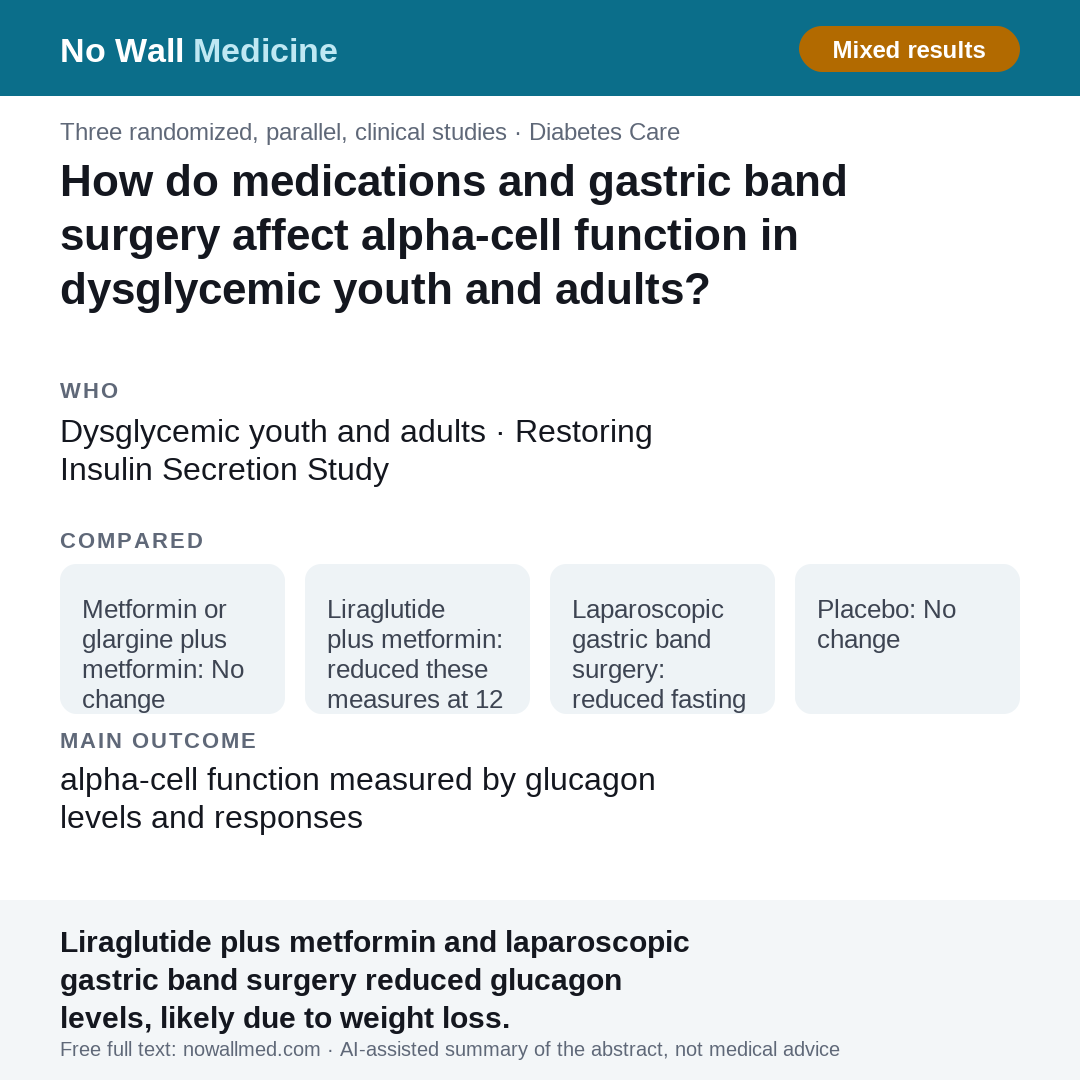
Clinical question: How do medications and gastric band surgery affect alpha-cell function in dysglycemic youth and adults?
Abstract
Objective
To compare effects of medications and laparoscopic gastric band surgery (LB) on α-cell function in dysglycemic youth and adults in the Restoring Insulin Secretion (RISE) Study protocols. Research design and methods
Glucagon was measured in three randomized, parallel, clinical studies: 1) 91 youth studied at baseline, after 12 months on metformin alone (MET) or glargine followed by metformin (G/M), and 3 months after treatment withdrawal; 2) 267 adults studied at the same time points and treated with MET, G/M, or liraglutide plus metformin (L+M) or given placebo (PLAC); and 3) 88 adults studied at baseline and after 12 and 24 months of LB or MET. Fasting glucagon, glucagon suppression by glucose, and acute glucagon response (AGR) to arginine were assessed during hyperglycemic clamps. Glucagon suppression was also measured during oral glucose tolerance tests (OGTTs). Results
No change in fasting glucagon, steady-state glucagon, or AGR was seen at 12 months following treatment with MET or G/M (in youth and adults) or PLAC (in adults). In contrast, L+M reduced these measures at 12 months (all P ≤ 0.005), which was maintained 3 months after treatment withdrawal (all P < 0.01). LB in adults also reduced fasting glucagon, steady-state glucagon, and AGR at 12 and 24 months (P < 0.05 for all, except AGR at 12 months [P = 0.098]). Similarly, glucagon suppression during OGTTs was greater with L+M and LB. Linear models demonstrated that treatment effects on glucagon with L+M and LB were largely associated with weight loss. Conclusions
Glucagon concentrations were reduced by L+M and LB in adults with dysglycemia, an effect principally attributable to weight loss in both interventions.
Subject terms
Cite this article
Kahn SE, Edelstein SL, Arslanian SA, Barengolts E, Caprio S, Ehrmann DA. Effect of Medical and Surgical Interventions on α-Cell Function in Dysglycemic Youth and Adults in the RISE Study. Diabetes Care. 2021. doi:10.2337/dc21-0461
Spotted a mistake? Suggest a correction
Top studies every Monday
The week’s key trials and guidelines in your specialties, plus any topics you follow. By email, free.
Get the weekly digest