Mobile application types show varying effects on stroke recovery and exercise adherence
Effect of mobile application types on stroke rehabilitation: a systematic review
Systematic review of 29 studiesMixed results
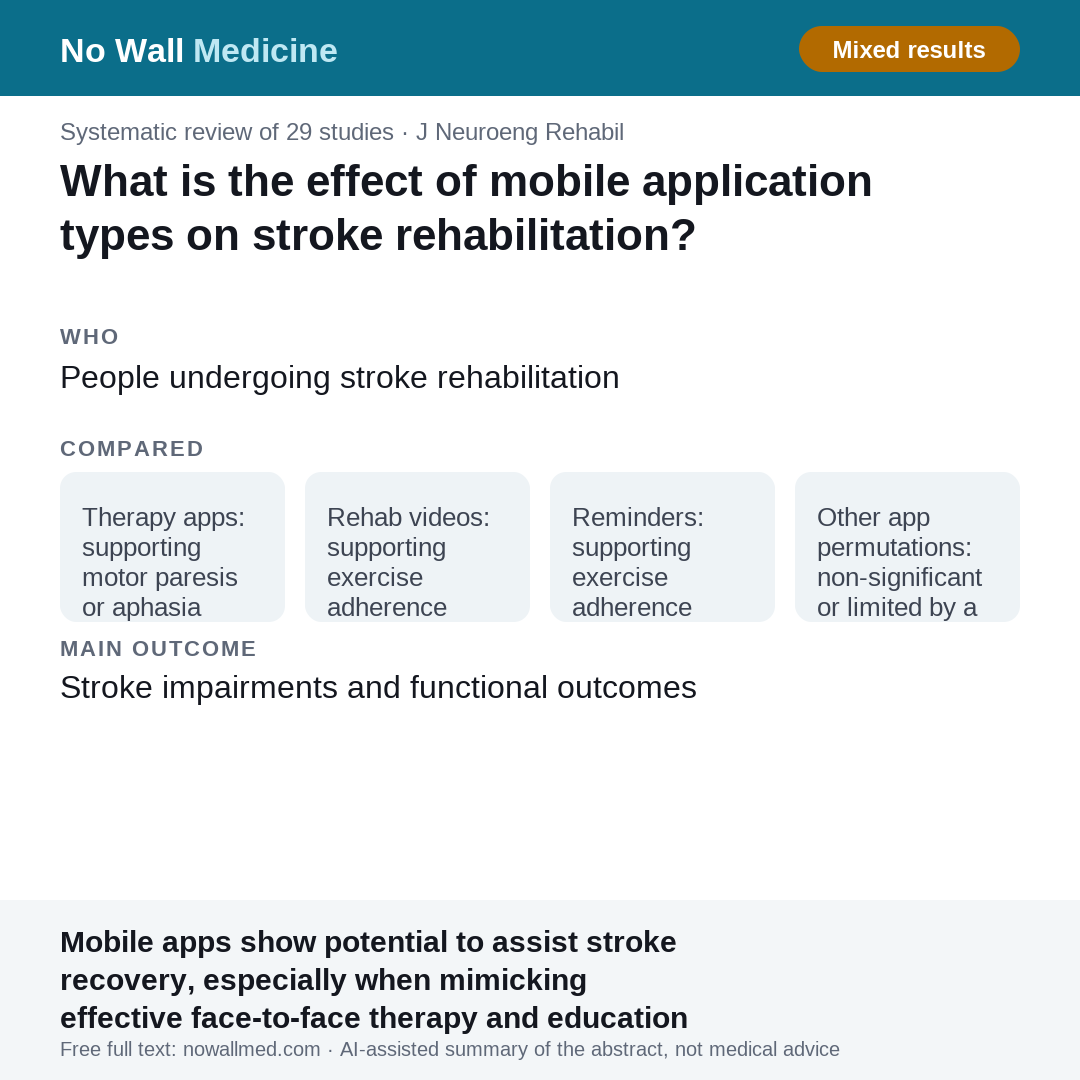
What is the effect of mobile application types on stroke rehabilitation?
Who
People undergoing stroke rehabilitation
Compared
Therapy apps: supporting motor paresis or aphasia
Rehab videos: supporting exercise adherence
Reminders: supporting exercise adherence
Other app permutations: non-significant or limited by a paucity of studies
Main outcome
Stroke impairments and functional outcomes
Bottom line: Mobile apps show potential to assist stroke recovery, especially when mimicking effective face-to-face therapy and education principles.
Limitation: Results for many app types were non-significant or limited by a paucity of studies.
J Neuroeng Rehabil · 2023-01-24Download image
Clinical question: What is the effect of mobile application types on stroke rehabilitation?
Why it matters: It is unknown how different types of mobile applications specifically impact various stroke impairments and functional recovery outcomes.
Key points
- Researchers reviewed 29 studies, including 11 randomized control trials and 18 quasi-experimental studies, to examine how different mobile app types affect stroke rehabilitation.
- Therapy apps were linked to improvements in motor paresis or aphasia, while rehab videos and reminders were linked to better adherence to exercise.
- Other app combinations showed non-significant results or were limited by a lack of available studies regarding functional outcomes and secondary prevention.
Limitation the authors note: The results for several app types and outcomes were limited by a paucity of studies.
Headline and key points written with AI from the paper’s abstract, with every number checked against it. Read the paper before relying on them.
Was this summary helpful?
Subject terms
Cite this article
Szeto SG, Wan H, Alavinia M, Dukelow S, MacNeill H. Effect of mobile application types on stroke rehabilitation: a systematic review. J Neuroeng Rehabil. 2023. doi:10.1186/s12984-023-01124-9
Spotted a mistake? Suggest a correction
Top studies every Monday
The week’s key trials and guidelines in your specialties, plus any topics you follow. By email, free.
Get the weekly digest