Modified vertical rectus belly transposition corrected eye misalignment better than augmented superior rectus transposition
Effect of Modified Vertical Rectus Belly Transposition vs Augmented Superior Rectus Transposition Plus Medial Rectus Recession for Chronic Sixth Nerve Palsy: A Randomized Clinical Trial
Randomized, double-masked trialBenefit found
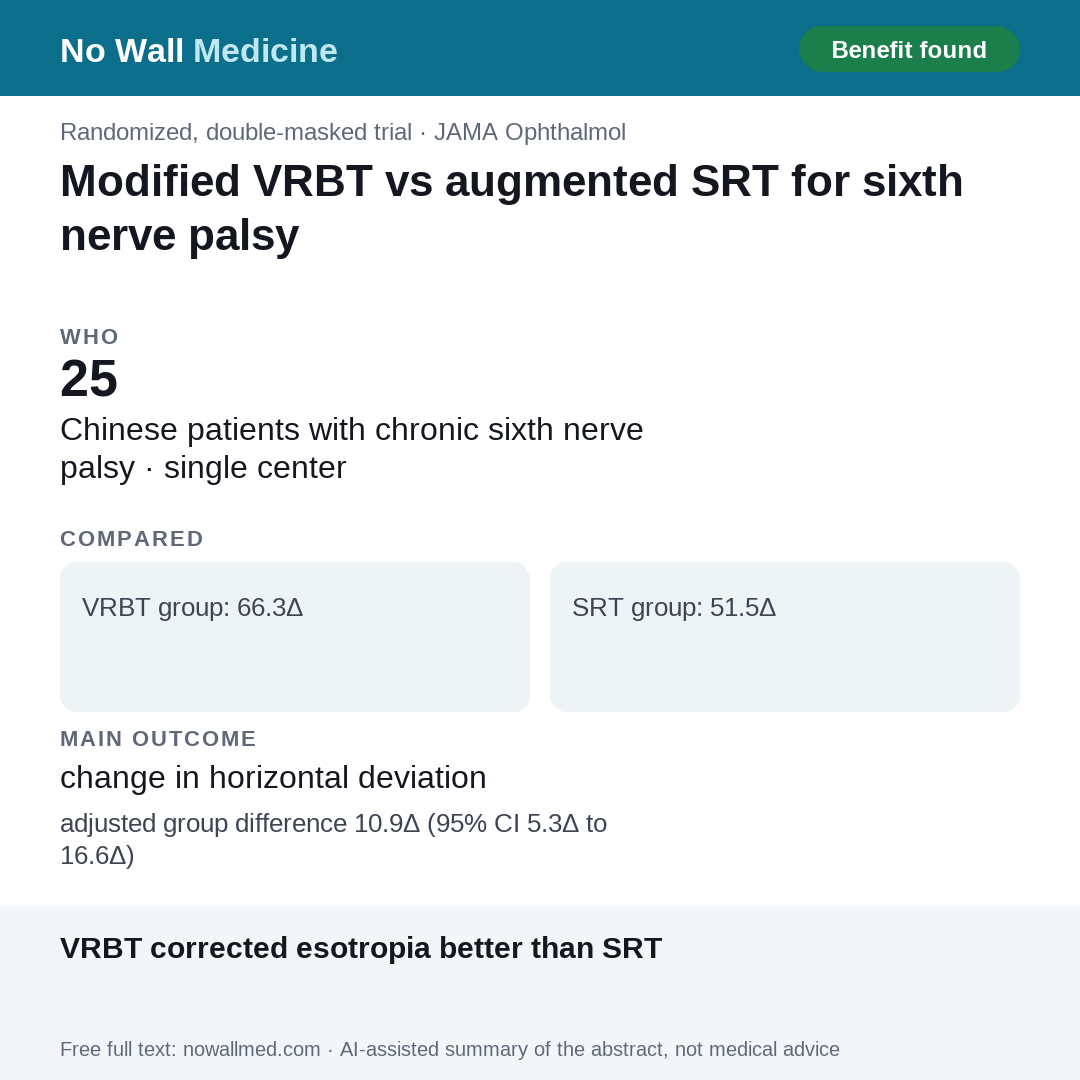
Modified VRBT vs augmented SRT for sixth nerve palsy
Who
25
Chinese patients with chronic sixth nerve palsy · single center
Compared
VRBT group: 66.3Δ
SRT group: 51.5Δ
Main outcome
change in horizontal deviation
Result: adjusted group difference 10.9Δ (95% CI 5.3Δ to 16.6Δ)
Bottom line: VRBT corrected esotropia better than SRT
Limitation: small sample size
JAMA Ophthalmol · 2022-08-05Download image
Why it matters: It is unclear whether modified vertical rectus belly transposition is superior to augmented superior rectus transposition plus medial rectus recession for correcting esotropia in chronic sixth nerve palsy.
Key points
- Researchers conducted a randomized trial with 25 Chinese patients with chronic sixth nerve palsy, comparing two different eye muscle surgery techniques.
- At 6 months, the modified vertical rectus belly transposition group had a mean horizontal deviation change of 66.3 prism diopters compared to 51.5 prism diopters in the augmented superior rectus transposition group.
- The modified vertical rectus belly transposition group had four times as many participants correcting more than 60 prism diopters and a higher rate of undercorrection in the other group.
Limitation the authors note: The authors note that results need to be confirmed in larger, diverse cohorts with longer follow-up.
Headline and key points written with AI from the paper’s abstract, with every number checked against it. Read the paper before relying on them.
Was this summary helpful?
Subject terms
Cite this article
Yao J, Jiang C, Wang X, Xia W, Ling L, Zhu W. Effect of Modified Vertical Rectus Belly Transposition vs Augmented Superior Rectus Transposition Plus Medial Rectus Recession for Chronic Sixth Nerve Palsy: A Randomized Clinical Trial. JAMA Ophthalmol. 2022. doi:10.1001/jamaophthalmol.2022.2856
Spotted a mistake? Suggest a correction
Top studies every Monday
The week’s key trials and guidelines in your specialties, plus any topics you follow. By email, free.
Get the weekly digest