Dihydroartemisinin-piperaquine was associated with more adverse pregnancy outcomes than sulfadoxine-pyrimethamine in African women
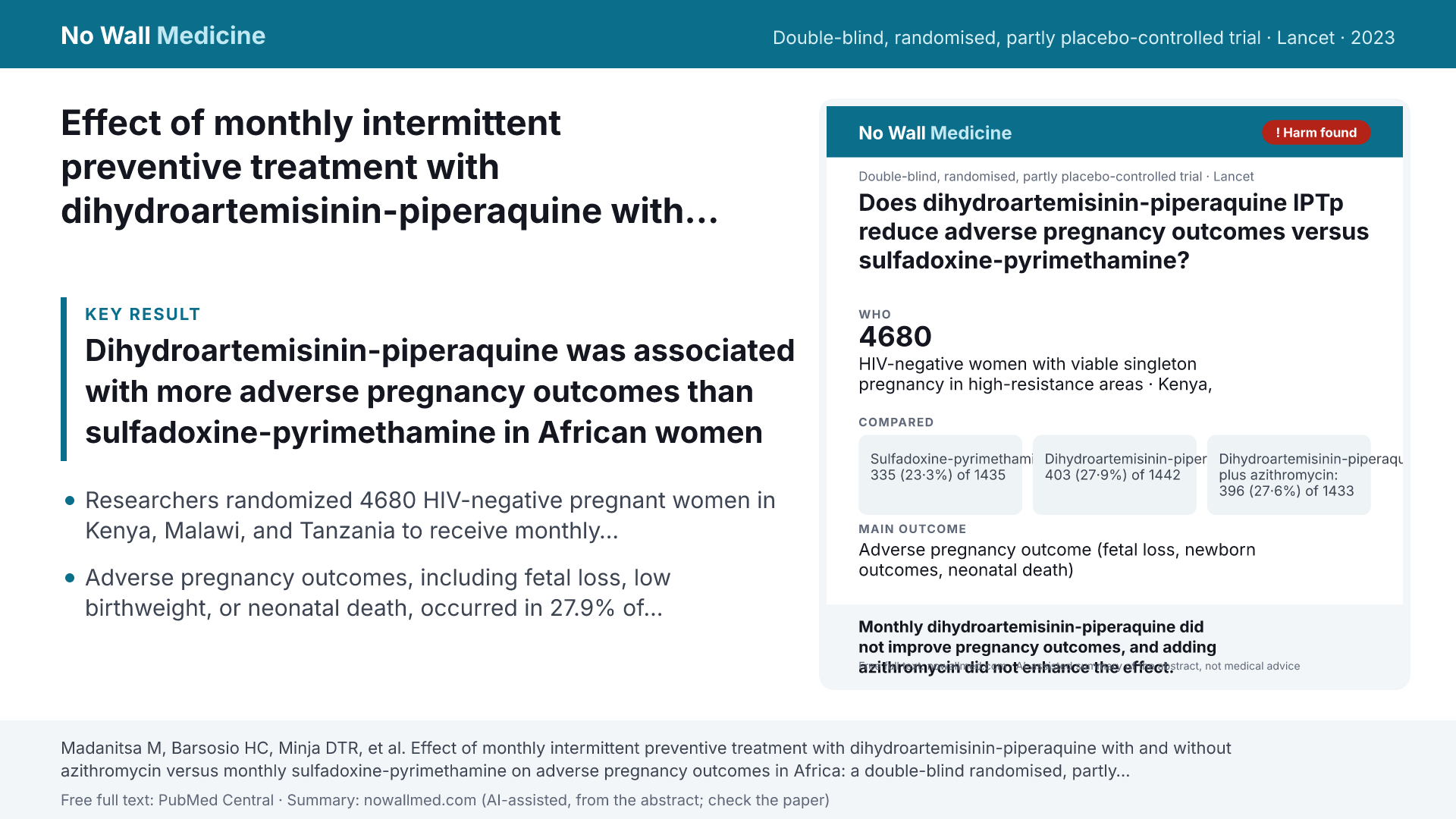
Effect of monthly intermittent preventive treatment with dihydroartemisinin-piperaquine with and without azithromycin versus monthly sulfadoxine-pyrimethamine on adverse pregnancy outcomes in Africa: a double-blind randomised, partly placebo-controlled trial
Randomised, double-blind, three-arm, partly placebo-controlled trialHarm found
Does dihydroartemisinin-piperaquine with or without azithromycin reduce adverse pregnancy outcomes compared to sulfadoxine-pyrimethamine?
Who
4680
HIV-negative women with a viable singleton pregnancy · Kenya, Malawi, and Tanzania
Compared
23.3%Sulfadoxine-pyrimethamine
27.9%Dihydroartemisinin-piperaquine
27.6%Dihydroartemisinin-piperaquine plus azithromycin
Main outcome
Adverse pregnancy outcome (fetal loss, adverse newborn outcomes, or neonatal death)
Result: risk ratio 1.20 (95% CI 1.06-1.36); risk ratio 1.16 (95% CI 1.03-1.32)
Bottom line: Dihydroartemisinin-piperaquine alone or with azithromycin increased adverse pregnancy outcomes compared to sulfadoxine-pyrimethamine.
Funded by: European & Developing Countries Clinical Trials Partnership 2, EU, UK FCDO, Medical Research Council
Lancet · 2023-03-10Download image
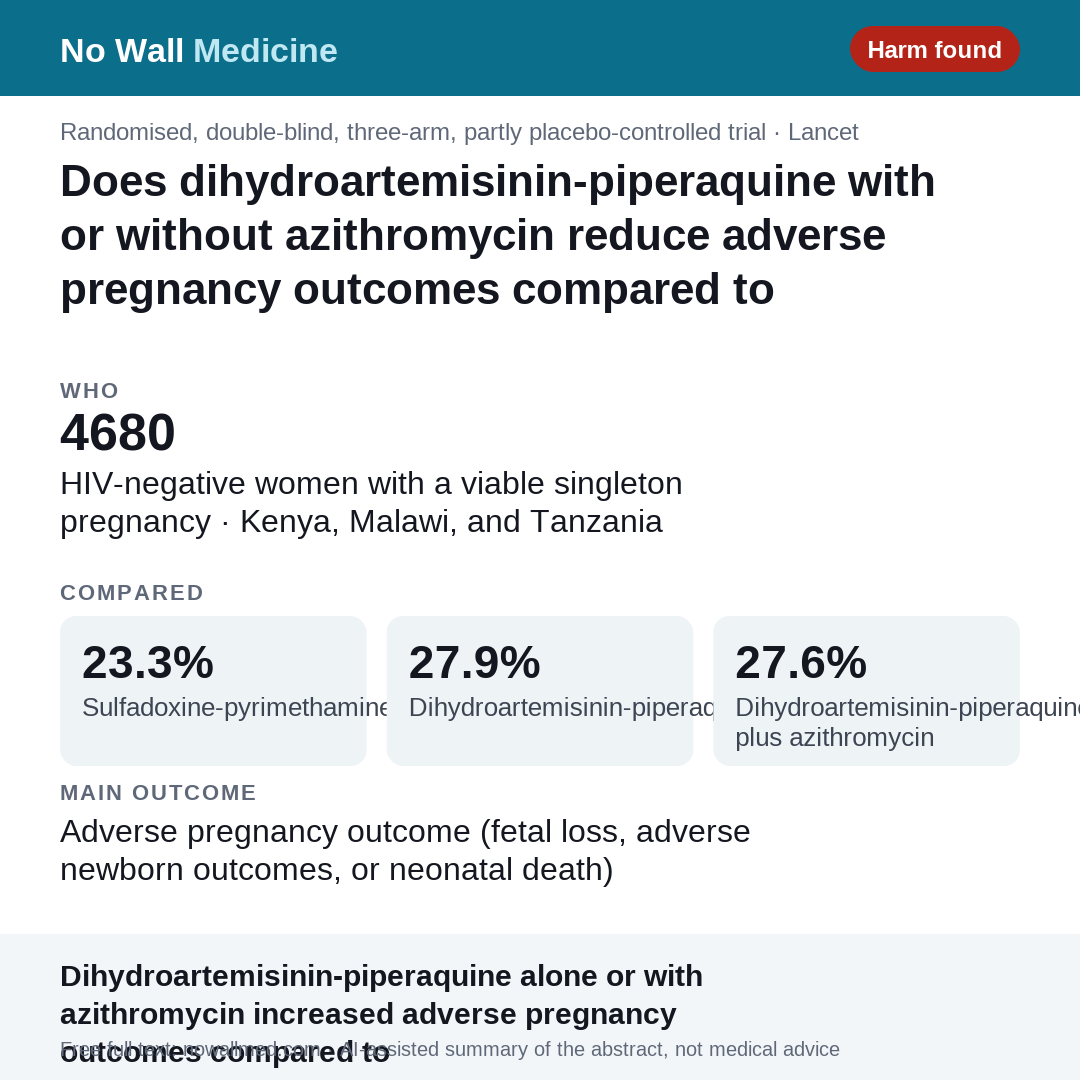
Clinical question: Does dihydroartemisinin-piperaquine with or without azithromycin reduce adverse pregnancy outcomes compared to sulfadoxine-pyrimethamine?
Why it matters: It is unclear if dihydroartemisinin-piperaquine, alone or with azithromycin, can reduce adverse pregnancy outcomes in areas where malaria parasites show high resistance to sulfadoxine-pyrimethamine.
Key points
- Researchers randomized 4680 HIV-negative pregnant women in Kenya, Malawi, and Tanzania to receive monthly malaria prevention with sulfadoxine-pyrimethamine, dihydroartemisinin-piperaquine, or dihydroartemisinin-piperaquine plus azithromycin.
- Adverse pregnancy outcomes, including fetal loss, low birthweight, or neonatal death, occurred in 27.9% of the dihydroartemisinin-piperaquine group and 27.6% of the dihydroartemisinin-piperaquine plus azithromycin group compared to 23.3% in the sulfadoxine-pyrimethamine group.
- The incidence of serious adverse events for mothers and infants was similar across all three treatment groups.
Headline and key points written with AI from the paper’s abstract, with every number checked against it. Read the paper before relying on them.
Was this summary helpful?
Abstract
Background
Intermittent preventive treatment in pregnancy (IPTp) with dihydroartemisinin-piperaquine is more effective than IPTp with sulfadoxine-pyrimethamine at reducing malaria infection during pregnancy in areas with high-grade resistance to sulfadoxine-pyrimethamine by Plasmodium falciparum in east Africa. We aimed to assess whether IPTp with dihydroartemisinin-piperaquine, alone or combined with azithromycin, can reduce adverse pregnancy outcomes compared with IPTp with sulfadoxine-pyrimethamine. Methods
We did an individually randomised, double-blind, three-arm, partly placebo-controlled trial in areas of high sulfadoxine-pyrimethamine resistance in Kenya, Malawi, and Tanzania. HIV-negative women with a viable singleton pregnancy were randomly assigned (1:1:1) by computer-generated block randomisation, stratified by site and gravidity, to receive monthly IPTp with sulfadoxine-pyrimethamine (500 mg of sulfadoxine and 25 mg of pyrimethamine for 1 day), monthly IPTp with dihydroartemisinin-piperaquine (dosed by weight; three to five tablets containing 40 mg of dihydroartemisinin and 320 mg of piperaquine once daily for 3 consecutive days) plus a single treatment course of placebo, or monthly IPTp with dihydroartemisinin-piperaquine plus a single treatment course of azithromycin (two tablets containing 500 mg once daily for 2 consecutive days). Outcome assessors in the delivery units were masked to treatment group. The composite primary endpoint was adverse pregnancy outcome, defined as fetal loss, adverse newborn baby outcomes (small for gestational age, low birthweight, or preterm), or neonatal death. The primary analysis was by modified intention to treat, consisting of all randomised participants with primary endpoint data. Women who received at least one dose of study drug were included in the safety analyses. This trial is registered with ClinicalTrials.gov, NCT03208179. Findings
From March-29, 2018, to July 5, 2019, 4680 women (mean age 25·0 years [SD 6·0]) were enrolled and randomly assigned: 1561 (33%; mean age 24·9 years [SD 6·1]) to the sulfadoxine-pyrimethamine group, 1561 (33%; mean age 25·1 years [6·1]) to the dihydroartemisinin-piperaquine group, and 1558 (33%; mean age 24·9 years [6.0]) to the dihydroartemisinin-piperaquine plus azithromycin group. Compared with 335 (23·3%) of 1435 women in the sulfadoxine-pyrimethamine group, the primary composite endpoint of adverse pregnancy outcomes was reported more frequently in the dihydroartemisinin-piperaquine group (403 [27·9%] of 1442; risk ratio 1·20, 95% CI 1·06-1·36; p=0·0040) and in the dihydroartemisinin-piperaquine plus azithromycin group (396 [27·6%] of 1433; 1·16, 1·03-1·32; p=0·017). The incidence of serious adverse events was similar in mothers (sulfadoxine-pyrimethamine group 17·7 per 100 person-years, dihydroartemisinin-piperaquine group 14·8 per 100 person-years, and dihydroartemisinin-piperaquine plus azithromycin group 16·9 per 100 person-years) and infants (sulfadoxine-pyrimethamine group 49·2 per 100 person-years, dihydroartemisinin-piperaquine group 42·4 per 100 person-years, and dihydroartemisinin-piperaquine plus azithromycin group 47·8 per 100 person-years) across treatment groups. 12 (0·2%) of 6685 sulfadoxine-pyrimethamine, 19 (0·3%) of 7014 dihydroartemisinin-piperaquine, and 23 (0·3%) of 6849 dihydroartemisinin-piperaquine plus azithromycin treatment courses were vomited within 30 min. Interpretation
Monthly IPTp with dihydroartemisinin-piperaquine did not improve pregnancy outcomes, and the addition of a single course of azithromycin did not enhance the effect of monthly IPTp with dihydroartemisinin-piperaquine. Trials that combine sulfadoxine-pyrimethamine and dihydroartemisinin-piperaquine for IPTp should be considered. Funding
European & Developing Countries Clinical Trials Partnership 2, supported by the EU, and the UK Joint-Global-Health-Trials-Scheme of the Foreign, Commonwealth and Development Office, Medical Research Council, Department of Health and Social Care, Wellcome, and the Bill-&-Melinda-Gates-Foundation.
Abstract reproduced under the article’s CC BY licence.
Subject terms
Cite this article
Madanitsa M, Barsosio HC, Minja DTR, et al. Effect of monthly intermittent preventive treatment with dihydroartemisinin-piperaquine with and without azithromycin versus monthly sulfadoxine-pyrimethamine on adverse pregnancy outcomes in Africa: a double-blind randomised, partly placebo-controlled trial. Lancet. 2023. doi:10.1016/S0140-6736(22)02535-1
Spotted a mistake? Suggest a correction