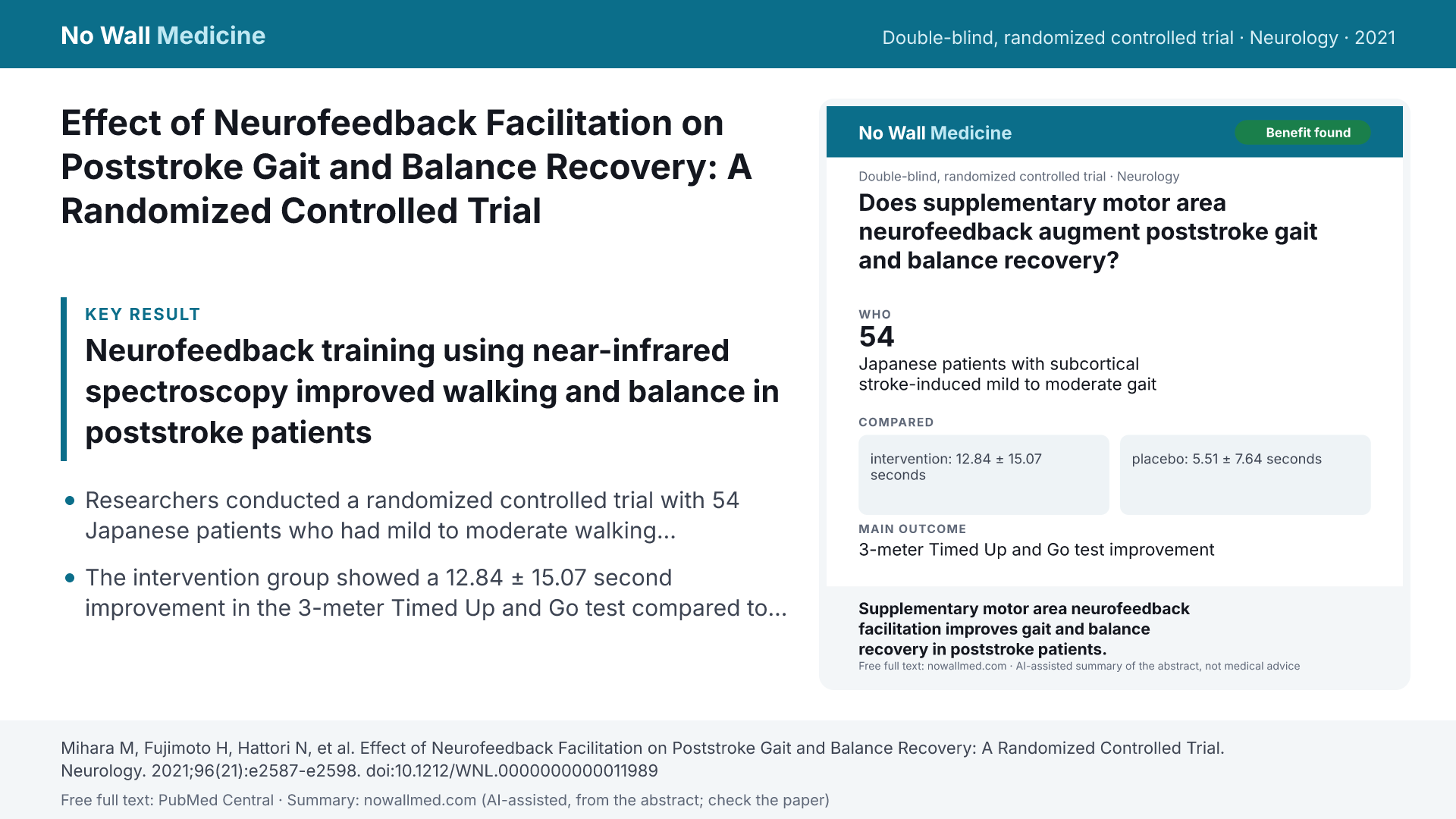
Neurofeedback training using near-infrared spectroscopy improved walking and balance in poststroke patients
Effect of Neurofeedback Facilitation on Poststroke Gait and Balance Recovery: A Randomized Controlled Trial
Double-blind, randomized controlled trialBenefit found
Does supplementary motor area neurofeedback augment poststroke gait and balance recovery?
Who
54
Japanese patients with subcortical stroke-induced mild to moderate gait disturbance · 2-center
Compared
intervention: 12.84 ± 15.07 seconds
placebo: 5.51 ± 7.64 seconds
Main outcome
3-meter Timed Up and Go test improvement
Result: group difference 7.33 seconds, 95% CI 0.83-13.83
Bottom line: Supplementary motor area neurofeedback facilitation improves gait and balance recovery in poststroke patients.
Neurology · 2021-04-20 · Save PNG
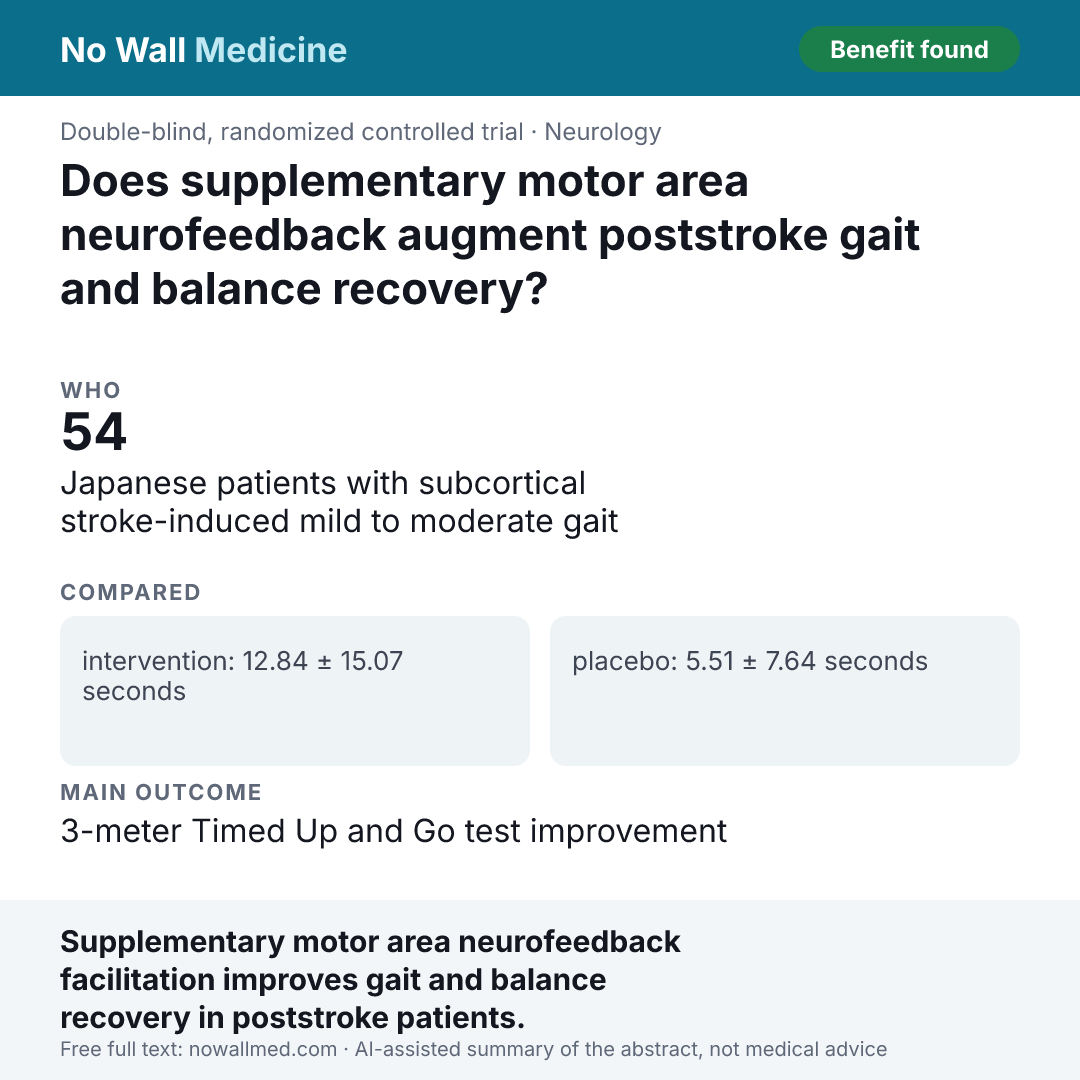
Clinical question: Does supplementary motor area neurofeedback augment poststroke gait and balance recovery?
Key points
- Researchers conducted a randomized controlled trial with 54 Japanese patients who had mild to moderate walking difficulties following a subcortical stroke.
- The intervention group showed a 12.84 ± 15.07 second improvement in the 3-meter Timed Up and Go test compared to a 5.51 ± 7.64 second improvement in the placebo group.
- Only the intervention group showed increased brain activation in the supplementary motor area and stronger connections between that area and the ventrolateral premotor area.
Headline and key points written with AI from the paper’s abstract, with every number checked against it. Read the paper before relying on them.
Was this summary helpful?
Subject terms
Headline, design, result, key points, caveat and citation as plain text.
Cite this article
Mihara M, Fujimoto H, Hattori N, et al. Effect of Neurofeedback Facilitation on Poststroke Gait and Balance Recovery: A Randomized Controlled Trial. Neurology. 2021;96(21):e2587-e2598. doi:10.1212/WNL.0000000000011989
Spotted a mistake? Suggest a correction