Protocol for randomized trial testing nociception level-directed opioid management during prostatectomy surgery
Effect of NOciception Level-Directed analgesic management on Opioid usage in Robot-assisted laparoscopic radical prostatectomy (NOLDOR): study protocol for a single-centre single-blinded randomised controlled trial
Single-centre single-blinded randomized controlled trialUnclear result
Does nociception level-directed opioid management reduce opioid usage in radical prostatectomy?
Who
54
Patients undergoing robot-assisted laparoscopic radical prostatectomy · Single-centre
Compared
NOL-directed intraoperative opioid management
Conventional intraoperative analgesic management
Main outcome
mean intraoperative remifentanil infusion rate
Bottom line: This study protocol aims to investigate the effects of nociception level-directed opioid management.
BJA Open · 2022-11-21Download image
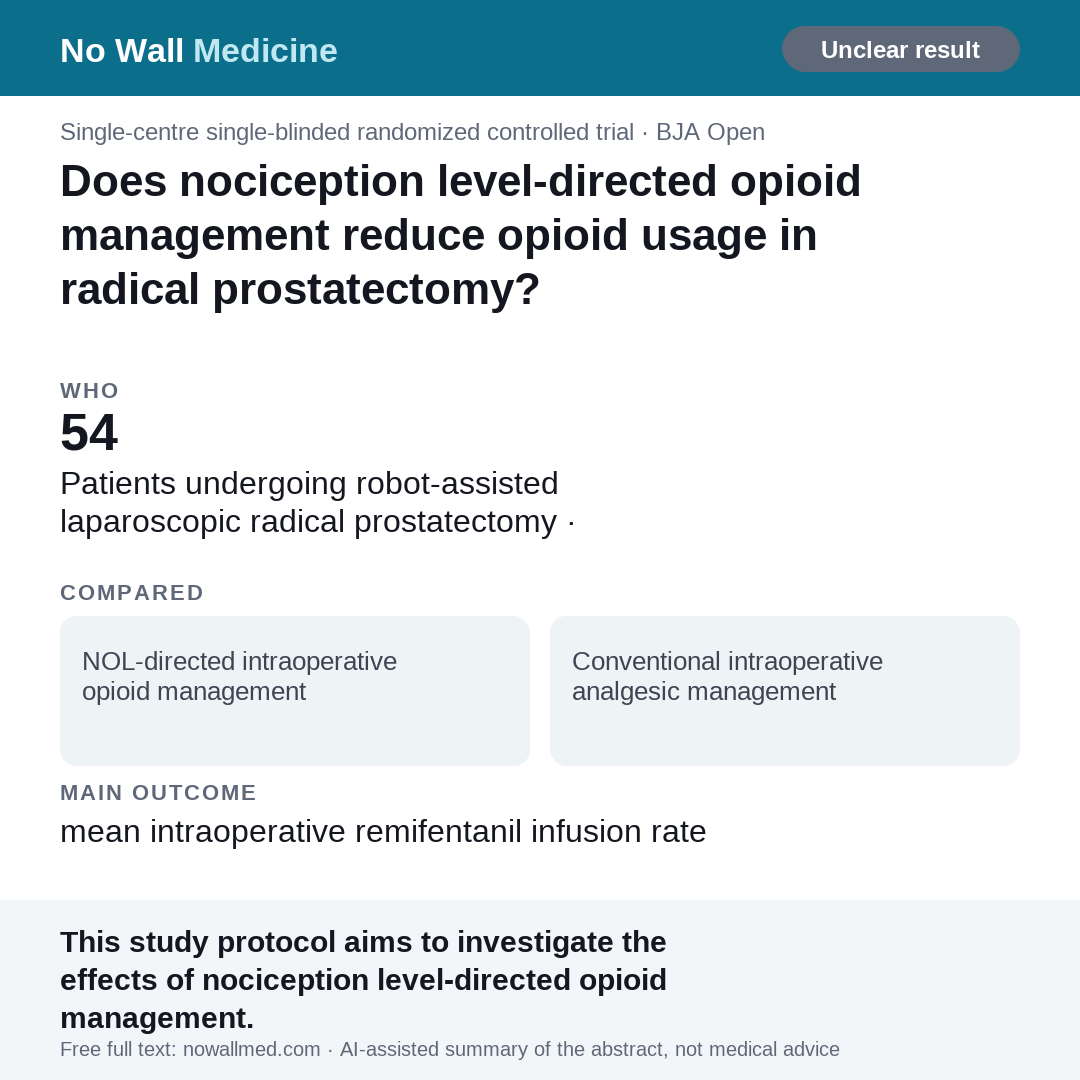
Clinical question: Does nociception level-directed opioid management reduce opioid usage in radical prostatectomy?
Why it matters: It is unknown if a nociception level-directed opioid protocol reduces intraoperative opioid consumption or if it causes an unintended increase in the stress response.
Key points
- The study will enroll 54 patients undergoing robot-assisted laparoscopic radical prostatectomy to compare nociception level-directed opioid management against conventional analgesic management.
- The primary outcome being measured is the mean intraoperative remifentanil infusion rate, which is a short-acting opioid used during surgery.
- Researchers will also measure plasma concentrations of three inflammatory biomarkers, including interleukin-6, C-reactive protein, and cortisol.
Headline and key points written with AI from the paper’s abstract, with every number checked against it. Read the paper before relying on them.
Was this summary helpful?
Cite this article
Kadoya Y, Tanaka N, Suzuka T, Yamanaka T, Ida M, Naito Y. Effect of NOciception Level-Directed analgesic management on Opioid usage in Robot-assisted laparoscopic radical prostatectomy (NOLDOR): study protocol for a single-centre single-blinded randomised controlled trial. BJA Open. 2022. doi:10.1016/j.bjao.2022.100112
Spotted a mistake? Suggest a correction
Top studies every Monday
The week’s key trials and guidelines in your specialties, plus any topics you follow. By email, free.
Get the weekly digest