Opioid-free anesthesia did not change morphine use after gastric bypass surgery compared to opioid-based methods
Effect of opioid-free versus opioid-based strategies during multimodal anaesthesia on postoperative morphine consumption after bariatric surgery: a randomised double-blind clinical trial
Randomised, double-blind clinical trialNo clear difference
Does opioid-free versus opioid-based multimodal anaesthesia reduce postoperative morphine consumption after bariatric surgery?
Who
172
Class III obese patients having laparoscopic gastric bypass surgery
Compared
Opioid-free group: median [inter-quartile range]: 16 [13-26] mg
Opioid-based group: median [inter-quartile range]: 15 [10-24] mg
Main outcome
24-h postoperative morphine consumption
Bottom line: Opioid-free anaesthesia did not decrease postoperative morphine consumption compared with opioid-based strategies during bariatric surgery.
BJA Open · 2024-02-23 · Save PNG
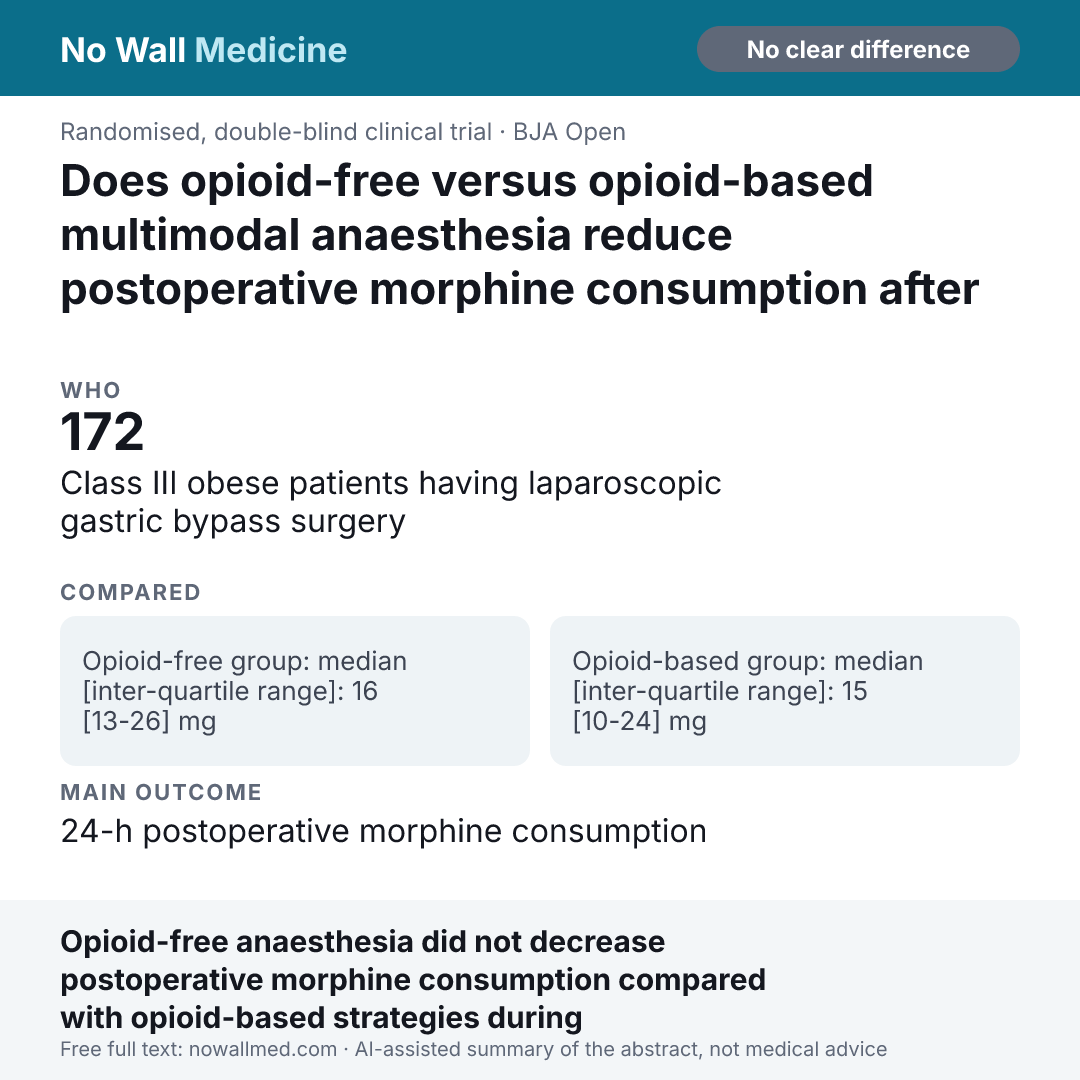
Clinical question: Does opioid-free versus opioid-based multimodal anaesthesia reduce postoperative morphine consumption after bariatric surgery?
Why it matters: It is debated whether an opioid-free anesthesia strategy combined with multimodal analgesia is more effective than opioid-based strategies for bariatric surgery patients.
Key points
- Researchers studied 172 class III obese patients undergoing laparoscopic gastric bypass surgery, comparing an opioid-free strategy to an opioid-based strategy.
- The median 24-hour postoperative morphine consumption was 16 [13-26] mg in the opioid-free group and 15 [10-24] mg in the opioid-based group.
- Postoperative nausea and vomiting was less frequent in the opioid-free group at 37% compared to 59% in the opioid-based group.
Headline and key points written with AI from the paper’s abstract, with every number checked against it. Read the paper before relying on them.
Was this summary helpful?
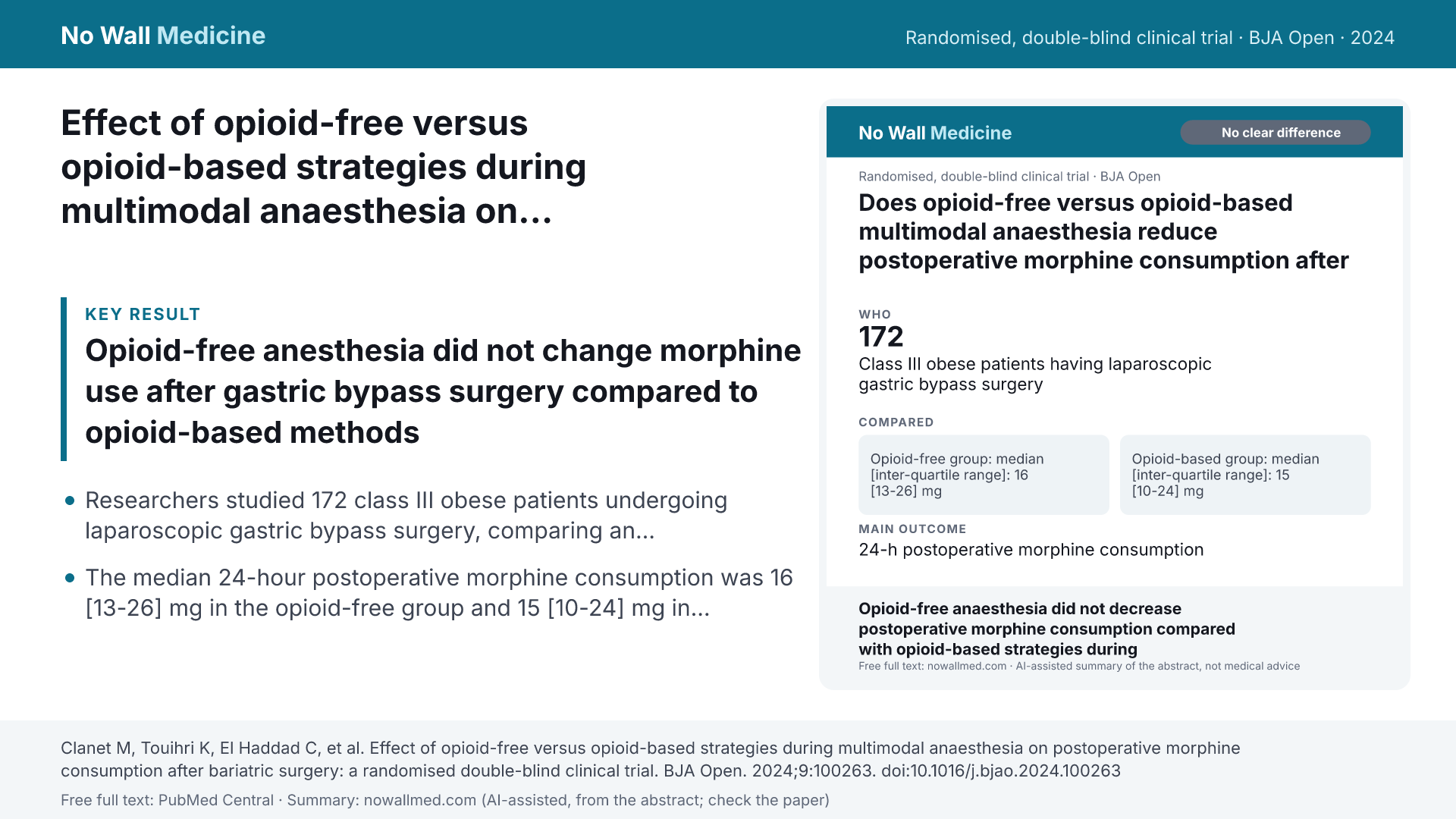
Headline, design, result, key points, caveat and citation as plain text.
Cite this article
Clanet M, Touihri K, El Haddad C, et al. Effect of opioid-free versus opioid-based strategies during multimodal anaesthesia on postoperative morphine consumption after bariatric surgery: a randomised double-blind clinical trial. BJA Open. 2024;9:100263. doi:10.1016/j.bjao.2024.100263
Spotted a mistake? Suggest a correction