Removing primary tumors was associated with longer survival in patients with metastatic small intestine neuroendocrine tumors
Effect of primary tumour resection without curative intent in patients with metastatic neuroendocrine tumours of the small intestine and right colon: meta-analysis
Meta-analysis of 16 studiesBenefit found
Does primary tumour resection without curative intent improve survival in metastatic small intestinal neuroendocrine tumours?
Who
9428
Patients with metastatic small intestinal and right colon neuroendocrine tumours
Compared
Primary tumour resection: 112 (i.q.r. 82-134) months
No resection: 60 (74-88) months
Main outcome
Overall survival
Result: hazard ratio 0.55 (95 per cent c.i. 0.47 to 0.66)
Bottom line: Primary tumour resection is associated with increased survival in patients with advanced, metastatic small intestinal neuroendocrine tumours.
Br J Surg · 2021-12-24Download image
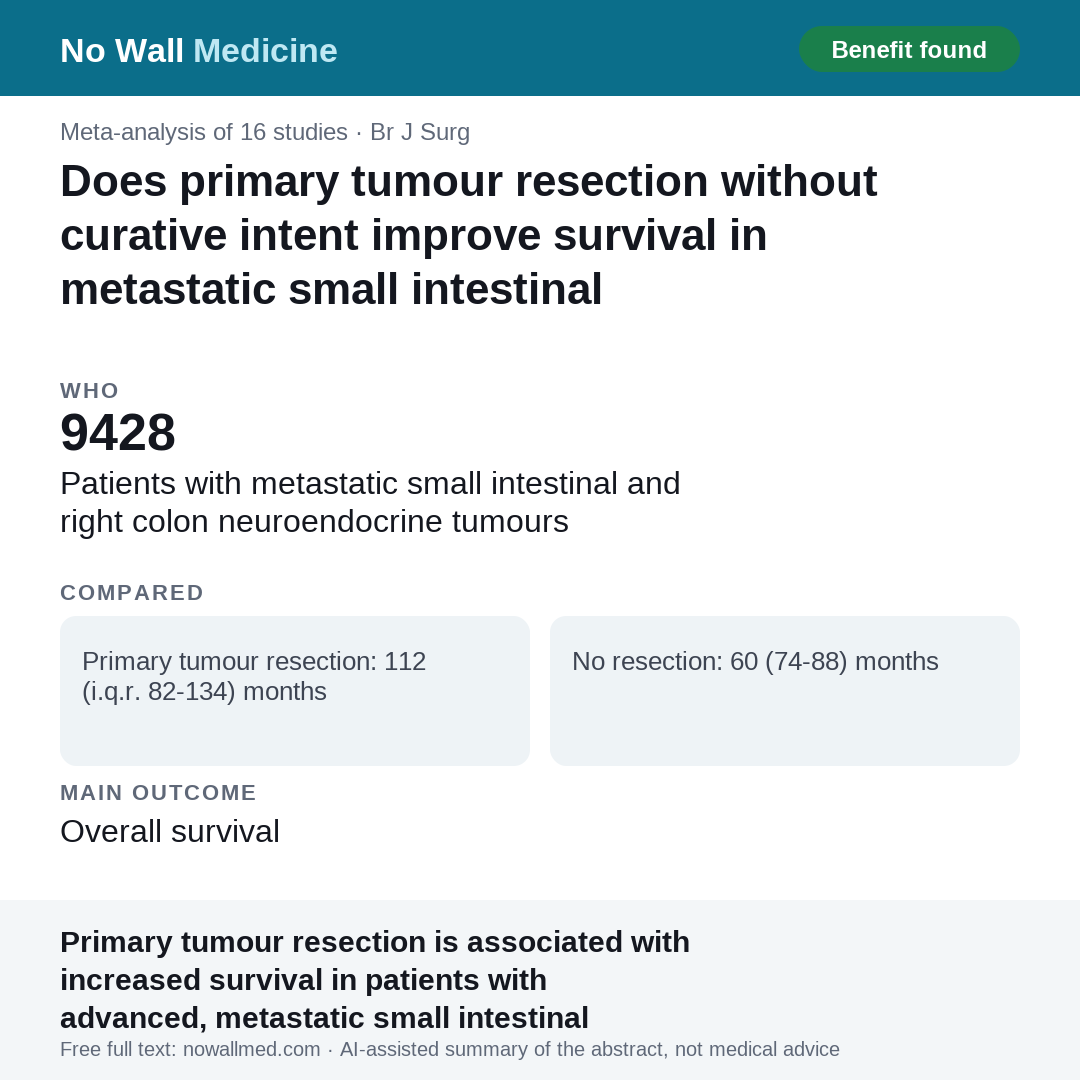
Clinical question: Does primary tumour resection without curative intent improve survival in metastatic small intestinal neuroendocrine tumours?
Why it matters: It is controversial whether removing the primary tumor without the intent to cure the patient is beneficial for those with metastatic small intestine neuroendocrine tumors.
Key points
- Researchers analyzed 16 studies involving 9428 patients to compare survival after primary tumor removal without curative intent versus no tumor removal.
- The primary tumor resection group had a median overall survival of 112 (i.q.r. 82-134) months compared to 60 (74-88) months for those without resection.
- Five-year overall survival rates were 74 (i.q.r. 67-77)% in the resection group and 44 (34-45)% in the group without resection.
Headline and key points written with AI from the paper’s abstract, with every number checked against it. Read the paper before relying on them.
Was this summary helpful?
Subject terms
Cite this article
Van Den Heede K, Chidambaram S, Van Slycke S, Brusselaers N, Warfvinge CF, Ohlsson H. Effect of primary tumour resection without curative intent in patients with metastatic neuroendocrine tumours of the small intestine and right colon: meta-analysis. Br J Surg. 2021. doi:10.1093/bjs/znab413
Spotted a mistake? Suggest a correction
Top studies every Monday
The week’s key trials and guidelines in your specialties, plus any topics you follow. By email, free.
Get the weekly digest