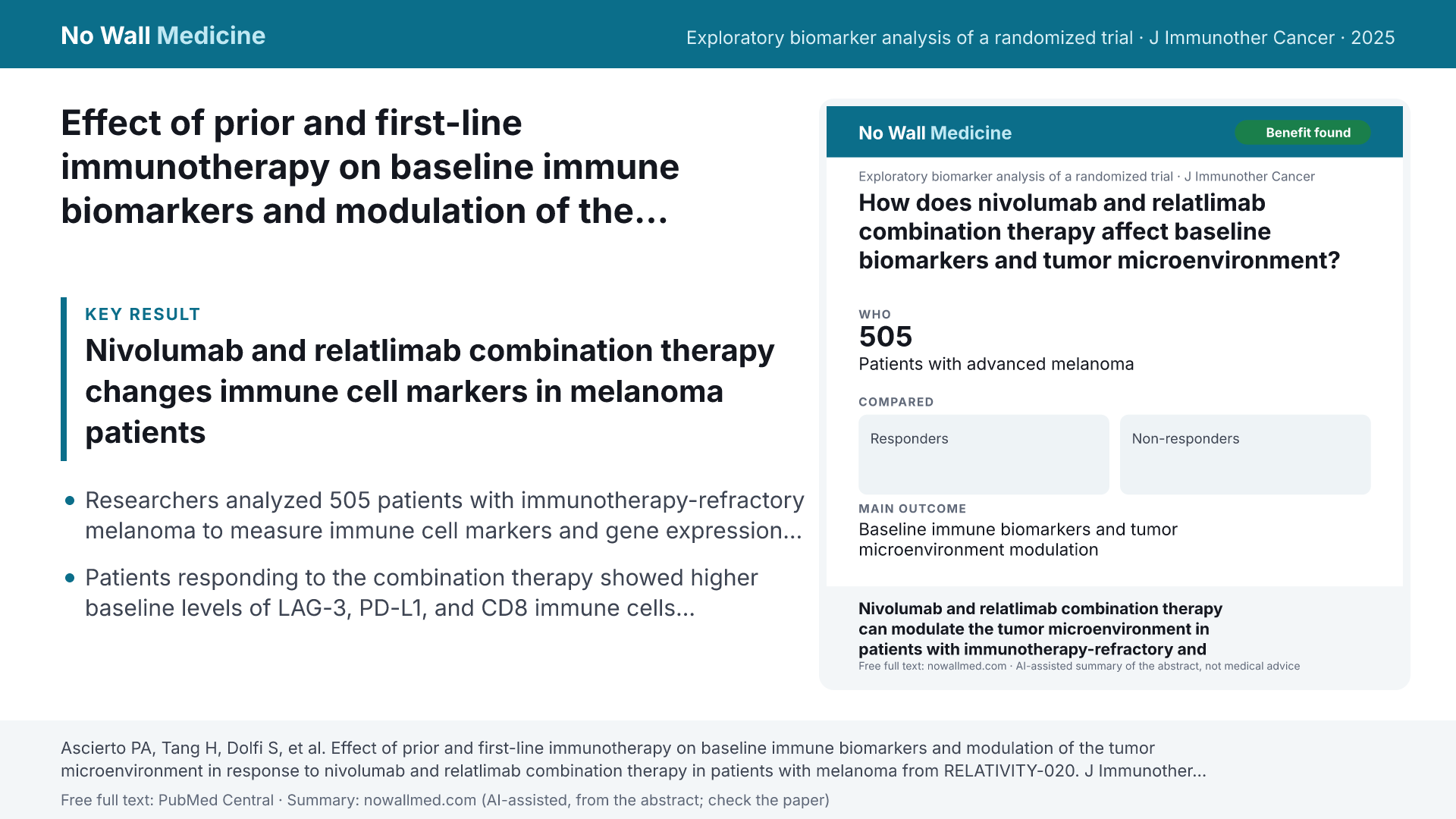
Nivolumab and relatlimab combination therapy changes immune cell markers in melanoma patients
Effect of prior and first-line immunotherapy on baseline immune biomarkers and modulation of the tumor microenvironment in response to nivolumab and relatlimab combination therapy in patients with melanoma from RELATIVITY-020
Exploratory biomarker analysis of a randomized trialBenefit found
How does nivolumab and relatlimab combination therapy affect baseline biomarkers and tumor microenvironment?
Who
505
Patients with advanced melanoma
Compared
Responders
Non-responders
Main outcome
Baseline immune biomarkers and tumor microenvironment modulation
Bottom line: Nivolumab and relatlimab combination therapy can modulate the tumor microenvironment in patients with immunotherapy-refractory and immunotherapy-naïve melanoma.
J Immunother Cancer · 2025-02-25Download image
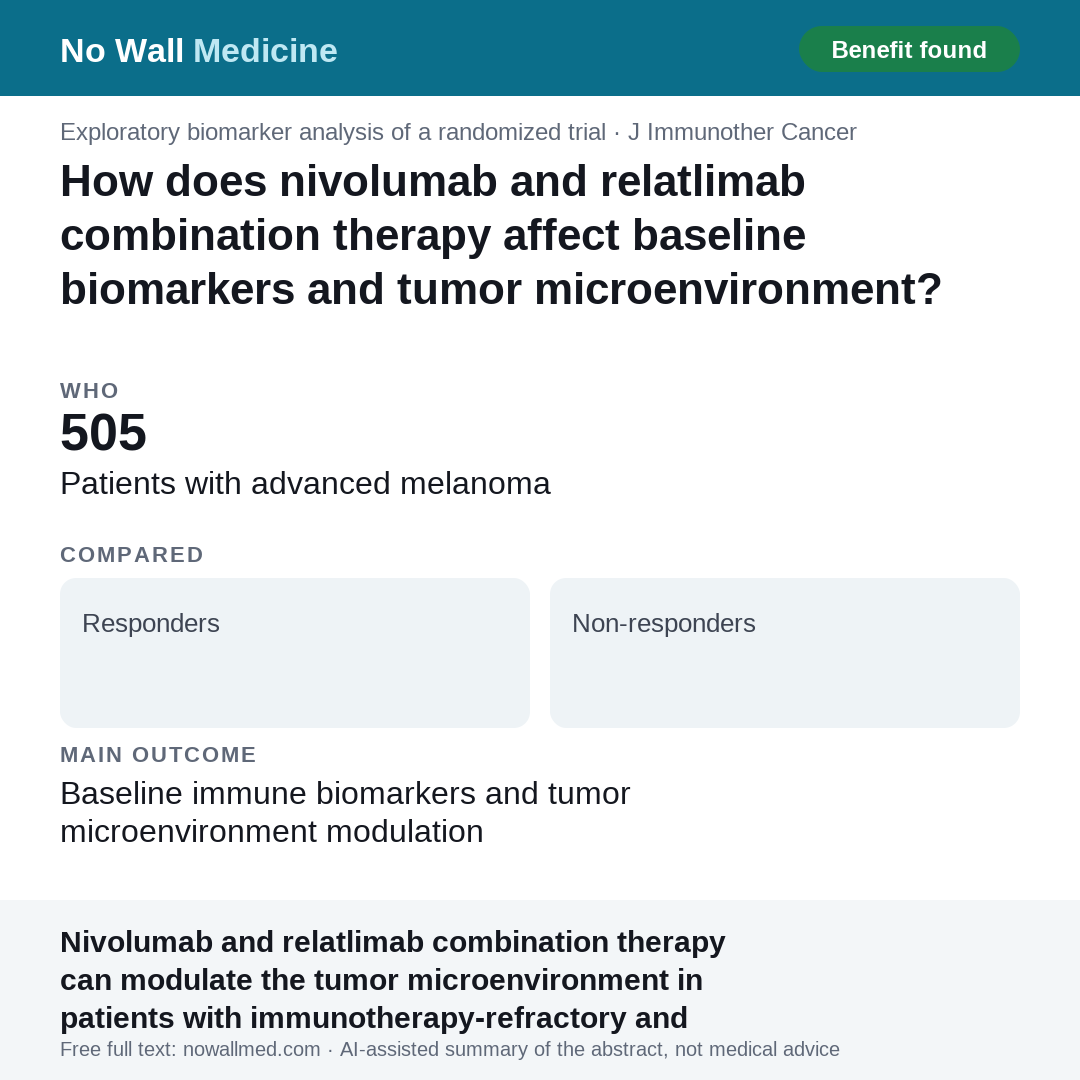
Clinical question: How does nivolumab and relatlimab combination therapy affect baseline biomarkers and tumor microenvironment?
Why it matters: It is unknown how prior immunotherapy exposure and different types of resistance affect baseline immune biomarkers and the tumor microenvironment when using new combination therapies.
Key points
- Researchers analyzed 505 patients with immunotherapy-refractory melanoma to measure immune cell markers and gene expression in tumor biopsies.
- Patients responding to the combination therapy showed higher baseline levels of LAG-3, PD-L1, and CD8 immune cells compared to non-responders.
- During treatment, LAG-3 expression increased in both immunotherapy-refractory and immunotherapy-naïve patients, while PD-L1 and CD8 increased in immunotherapy-naïve patients.
Headline and key points written with AI from the paper’s abstract, with every number checked against it. Read the paper before relying on them.
Was this summary helpful?
Abstract
Background
Some patients with melanoma experience disease progression during immunotherapy (IO) and may benefit from novel combinations of immune checkpoint inhibitors (ICIs). We report results from exploratory biomarker analyses to characterize the responses of patients with advanced melanoma to treatment with nivolumab (anti-programmed cell death-1 (PD-1)) and relatlimab (anti-lymphocyte-activation gene 3 (LAG-3)) combination therapy in RELATIVITY-020 (NCT01968109). Methods
Tumor biopsies collected at baseline and ≤4 weeks after treatment initiation were evaluated for % LAG-3-positive and % CD8-positive immune cells and % programmed death-ligand 1 (PD-L1) expression on tumor cells. Baseline biomarker expression was compared among patients with IO-refractory melanoma based on last prior therapy and IO-resistance type, and between patients with IO-refractory and IO-naïve melanoma. Change in biomarker expression after treatment was evaluated in patients with IO-refractory and IO-naïve melanoma. Immune-related gene expression was compared among resistance groups and by the last prior treatment. Results
Among patients with IO-refractory melanoma (N=505), elevated baseline LAG-3, PD-L1, and CD8 expression (p≤0.01, p≤0.05, p≤0.001, respectively) was observed in patients whose last prior therapy was IO versus non-IO, and in those who responded (complete/partial per Response Evaluation Criteria in Solid Tumors V.1.1) to nivolumab and relatlimab combination therapy versus those who did not (stable/progressive disease). Inflammation-related gene expression was significantly higher (p<0.05) in patients with secondary versus primary resistance to prior IO treatment, and in those whose last prior therapy was IO versus non-IO. IO-refractory patients whose tumors responded to nivolumab and relatlimab combination therapy had higher inflammation-related gene expression than non-responders (p<0.05); proliferation and hypoxia-related gene expression were enriched in non-responders. During treatment with nivolumab and relatlimab combination therapy, LAG-3 expression increased significantly in patients with IO-refractory (p≤0.01) and IO-naïve melanoma (p≤0.001), and PD-L1 and CD8 increased significantly (p≤0.01 and p≤0.05, respectively) in patients with IO-naïve melanoma. Conclusions
Nivolumab and relatlimab combination therapy can modulate the tumor microenvironment in patients with both IO-refractory and IO-naïve melanoma. Further research is needed to identify patients who will most benefit from anti-LAG-3/PD-(L)1 agents, and to elucidate the mechanisms of action of, and resistance to, this combination therapy in patients with advanced melanoma. Trial registration number
NCT01968109.
Abstract reproduced under the article’s CC BY NC licence.
Subject terms
Cite this article
Ascierto PA, Tang H, Dolfi S, Nyakas M, Marie Svane I, Muñoz-Couselo E. Effect of prior and first-line immunotherapy on baseline immune biomarkers and modulation of the tumor microenvironment in response to nivolumab and relatlimab combination therapy in patients with melanoma from RELATIVITY-020. J Immunother Cancer. 2025. doi:10.1136/jitc-2024-009773
Spotted a mistake? Suggest a correction