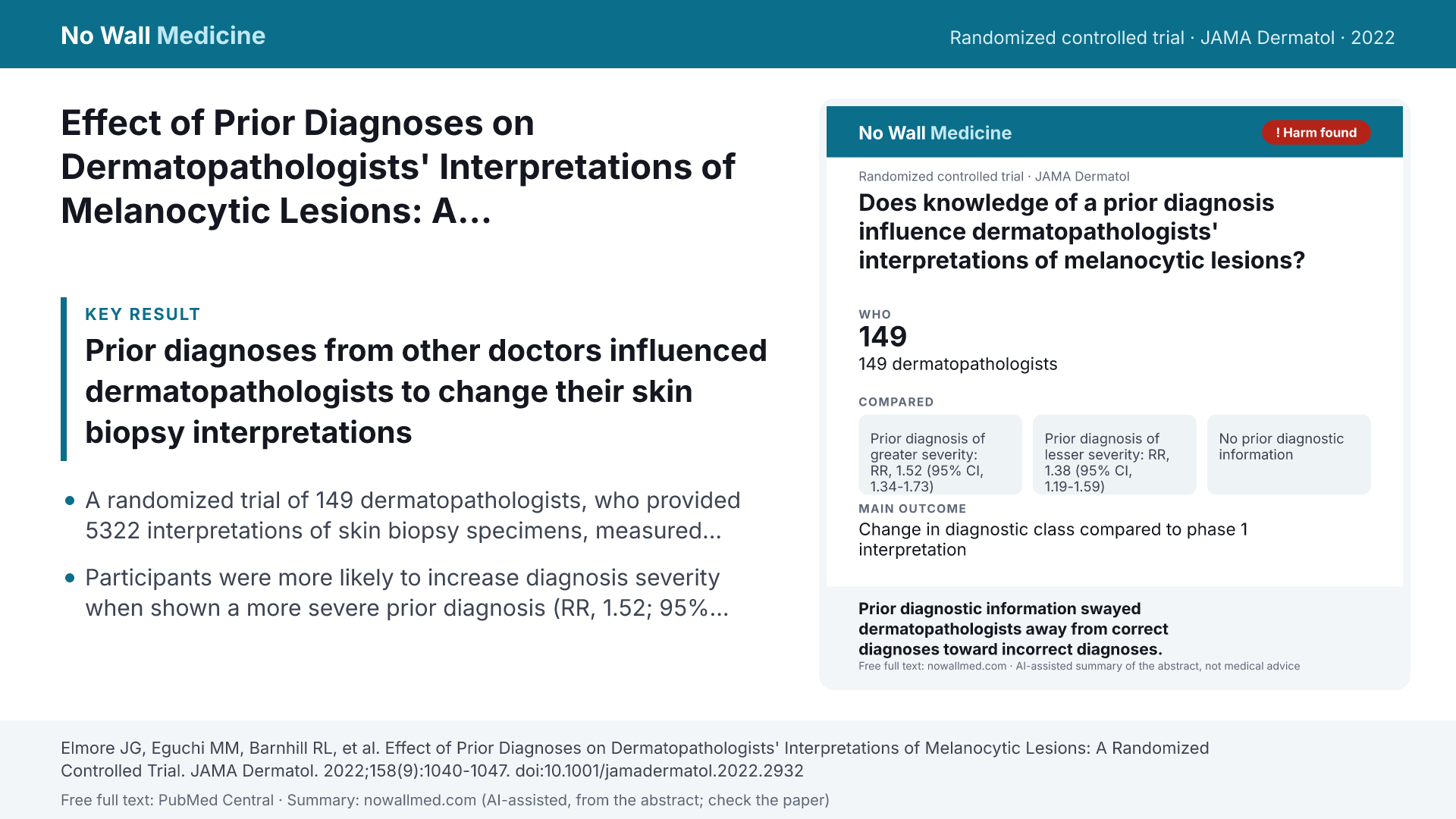
Prior diagnoses from other doctors influenced dermatopathologists to change their skin biopsy interpretations
Effect of Prior Diagnoses on Dermatopathologists' Interpretations of Melanocytic Lesions: A Randomized Controlled Trial
Randomized controlled trialHarm found
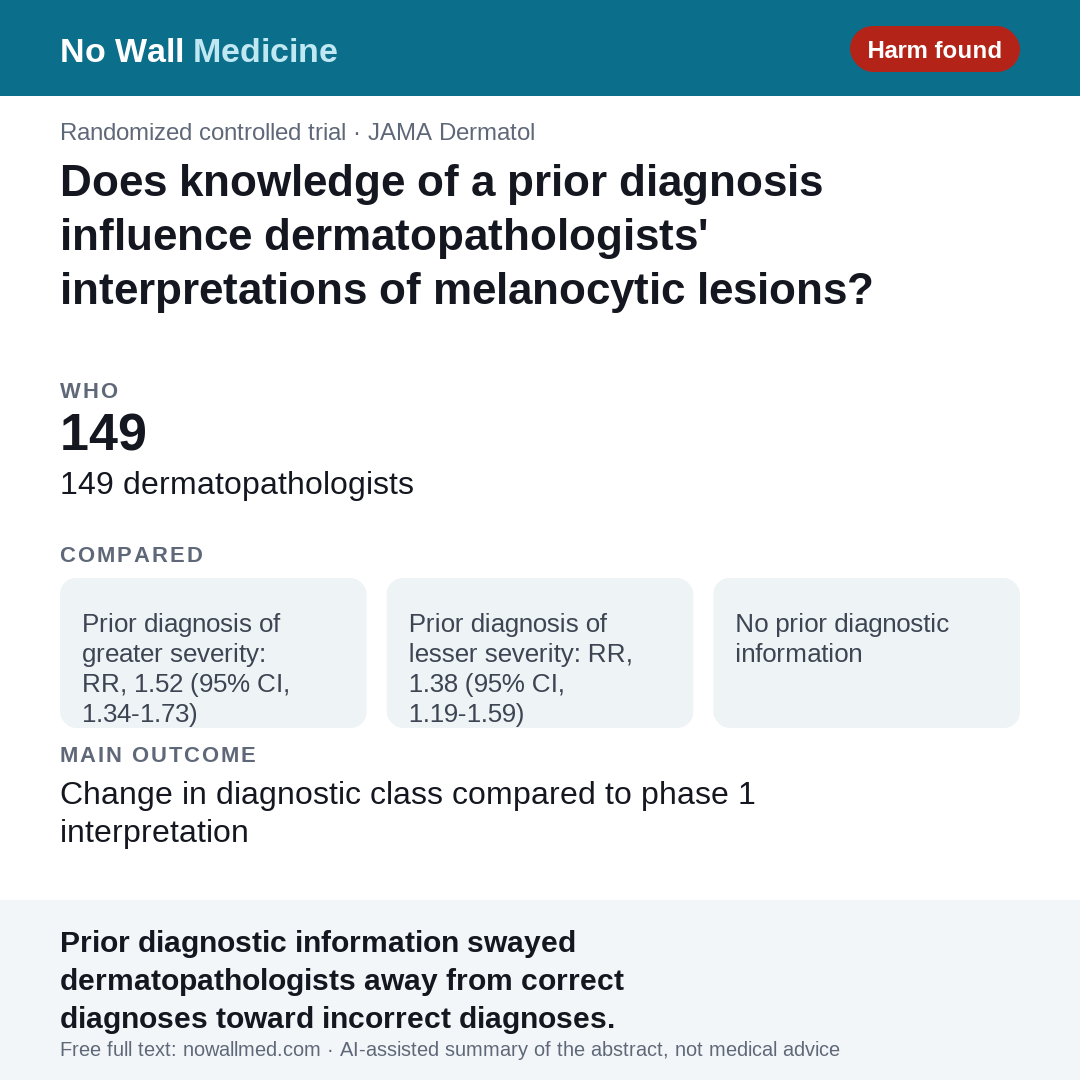
Does knowledge of a prior diagnosis influence dermatopathologists' interpretations of melanocytic lesions?
Who
149
149 dermatopathologists
Compared
Prior diagnosis of greater severity: RR, 1.52 (95% CI, 1.34-1.73)
Prior diagnosis of lesser severity: RR, 1.38 (95% CI, 1.19-1.59)
No prior diagnostic information
Main outcome
Change in diagnostic class compared to phase 1 interpretation
Result: RR, 1.52 (95% CI, 1.34-1.73) for greater severity; RR, 1.38 (95% CI, 1.19-1.59) for lesser severity
Bottom line: Prior diagnostic information swayed dermatopathologists away from correct diagnoses toward incorrect diagnoses.
JAMA Dermatol · 2022-08-11Download image
Clinical question: Does knowledge of a prior diagnosis influence dermatopathologists' interpretations of melanocytic lesions?
Key points
- A randomized trial of 149 dermatopathologists, who provided 5322 interpretations of skin biopsy specimens, measured how prior diagnostic information affected their assessments.
- Participants were more likely to increase diagnosis severity when shown a more severe prior diagnosis (RR, 1.52; 95% CI, 1.34-1.73) and decrease severity when shown a less severe one (RR, 1.38; 95% CI, 1.19-1.59).
- The presence of prior diagnostic information was associated with dermatopathologists being swayed away from correct diagnoses.
Headline and key points written with AI from the paper’s abstract, with every number checked against it. Read the paper before relying on them.
Was this summary helpful?
Subject terms
Headline, design, result, key points, caveat and citation as plain text.
Cite this article
Elmore JG, Eguchi MM, Barnhill RL, et al. Effect of Prior Diagnoses on Dermatopathologists' Interpretations of Melanocytic Lesions: A Randomized Controlled Trial. JAMA Dermatol. 2022. doi:10.1001/jamadermatol.2022.2932
Spotted a mistake? Suggest a correction