Remote ischemic preconditioning did not change the incidence of neurocognitive disorder after major surgery
Effect of remote ischemic preconditioning on perioperative neurocognitive disorder in elderly patients undergoing major surgery and associated genetic variant analysis: a randomized clinical trial
Randomized clinical trialNo clear difference
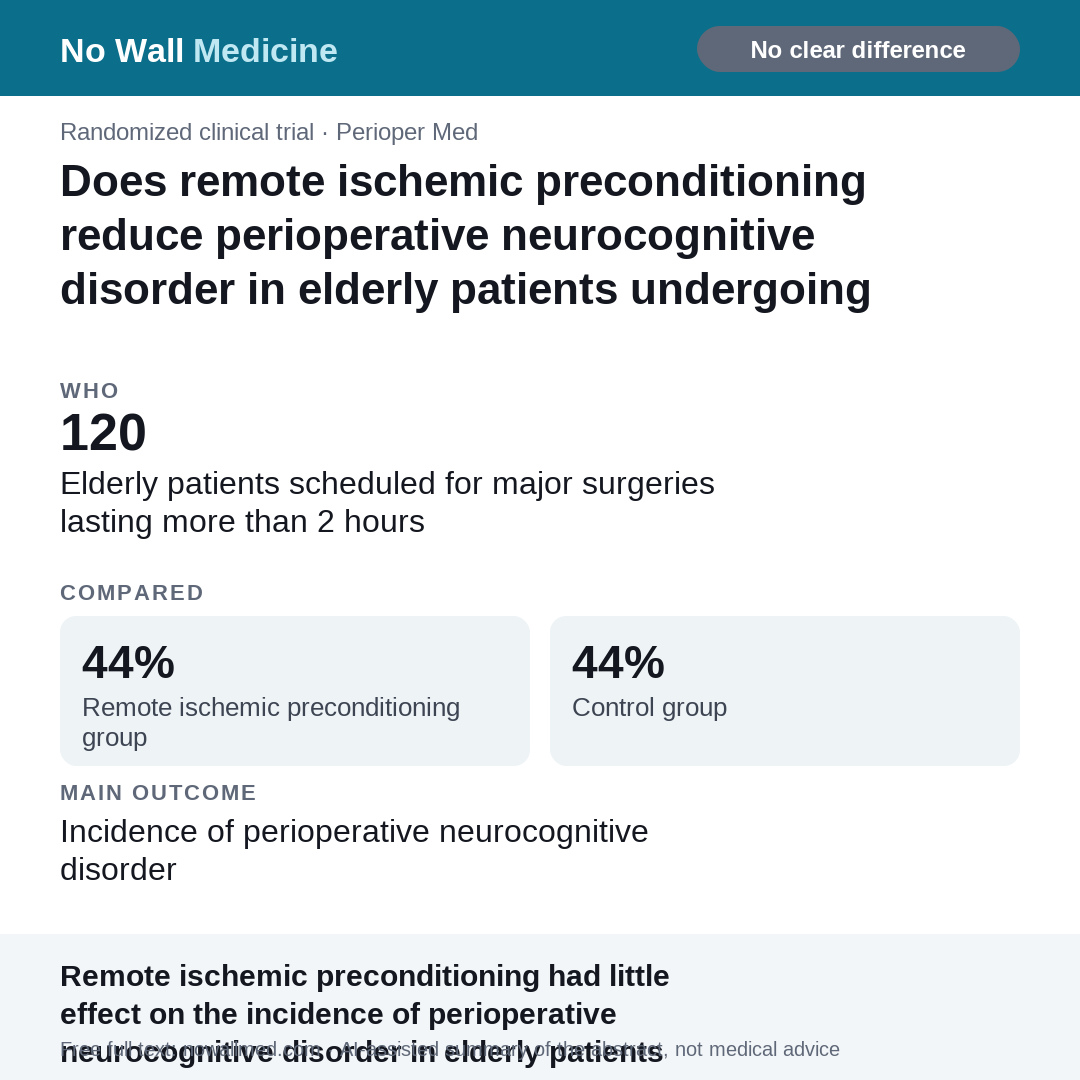
Does remote ischemic preconditioning reduce perioperative neurocognitive disorder in elderly patients undergoing major surgery?
Who
120
Elderly patients scheduled for major surgeries lasting more than 2 hours
Compared
44%Remote ischemic preconditioning group
44%Control group
Main outcome
Incidence of perioperative neurocognitive disorder
Bottom line: Remote ischemic preconditioning had little effect on the incidence of perioperative neurocognitive disorder in elderly patients undergoing major surgery.
Perioper Med · 2025-02-05Download image
Clinical question: Does remote ischemic preconditioning reduce perioperative neurocognitive disorder in elderly patients undergoing major surgery?
Why it matters: It was unknown if remote ischemic preconditioning could reduce the incidence of neurocognitive disorder in elderly patients undergoing major surgery.
Key points
- Researchers randomly assigned 120 elderly patients undergoing major surgery to either a control group or a group receiving remote ischemic preconditioning, which involves repeated cycles of blood pressure cuff inflation.
- The incidence of perioperative neurocognitive disorder was 44% in the remote ischemic preconditioning group and 44% in the control group.
- Serum levels of myeloid differentiation factor 2 and cystatin C were not significantly different between patients with and without neurocognitive disorder.
Headline and key points written with AI from the paper’s abstract, with every number checked against it. Read the paper before relying on them.
Cite this article
Xu F, Liu T, Liu H, Deng J, He S, Lu Z. Effect of remote ischemic preconditioning on perioperative neurocognitive disorder in elderly patients undergoing major surgery and associated genetic variant analysis: a randomized clinical trial. Perioper Med. 2025. doi:10.1186/s13741-025-00497-w
Spotted a mistake? Suggest a correction
Top studies every Monday
The week’s key trials and guidelines in your specialties, by email. Free.
Get the weekly digest