Higher intensity and lower frequency resistance exercise were associated with better tendinopathy management outcomes
Effect of resistance exercise dose components for tendinopathy management: a systematic review with meta-analysis
Systematic review with meta-analysis and meta-regressionsBenefit found
How do resistance exercise dose components affect common tendinopathy management?
Who
3953
Participants with common tendinopathies
Compared
Higher intensity (additional external resistance): β BodyMass: External = 0.50 (95% credible interval (CrI): 0.15 to 0.84)
Body mass only
Main outcome
Pooled mean effect sizes for tendinopathy management
Result: β BodyMass: External = 0.50 (95% credible interval (CrI): 0.15 to 0.84)
Bottom line: Higher intensity with additional loads and lower frequency may provide greater efficacy for managing common tendinopathies.
Limitation: Resistance exercise dose is poorly reported within tendinopathy management literature.
Br J Sports Med · 2023-05-11Download image
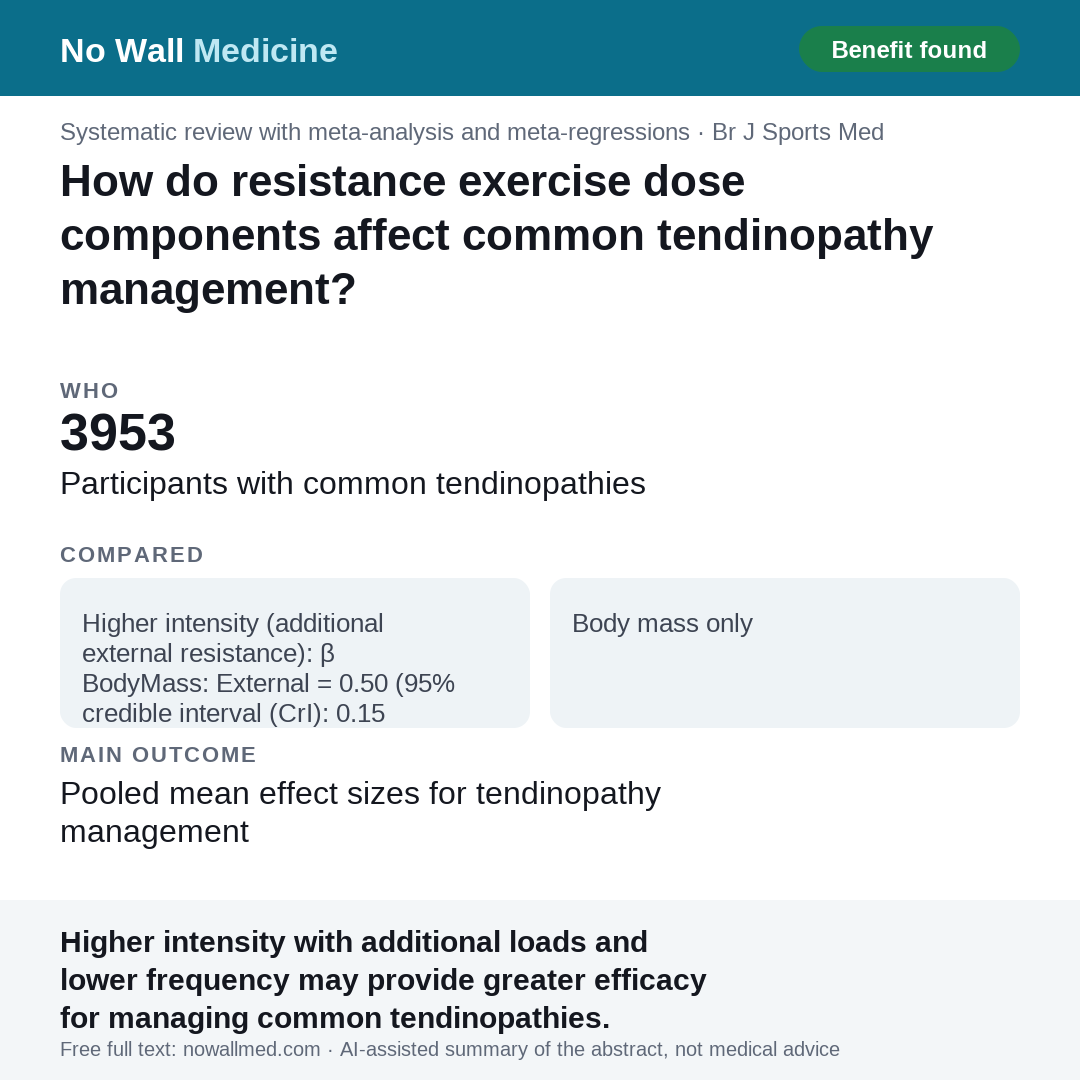
Clinical question: How do resistance exercise dose components affect common tendinopathy management?
Why it matters: It is unknown how specific components of exercise dose, such as intensity, volume, and frequency, moderate the management of common tendinopathies.
Key points
- Researchers analyzed 110 studies involving 3953 participants across five different tendinopathy locations including the Achilles and rotator cuff.
- Higher intensity therapies using additional external resistance were associated with greater effect sizes compared to using body mass only (β BodyMass: External = 0.50; 95% CrI: 0.15 to 0.84).
- Lower exercise frequency, specifically less than daily, was associated with greater effect sizes compared to daily or more than once per day frequencies.
Limitation the authors note: Resistance exercise dose is poorly reported within tendinopathy management literature.
Headline and key points written with AI from the paper’s abstract, with every number checked against it. Read the paper before relying on them.
Abstract
Objective
To investigate potential moderating effects of resistance exercise dose components including intensity, volume and frequency, for the management of common tendinopathies. Design
Systematic review with meta-analysis and meta-regressions. Data sources
Including but not limited to: MEDLINE, CINAHL, SPORTDiscus, ClinicalTrials.gov and ISRCTN Registry. Eligibility criteria for selecting studies
Randomised and non-randomised controlled trials investigating resistance exercise as the dominant treatment class, reporting sufficient information regarding ≥2 components of exercise dose. Results
A total of 110 studies were included in meta-analyses (148 treatment arms (TAs), 3953 participants), reporting on five tendinopathy locations (rotator cuff: 48 TAs; Achilles: 43 TAs; lateral elbow: 29 TAs; patellar: 24 TAs; gluteal: 4 TAs). Meta-regressions provided consistent evidence of greater pooled mean effect sizes for higher intensity therapies comprising additional external resistance compared with body mass only (large effect size domains: β BodyMass: External = 0.50 (95% credible interval (CrI): 0.15 to 0.84; p=0.998); small effect size domains (β BodyMass: External = 0.04 (95% CrI: -0.21 to 0.31; p=0.619)) when combined across tendinopathy locations or analysed separately. Greater pooled mean effect sizes were also identified for the lowest frequency (less than daily) compared with mid (daily) and high frequencies (more than once per day) for both effect size domains when combined or analysed separately (p≥0.976). Evidence for associations between training volume and pooled mean effect sizes was minimal and inconsistent. Summary/conclusion
Resistance exercise dose is poorly reported within tendinopathy management literature. However, this large meta-analysis identified some consistent patterns indicating greater efficacy on average with therapies prescribing higher intensities (through inclusion of additional loads) and lower frequencies, potentially creating stronger stimuli and facilitating adequate recovery.
Abstract reproduced under the article’s CC BY licence.
Topics
Cite this article
Pavlova AV, Shim JSC, Moss R, Maclean C, Brandie D, Mitchell L. Effect of resistance exercise dose components for tendinopathy management: a systematic review with meta-analysis. Br J Sports Med. 2023. doi:10.1136/bjsports-2022-105754
Spotted a mistake? Suggest a correction
Top studies every Monday
The week’s key trials and guidelines in your specialties, plus any topics you follow. By email, free.
Get the weekly digest