Offering self-sampling for human papillomavirus testing increased detection rates compared to clinician sampling alone
Effect of Self-Sampling HPV DNA Testing on Cervical Cancer Screening in Singapore's Primary Care: Pragmatic Randomized Controlled Trial
Pragmatic, 2-arm randomized controlled trialBenefit found
Does offering self-sampling HPV DNA testing improve screening uptake and high-risk HPV detection?
Who
640
Women aged 30-69 years due for cervical cancer screening · NHG Polyclinics and NHG Health in Singapore
Compared
3.1%Intervention (offered clinician and self-sampling)
0.3%Usual care (clinician sampling alone)
Main outcome
High-risk human papillomavirus DNA detection
Result: absolute difference 2.8% (95% CI, 0.8-4.8)
Bottom line: Offering self-sampling alongside clinician sampling significantly increased high-risk human papillomavirus detection and screening uptake.
Limitation: Uptake remained lower among women with less education.
Ann Fam Med · 2026-07-27Download image
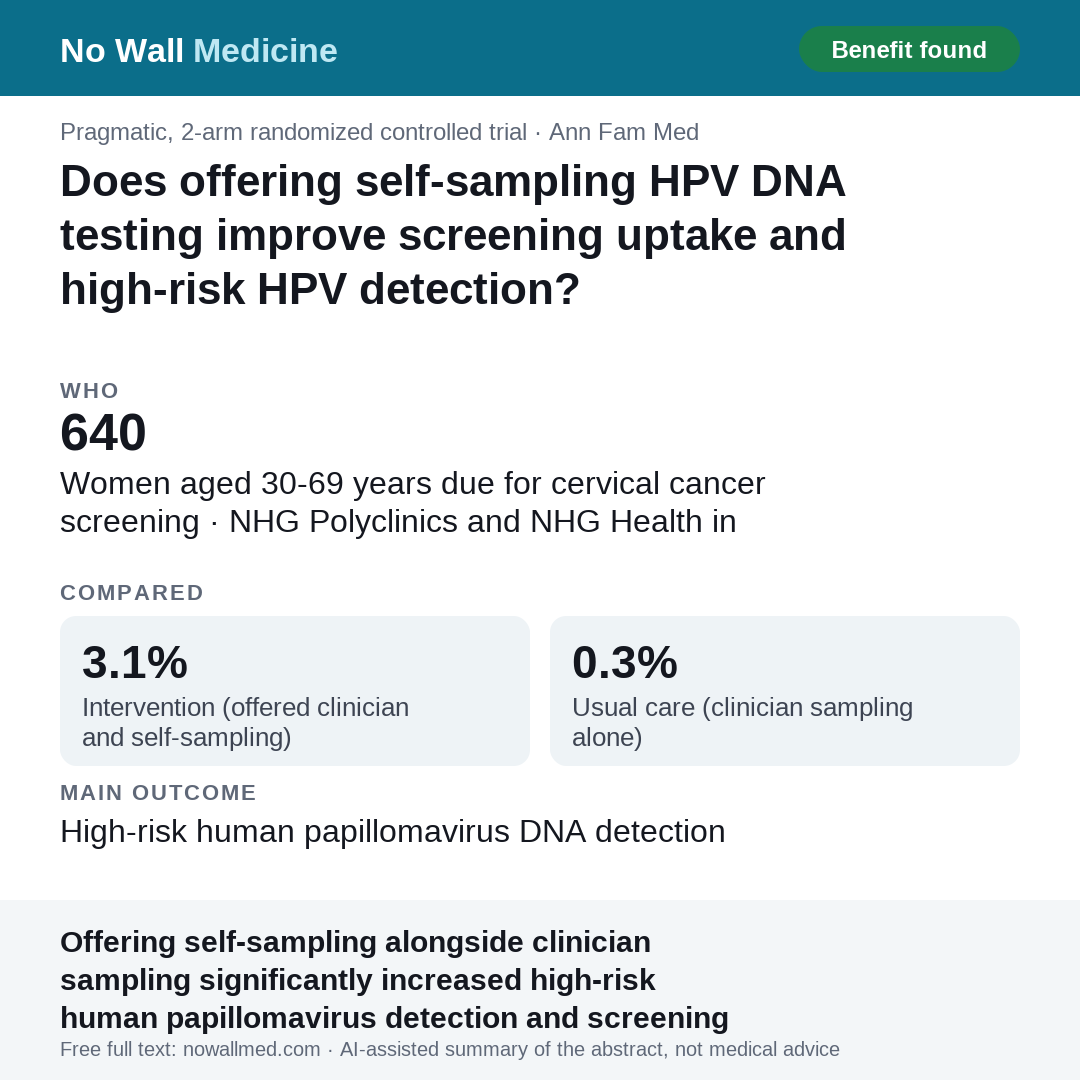
Clinical question: Does offering self-sampling HPV DNA testing improve screening uptake and high-risk HPV detection?
Why it matters: Cervical cancer screening rates in Singapore are suboptimal because the national program currently only includes sampling performed by a clinician.
In absolute numbers
Intervention (offered clinician and self-sampling): 3.1% · Usual care (clinician sampling alone): 0.3% → a difference of 2.8 percentage points, so about 36 people would need the treatment for 1 more to benefit (number needed to treat) over the trial’s follow-up.
Worked out by us from the two group results above, not reported by the authors. Check the paper for the exact outcome and timing.
Key points
- Researchers studied 640 women aged 30-69 years in Singapore to compare clinician-led sampling with an option for self-sampling.
- The group offered self-sampling had a significantly higher detection rate of high-risk human papillomavirus DNA at 3.1% compared to 0.3% in the usual care group.
- Screening uptake was also higher in the intervention group, though participation remained lower among women with less education.
Headline and key points written with AI from the paper’s abstract, with every number checked against it. Read the paper before relying on them.
Topics
Spotted a mistake? Suggest a correction