Continuous positive airway pressure most effective for reducing sleep apnoea events and daytime sleepiness
Effect of sleep apnoea interventions on multiple health outcomes: an umbrella review of meta-analyses of randomised controlled trials
Umbrella review of meta-analysesMixed results
What are the effects of sleep apnoea interventions on multiple health outcomes?
Who
36,353
Patients with obstructive sleep apnoea
Compared
Continuous positive airway pressure: MD -30.7 events/h
Glucagon-like peptide-1 receptor agonists: MD -21.86 events/h
Mandibular advancement devices: MD -11.91 events/h
Main outcome
Apnoea-hypopnoea index, daytime sleepiness, quality of life, and blood pressure
Result: CPAP AHI reduction SMD -1.65 (95% CI -1.87 to -1.43)
Bottom line: Continuous positive airway pressure is most effective for AHI reduction, while physical activity improves quality of life.
Limitation: Data on safety, long-term adherence, and combination therapies remain scarce.
eClinicalMedicine · 2025-10-08 · Save PNG
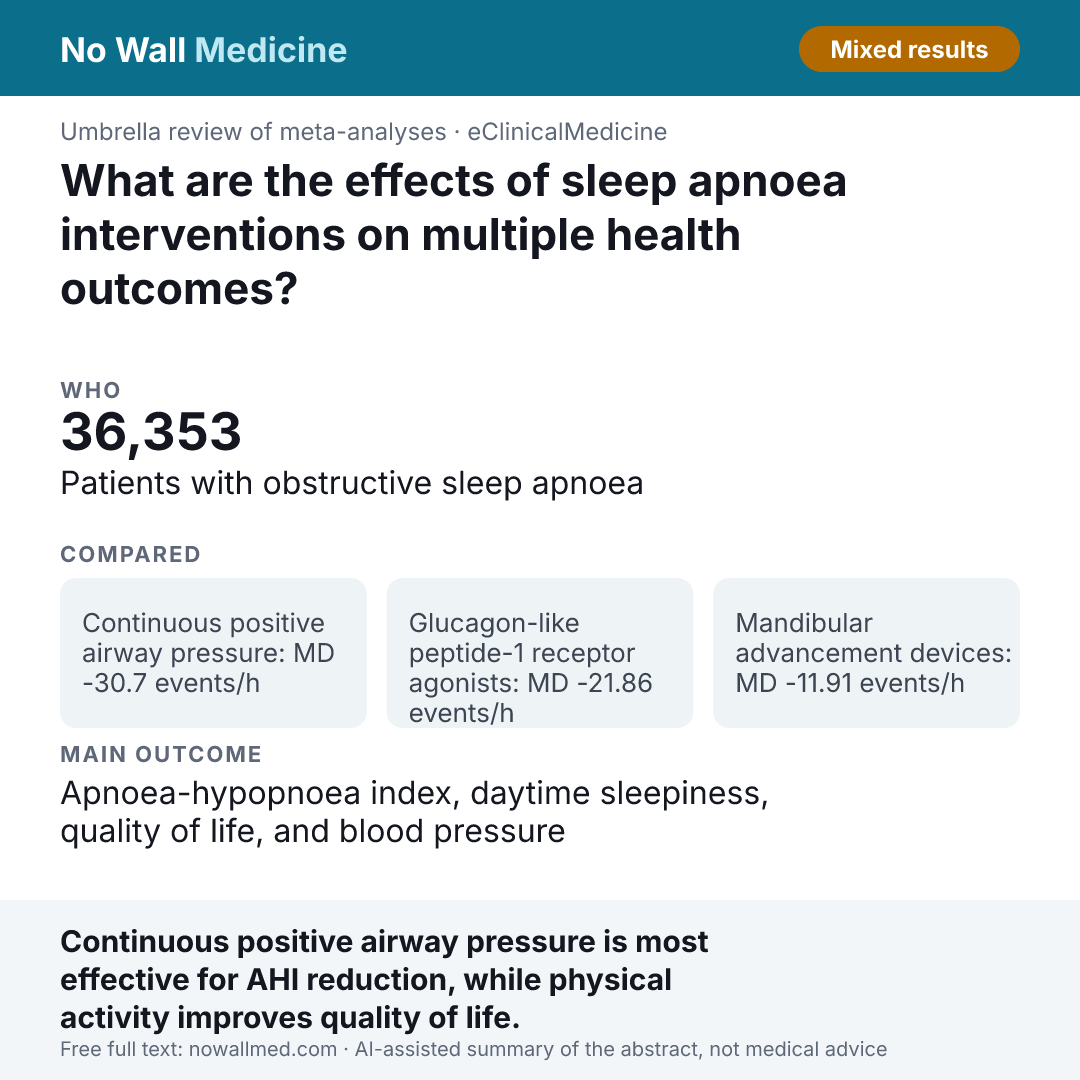
Clinical question: What are the effects of sleep apnoea interventions on multiple health outcomes?
Why it matters: Suboptimal adherence to continuous positive airway pressure limits its effectiveness, creating a need to evaluate alternative therapies for obstructive sleep apnoea.
Key points
- Researchers reviewed 34 meta-analyses involving 230 randomized controlled trials and 36,353 participants to evaluate obstructive sleep apnoea treatments.
- Continuous positive airway pressure reduced the apnoea-hypopnoea index by a mean difference of -30.7 events/h, while physical activity showed the greatest quality of life improvements.
- Other treatments like tirzepatide and mandibular advancement devices also reduced the apnoea-hypopnoea index, but with smaller mean differences of -21.86 events/h and -11.91 events/h respectively.
Headline and key points written with AI from the paper’s abstract, with every number checked against it. Read the paper before relying on them.
Was this summary helpful?
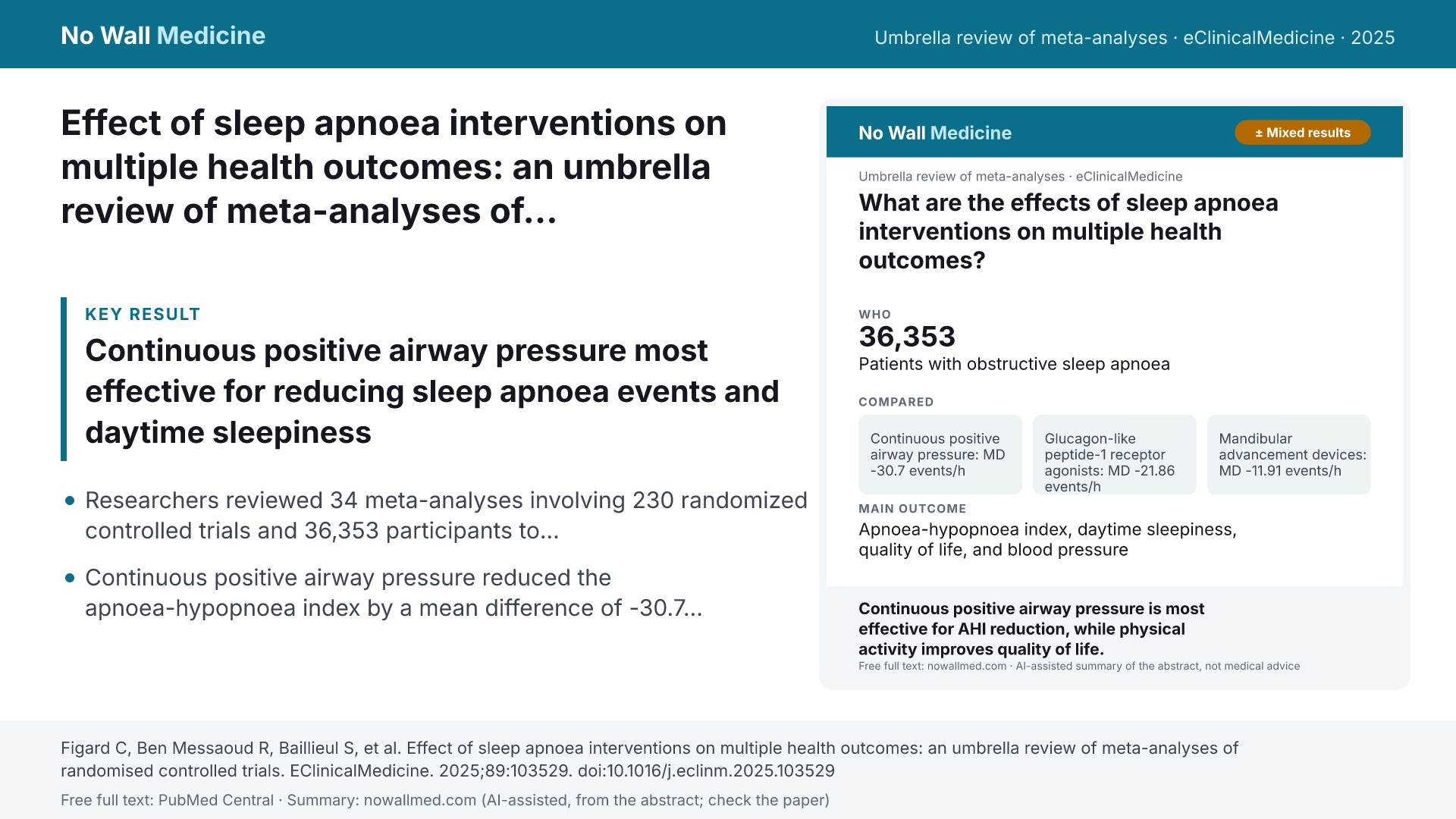
Headline, design, result, key points, caveat and citation as plain text.
Cite this article
Figard C, Ben Messaoud R, Baillieul S, et al. Effect of sleep apnoea interventions on multiple health outcomes: an umbrella review of meta-analyses of randomised controlled trials. EClinicalMedicine. 2025;89:103529. doi:10.1016/j.eclinm.2025.103529
Spotted a mistake? Suggest a correction